“I exercise, I eat well, I’m at my ideal weight… so why is my double chin still there?”
This is one of the most common frustrations we hear. Many people assume a double chin means simply being overweight, but the truth is more complex. That stubborn pocket of fat under your chin, called the submental fat pad, is biologically designed to hang on tight — no matter how disciplined your diet or exercise routine, or how many natural double chin treatments you try.
This guide breaks down the top five reasons you might have a double chin, from your DNA to your hormones — so you can understand why it’s happening, and how to finally treat it.
Reason 1: The “skinny” double chin (Genetics)
If you’ve ever searched “why do I have a double chin when I’m skinny?”—this section is for you.
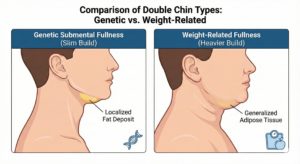
For many people, a double chin has nothing to do with weight gain at all. It comes down to genetics. Just as some bodies preferentially store fat in the hips or thighs, others are programmed to store fat in a very specific place: the submental fat pad, the small pocket that sits directly under the chin.
This fat pad is hereditary. If one or both of your parents had fullness under the chin—even at a healthy weight—there’s a strong chance you inherited the same distribution pattern. Your body essentially “defends” this area. When you diet, it will happily pull fat from your arms, waist, or legs first, while leaving the chin untouched.
That’s why many lean patients reach a frustrating point where further weight loss only makes them look tired or gaunt elsewhere, while the double chin remains unchanged.
From an anatomical perspective, this is actually good news. A genetic double chin is a localised fat problem, not a systemic one. And localised fat responds extremely well to targeted treatment.
What this means for treatment:
When the issue is purely genetic fat — not loose skin or weak bone structure — fat dissolving is often the most precise and predictable solution. They remove the fat cells your body refuses to let go of on its own, without affecting the rest of your face or body.
This is why there are before-and-after results come from patients who are otherwise fit, healthy, and “skinny everywhere else.”
Reason 2: Bone structure & anatomy (The hyoid bone and chin position)
Sometimes, the issue isn’t how much fat you have — it’s where your framework sits underneath it.
Two people can have the exact same amount of submental fat, yet one looks sharp and defined while the other looks heavy under the chin. The difference is anatomy.
The hyoid bone: the hidden player
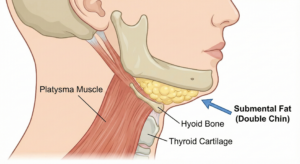
The hyoid bone is a small, horseshoe-shaped bone that anchors the muscles of the tongue and neck. Its position varies naturally between individuals.
- If the hyoid sits lower, the neck stretches out more vertically, creating a longer, cleaner neck angle.
- If it sits higher, the skin and soft tissue have less vertical distance to drape across, so even a small fat pad can look more obvious.
You haven’t done anything wrong — this is structural, not lifestyle-related.
Weak or receding chin = visual crowding
A receding chin (retrognathia) can also create the illusion of a double chin, even when fat levels are modest.
When the chin bone sits further back:
- The skin has no firm “shelf” to stretch across
- Soft tissue bunches under the jawline
- The neck-chin angle collapses
This is why some patients dissolve fat and still feel their profile looks soft — the underlying bone hasn’t been addressed.
What this means for treatment
- If structural anatomy is the primary driver, dissolving fat alone may only partially help.
- Some patients need a sequence, not a single treatment:
- Remove excess fat first (to unveil the structure)
- Then assess whether chin projection is needed
Trying to project the chin without removing fat first often exaggerates fullness. Unveiling always comes before enhancement.
Clinical takeaway:
If your double chin is structural, treatment isn’t about “melting everything.” It’s about restoring balance between fat, bone, and skin — in the correct order.
(If this sounds like you, this is where treatment for chin structure vs fat dissolving decisions really matter.)
Reason 3: Hormones & medical factors (The thyroid connection)
If your double chin seemed to appear suddenly, or changed without a clear shift in diet or weight, hormones may be part of the story.
This is where many patients — especially women — feel confused and dismissed. But the concern is valid.
How hormones affect the chin and neck
Hormones influence:
- Fat distribution
- Fluid retention
- Skin thickness
- Inflammation
When they fluctuate, the face and neck often show it first.
The thyroid link explained
An underactive thyroid (hypothyroidism) can cause:
- Facial and neck puffiness
- Fluid retention under the chin
- A heavier, swollen look without true fat gain
This is why people search for terms like thyroid double chin or double chin caused by thyroid. The fullness isn’t always fat — sometimes it’s a mix of fluid, inflammation, and slowed metabolism.
Importantly, this type of change often:
- Appears relatively quickly
- Feels firmer or “boggy” rather than soft
- Comes with other symptoms like fatigue, cold sensitivity, or unexplained weight changes
What to do if you suspect a hormonal cause
This is not something to treat blindly with cosmetic procedures.
- First step: see your GP for blood tests
- Stabilise the medical issue first
- Reassess the neck once hormones are controlled
Once thyroid levels are optimised, any residual submental fat can be treated safely and effectively. In many cases, the aesthetic concern becomes much easier to correct once the underlying cause is addressed.
Key distinction
- Hormonal puffiness can improve with medical treatment
- True submental fat does not disappear on its own
That’s why proper diagnosis matters. Treating fat when the issue is fluid leads to disappointment. Treating fat after hormones are stable leads to predictable results.
Clinical perspective:
A sudden double chin is a signal — not just a cosmetic nuisance. Rule out medical causes first, then treat what remains with precision.
Reason 4: Age, muscle laxity & posture (The platysma effect)
Not every double chin is about fat. In many patients—especially from their late 30s onward—the issue starts with muscle support, not volume.
Meet the platysma muscle
The platysma is a thin, sheet-like muscle that runs from the jawline down to the collarbone. When it’s strong and tight, it acts like a natural sling, holding the soft tissue of the neck up and back against the jaw.
Over time, that support weakens.
As the platysma relaxes:
- The angle between the chin and neck softens
- Fat that was once hidden becomes more visible
- Skin begins to drape instead of stretch
This is why some people say, “I didn’t gain weight, but my neck looks heavier.” The fat was always there—it’s just no longer being held in place.
Age accelerates visibility, not fat creation
Aging doesn’t suddenly create a new fat pad. What it does is:
- Reduce muscle tone
- Reduce skin elasticity
- Allow existing submental fat to descend
That descent creates the appearance of a double chin even when the actual fat volume hasn’t changed much.
The posture problem (aka “tech neck”)
Modern posture makes this worse.
Hours spent looking down at phones and laptops keep the platysma in a shortened, inactive position. Over time, that weakens the muscle and trains the skin to fold in exactly the spot where a double chin forms.
This is why younger patients with excellent fitness levels still develop early under-chin fullness—it’s mechanical, not metabolic.
Treatment implications
When muscle laxity is the main driver:
- Fat removal alone may help, but only if there is pinchable fat
- Surgery may be needed if laxity dominates
- In many cases, a combined approach gives the best result
The key is recognising whether the problem is:
- Too much volume
- Not enough support
- Or both
Treating muscle-related laxity as “just fat” leads to underwhelming outcomes. Correctly identifying it leads to sharp, natural-looking definition.
Clinical takeaway:
Aging doesn’t create a double chin—it reveals it. The solution depends on whether fat, muscle, or skin is doing the revealing.
Reason 5: Weight gain (The obvious one—With a catch)
Yes, weight gain can cause a double chin. But it rarely tells the whole story.
How weight gain affects the chin
When you gain weight, fat cells expand throughout the body—including the submental fat pad under the chin. For some people, this area is an early warning sign. The face and neck show changes before the stomach or hips do.
That’s why patients often say, “My chin went first.”
The catch: not all fat shrinks evenly
Here’s the part most people don’t realise.
When you lose weight, fat does not come off evenly. Your body decides where it burns fat from first—and the chin is often last in line. This is especially true if:
- You have a genetic predisposition to store fat under the chin
- You’ve previously gained and lost weight
- The fat cells in that area have already expanded
So even after weight loss, the double chin can linger.
Why dieting alone often disappoints
Weight loss can:
- Reduce the size of fat cells
- Improve overall health
- Slightly soften under-chin fullness
But it cannot:
- Remove a genetically programmed fat pad
- Destroy fat cells that have already multiplied
- Restore lost skin or muscle support
This is why many slim, fit patients still have a visible double chin even at their goal weight.
Treatment implications
If weight gain is the primary driver:
- Lifestyle changes matter and should come first
- Fat dissolving works well for the stubborn remainder
- Treating the area after weight stabilisation produces the most predictable result
Think of dissolving as a precision tool, not a substitute for health. They finish the job your body won’t.
Clinical takeaway:
Weight gain can reveal a double chin—but weight loss alone doesn’t guarantee it will disappear. When fat cells have chosen this area as home, they usually need targeted removal.
Check your suitability
How to treat your specific “why”
Once you understand why your double chin exists, the treatment choice becomes much clearer. Guessing leads to wasted time and money. Anatomy-led treatment delivers results.
Here’s how we match cause to solution in clinical practice.
If the cause is genetics (the “skinny” double chin)
This is the most common scenario we see.
- You’re at a healthy weight
- The fat is pinchable, soft, and central
- Diet and exercise haven’t touched it
Best treatment:
Non-surgical fat removal or liposuction.
If the cause is weight gain
Weight contributes, but it’s rarely the only factor.
Fat appears elsewhere on the body
The chin fullness reduces slightly with weight loss but never fully resolves
Best approach:
- Lifestyle optimisation first
- Fat dissolving or liposuction for the residual fat that won’t budge
This combination prevents over treatment and produces a more natural result.
If the cause is bone structure (weak or receding chin)
Sometimes the issue isn’t excess fat—it’s lack of support.
- Your chin sits behind your lower lip on profile
- The neck skin bunches because there’s no “shelf” to stretch across
Best treatment:
- Add chin projection, with chin volume injections or surgery: Projecting the chin forward tightens the neck line without removing fat. In some cases, we combine volume treatments after removing fat for optimal balance.
If the cause is muscle or age-related laxity
This is common after 40.
- The platysma muscle weakens
- Skin loses elasticity
- The area looks loose rather than bulky
Best treatment:
- Surgical neck and lower face lift
If multiple factors are involved (most patients)
Many patients don’t fit into a single box.
- Genetic fat plus mild skin laxity
- Fat and a slightly recessed chin
Best strategy:
A staged approach:
- Remove the obstruction (fat)
- Reassess structure and skin
- Refine with tightening or structural support if needed
This sequencing avoids overcorrection and preserves a natural profile.
Want to know more about double chin fat removal?
Learn more about double chin treatments in our complete double chin treatment guide.
Searching online for “double chin fat removal near me”?
Curious about whether you’re suitable for double chin fat injections? Explore our double chin treatment and start your journey.