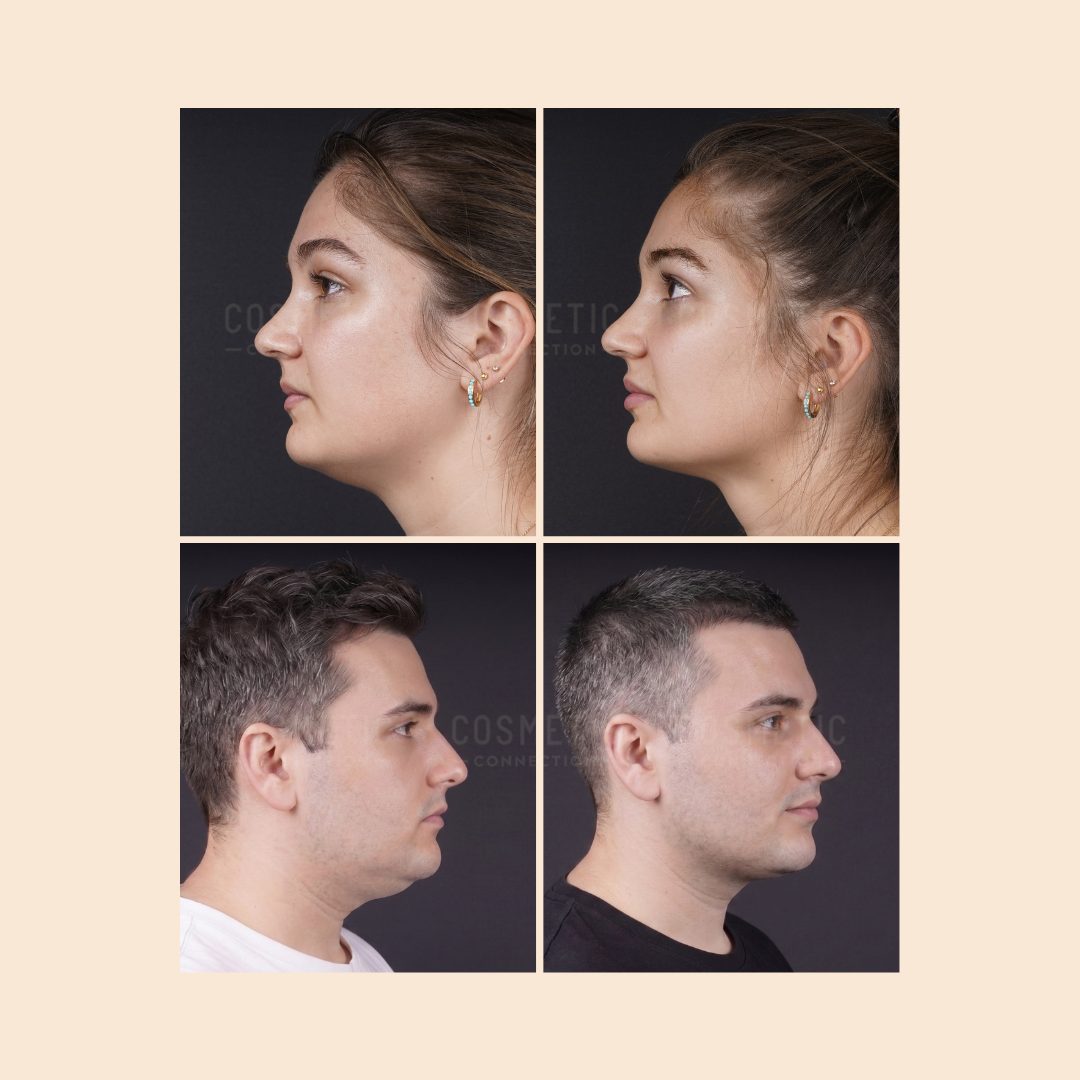
You’re not alone if you feel frustrated looking in the mirror and thinking, “Where’s my jawline?”, or “Why do I have a double chin?” Many people carry a stubborn fullness under the chin that just won’t budge, even when the rest of their body is lean.
Here’s the key insight: double chin or submental fullness isn’t always about your weight. It often comes down to three main factors working together — a fat pad under the chin, a small or recessed chin bone, and/or loose, sagging skin.
Think of your jawline like a sculpture. If fat covers it, even the best bone structure stays hidden. Before you can reveal your natural contours, you need to remove the “padding” — the submental fat — that blurs your profile.
This “unveiling” is the core philosophy behind double chin removal: you can’t see what’s underneath until you clear away what’s on top. Whether you need fat dissolving treatments, chin volume, skin tightening, or a combination, understanding your anatomy is the first step toward refining your under chin and lower face.
Test 1: Is it fat? (The pinch test)
Submental fat is a genetic pocket of soft tissue that sits right between your face and neck. This fat pad acts like natural “padding,” but when it’s thick, it can blur your jawline and create the dreaded double chin.
Here’s a quick way to find out if fat is your main issue:
- Stand in front of a mirror.
- Tilt your chin down toward your chest.
- Use your thumb and fingers to gently pinch the center of the area beneath your chin.
What you’re feeling matters:
If you can pinch a soft, squishy roll thicker than about 1 centimeter (roughly the width of your thumb), this means you have subcutaneous fat — and you are likely to be a great candidate for fat dissolving.
If the area feels thin or empty, it’s probably skin, not fat (we’ll cover that test soon).
Why does this matter? Because fat dissolving treatments break down fat cells to reduce volume and reveal your jawline. If you don’t have pinchable fat, trying to remove it won’t help.
Removing double chin fat with injections is often the first crucial step to unveiling your natural bone structure and improving your profile.
See what results after removing submental fat look like.

Skin pinch test assessing for submental fat.
Test 2: Is it bone? (The profile test)
Sometimes, what looks like a double chin isn’t about fat at all—it’s about your bone structure. A weak or receding chin can create the illusion of fullness under the jaw because the skin has no strong “shelf” to stretch across. Instead, it bunches or sags, making the neck and jawline appear heavier.
To check if this is the case:
- Take a side-profile photo or look in a side mirror, aiming to align your nose tip with the middle of your ear.
- Imagine drawing a vertical line straight down from the middle of your lower lip.
- Observe where your chin sits relative to this line.
Here’s what to look for:
- If your chin sits noticeably behind this line, you likely have a receding chin (also called retrognathia).
- This bone positioning affects your jawline definition and can contribute to a “weak chin” appearance.
What can you do?
Fat removal treatments won’t fix this because the issue isn’t fat volume but bone projection.
The best solution is to add structure to your chin — non-surgically, this involves adding volume to increase projection and bring your chin forward, which tightens the skin and enhances your neck angle.
If you have both a weak chin and excess fat:
- Start by reducing the fat first to clear the way and “unveil” your natural bone.
- After the fat reduction, you can consider chin structure for the best overall profile improvement.
Get started
Test 3: Is it skin? (The gravity test)
Not all fullness under your chin comes from fat. Sometimes, loose, sagging skin—what’s often called “turkey neck”—is the real culprit. This happens when skin loses its elasticity and starts to droop due to aging, sun damage, or genetics.
To find out if skin laxity is causing your double chin look, try this simple test:
- Lie flat on your back and look straight up at the ceiling.
- Observe the area under your chin carefully.
Here’s what it means:
- If the “bulk” under your chin slides back or almost disappears when you’re lying down, it’s loose skin.
- If the fullness stays in place and doesn’t shift much, it’s more likely fat.
You can also try a gentle pinch test:
- If you pinch the skin under your chin and feel little to no soft padding, that suggests loose or thin skin rather than fat.
What’s the fix?
- Fat removal won’t tighten loose skin.
- Treatments like High-Intensity Focused Ultrasound (HIFU) or Radiofrequency (RF) skin tightening can stimulate collagen and improve firmness, but with very subtle changes.
- In more severe cases, a surgical neck lift might be the best option.
Understanding whether your double chin comes from fat or skin is critical—because the treatments are very different.
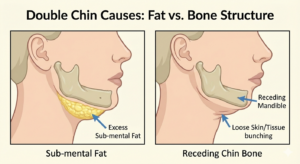
Two side-by-side illustrations show double chin causes: left image highlights excess sub-mental fat beneath the chin, while the right shows a receding chin bone with loose skin and tissue bunching under the jaw.
Test 4: Is it jowls? (The “W” vs. “U” shape)
Many people confuse jowls with a double chin because both affect the lower face. But they’re quite different—and that distinction matters when choosing treatment.
What’s the difference?
- Double chin: This is central fullness right under the chin, creating a soft “U” shape when you look straight on.
- Jowls: These are sagging or drooping skin and fat along the sides of your jawline, forming a “W” shape when viewed from the front.
Why it matters:
- Identifying the cause means you are recommended the right treatment.
- There may be different treatment options, or considerations, for reducing jowls compared to removing a double chin.
Bottom line:
If your concern is sagging jowls, fat dissolving may not be the best answer. But if the fullness sits centrally under your chin, targeted fat reduction can help you get that defined jawline.
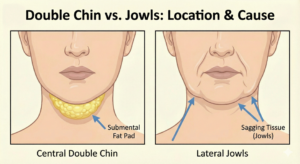
Side-by-side diagrams show a double chin with a highlighted submental fat pad under the chin, and jowls with arrows pointing to sagging tissue along the jawline. Text explains locations and causes.
The “deep” neck warning (Safety)
Sometimes, what looks like a double chin isn’t just fat sitting right under the skin. If your neck feels very firm or looks full even when you’re pinching the area, the fat might be deeper than usual.
The fat could be sub-platysmal, meaning it lies underneath the platysma muscle, making it inaccessible to treatment. In some cases, fullness may come from enlarged salivary or lymph glands or other tissue, not fat.
Because fat removal treatments target subcutaneous fat—the soft layer just beneath your skin, deeper fat or glandular tissue won’t respond, and require a different approach.
If you have deep neck fullness, your best option is to consult with a surgeon to discuss treatment methods. Trying to remove deep fat non-surgically can be dangerous.
Always get a thorough assessment from a trained professional. If your neck fullness feels unusually hard or doesn’t pinch easily, non-surgical methods may not be the right treatment for you.
Which treatment do you need?
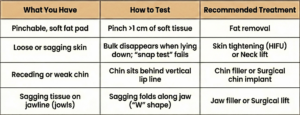
Understanding your unique anatomy is the first step towards knowing your treatment options to remove under chin fullness. Accordingly, choosing the right provider is essential for an accurate assessment. Use this quick guide to figure out what’s behind your double chin—and which treatment fits best:
Want to know more about double chin fat removal?
Learn more about double chin treatments in our complete double chin treatment guide.
Searching online for “double chin fat removal near me”?
Curious about whether you’re suitable for double chin fat treatment? Explore our double chin treatment and start your journey.