
Fat dissolving injections are non-surgical — and while they are no downtime, there’a some important things to understand about the post-treatment period.
Many patients expect to walk out with a slimmer chin and carry on as normal. Instead, they walk out looking more swollen than when they walked in. This surprises people who weren’t properly prepared — and it’s the reason recovery deserves its own guide.
We call this the”swelling stage”. It isn’t a complication. It isn’t a bad reaction. And it doesn’t mean something has gone wrong. In fact, swelling is a sign the treatment is doing exactly what it’s supposed to do.
Fat dissolving works by triggering a controlled inflammatory response. The process damages the fat cell wall, and your body floods the area with fluid and immune cells to break down and clear the destroyed fat. No inflammation means no fat destruction — so swelling isn’t optional, it’s essential.
This guide walks you through the full recovery process step by step:
- what swelling should look and feel like
- how long each phase lasts
- what’s normal, what’s not, and when to call your clinic
- and how to care for the area so healing stays smooth and predictable
If you know what’s coming, recovery feels manageable — not alarming. And once the swelling settles, the payoff becomes clear.
What is the “swelling stage”? (And why you want it)
The “swelling stage” effect describes the visible swelling that appears almost immediately after fat dissolving injections in the double chin area. For most patients, the under-chin can look up to twice its usual size within hours of treatment. It can feel firm, puffy, warm, or slightly tender to touch.
This swelling happens for two reasons.
- The treatment itself adds temporary volume.
- Your body sends fluid and inflammatory cells to the area to break down the damaged fat cells and carry the debris away. This biological clean-up process is what ultimately creates the result.
This is why fat dissolving swelling is not something to “avoid” or suppress. It’s a core part of how the treatment works. Patients who swell tend to respond better than those who barely react.
Practically, this means a few things:
- You won’t walk out looking slimmer — you’ll look temporarily fuller.
- The swelling peaks early, then gradually settles.
- The presence of swelling does not predict poor results. It predicts activity.
Many patients plan their treatment around this phase. Booking before a weekend, wearing a scarf or high-neck clothing, or scheduling during a quieter social period can make the experience far more comfortable.
Once the swelling subsides, the contour change underneath becomes visible — and that’s when the result starts to feel worth it.
Fat dissolving recovery: Day-by-day timeline
Below is a realistic, experience-based guide to what most patients go through after fat dissolving injections under the chin. Everyone heals slightly differently, but this gives you a reliable framework so there are no surprises.
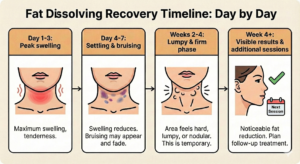
Days 1–3: Peak swelling (The “swollen” phase)
This is when swelling is at its maximum.
- The area under the chin may look significantly larger than before treatment.
- The tissue often feels soft, jiggly, or water-filled, similar to gel or jelly.
- Tenderness, warmth, and mild aching are normal.
- Some patients notice temporary numbness or tingling.
This phase is not a complication — it’s the inflammatory response breaking down fat cells. Trying to aggressively “flatten” the swelling at this stage is counterproductive.
Days 4–7: Settling and bruising
The swelling begins to reduce, but visual changes can be uneven.
- Bruising may become more visible as swelling drops (yellow, purple, or green tones).
- The area may feel firmer in patches rather than soft.
- Mild tightness or itchiness is common as healing begins.
Most people feel comfortable being seen in public again during this window, even though the area doesn’t look “normal” yet.
Weeks 2–4: The lumpy or firm phase
This stage causes the most worry — and it’s also the most misunderstood.
- You may feel small, firm, pea-sized or rope-like areas under the skin.
- The area can feel uneven or slightly tender to pressure.
This is called induration. It’s the fat hardening as it’s being broken down and cleared by your lymphatic system. These are not filler lumps, not scar tissue, and not permanent. They resolve gradually without intervention.
Beyond 4 weeks: Visible results appear
This is when the payoff happens.
- Swelling has resolved.
- The skin begins to retract and adhere more closely to the jawline.
- The under-chin profile looks smoother and more defined as results emerge.
- At this point, we assess whether:
- Another round of fat dissolving is needed (most people undergo 2-4 sessions), or
- Other treatments would add refinement, or
- Treatment is complete.
Fat dissolving is a gradual-reward treatment. The result doesn’t appear overnight — it appears once your body finishes the clean-up process.
Fat dissolving aftercare: The do’s and don’ts
Proper aftercare doesn’t make the treatment “work better” — but it does reduce unnecessary swelling, bruising, and discomfort while your body does the real work. Think of this phase as supporting the healing process, not interfering with it.
What to do after fat dissolving
Sleep on your back with 1-2 pillows for 3 nights. This helps fluid drain away from the treated area and can noticeably reduce morning swelling.
Apply cold packs for 20 minutes per hour, for up to 72 hours. This helps with swelling, comfort and bruising — not fat breakdown.
What To Avoid after fat dissolving
Alcohol for 48 hours. Alcohol increases inflammation and bruising, which can prolong recovery.
Heat exposure. Skip saunas, steam rooms, hot yoga, and long hot showers for at least 72 hours. Heat amplifies swelling during the inflammatory phase.
Massage or pressure (first 48 hours). Let the product stay exactly where it was placed. Early massage can shift inflammation into areas we deliberately avoided.
High-impact exercise (first 48 hours). Light walking is fine. Intense cardio or weight training can worsen swelling early on.
A Common Mistake
Trying to “fix” swelling with massage, devices, or aggressive lymphatic treatments too early can actually delay recovery. The goal is calm, steady healing — not forcing the area to flatten quickly.
How to reduce swelling after fat dissolving injections
Here are some great ways you can minimise any swelling after fat dissolving injections:
- Avoid hot environments until the swelling has resolved. This includes hot showers, saunas and sitting out in the sun.
- Sleep flat on your back (so the swelling drains back from the under chin to the lymphatic system in the neck)
- You can take an antihistamine on the day of your treatment, as long as you are medically suitable.
- Avoid touching or rubbing at the skin of your jawline.
- Gently apply a wrapped ice pack for 20 minutes per hour, for up to 72 hours.
How to reduce bruising after fat dissolving injections
If you are worried about bruising after fat dissolving injections, consider following these steps:
- Avoid excessive alcohol for 24 hours
- Avoid intense exercise for the first day
- Gently apply a wrapped cold pack intermittently for the first few hours after your fat dissolving injections (be careful not to apply any pressure).
- If you have bruising after your fat dissolving injections, you can cover it with makeup the day after your treatment.
Is fat dissolving safe? Addressing nerve injury & rare side effects
This is the part most clinics gloss over — and the part patients actually care about. Fat dissolving is widely used and well-studied, but it is still a biological treatment, not a cosmetic cream.
Understanding the real risks (and how rare they are) is part of informed consent.
The big picture
When performed correctly, fat dissolving injections are considered safe and predictable. Serious complications are uncommon, and most side effects are temporary and self-limiting. The key variable is injector anatomy knowledge and depth control.
Temporary nerve weakness (The “uneven smile” concern)
This is the most searched fear — and for good reason.
What patients notice
- A slight asymmetry when smiling or moving the lower lip on one side.
Why it can happen
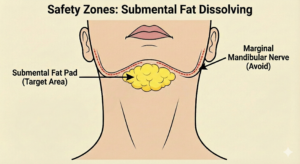
- The marginal mandibular nerve runs close to the jawline. If inflammation occurs near this nerve, it can temporarily reduce muscle movement.
What matters clinically
- This is not permanent nerve damage. It is usually a temporary conduction block caused by inflammation, not nerve destruction.
Recovery
- In the vast majority of cases, normal movement returns over weeks to a few months as swelling settles.
Risk reduction
- Correct injection depth, conservative treatment near the jawline, and anatomical mapping dramatically reduce this risk.
Neck tightness
What’s happening
- Early swelling can press on nearby tissues, creating a sensation of tightness.
What it isn’t
- It is unlikely to be airway compromise.
Timeline
- This resolves as swelling decreases, usually within days.
Skin changes & rare complications
Firm nodules or hardness
- These are expected during healing. They represent fat breakdown and inflammation, not scar tissue.
Skin injury or necrosis
- Extremely rare when injected at the correct depth by a trained medical professional. This risk rises sharply with poor technique or non-medical injectors.
The honest risk summary
- Swelling: Expected
- Bruising: Common
- Temporary numbness or firmness: Normal
- Temporary nerve weakness: Rare
- Skin injury: Extremelyy rare
Fat dissolving has a strong safety profile — when anatomy is respected.
After fat dissolving: What’s normal — And when to call your clinic
Once the injections are done, most of what happens next is predictable, even if it looks dramatic. Knowing what’s normal versus what needs review removes a lot of unnecessary anxiety during recovery.
What’s normal (Even if it feels strange)
In the days and weeks after fat dissolving, it’s common to experience:
- Significant swelling under the chin or jawline. This can peak in the first 48–72 hours and make the area look larger than before treatment.
- Tenderness or aching. Especially when touching the area or moving the neck.
- Firmness or small lumps. These develop as fat cells break down and the body clears the debris. They soften gradually.
- Numbness or altered sensation. Temporary nerve irritation is common and usually resolves on its own.
- Bruising. Often appears days later and fades from purple to yellow over 1–2 weeks.
All of the above are signs that the inflammatory process is doing its job.
What’s not normal (And should be checked)
Contact your clinic or seek medical attention if you notice:
- Severe or worsening pain that doesn’t respond to simple pain relief
- Rapidly increasing redness or heat spreading beyond the treated area
- Skin breakdown, blistering, or dark discolouration
- Persistent difficulty swallowing or speaking
- Asymmetry that worsens rather than improves after the first week
These scenarios are uncommon — but early review matters.
Timing matters: When symptoms should improve
A useful rule of thumb:
- Days 1–3: Expect swelling and discomfort
- Days 4–10: Swelling slowly reduces, bruising may peak
- Weeks 2–4: Firmness and nodules soften
- Beyond week 4: Final contour becomes visible
If symptoms fall outside this pattern, it’s reasonable to check in.
Why follow-up is part of safe treatment
Fat dissolving isn’t a “set and forget” procedure. A proper treatment plan includes:
- Clear aftercare instructions
- Access to clinical review if needed
- A follow-up assessment to decide if further treatment is required
This is also when skin retraction is evaluated — and when decisions about tightening treatments (if any) are made.
Bottom line
Most post-treatment concerns are normal, temporary, and self-resolving. Serious complications are rare, but good clinics want to hear from you if something doesn’t feel right.
Recovery is a process — not a moment.
Swelling is temporary. Structure is not.
Fat dissolving recovery can look dramatic in the short term, but it follows a reliable biological process. The swelling and firmness phases are not complications — they are the visible signs that fat cells are being broken down and cleared.
What matters most is understanding what phase you’re in, giving your body time to heal, and judging results only once the inflammation has fully settled.
For most patients:
- Healing is measured in days, not weeks
- The improved contour is long-lasting
When performed correctly and followed by appropriate aftercare, fat dissolving is one of the most predictable non-surgical ways to reduce under-chin fullness.
One last reminder
Fat dissolving treats volume, not skin or bone. If swelling has settled but the shape still isn’t right, that’s not a failure — it’s a diagnostic clue.
Sometimes the next step is:
- Another session
- Address loose skin
- Add chin and jaw structure
That’s why professional assessment matters more than chasing a single treatment.
Want to know more about double chin fat removal?
Learn more about double chin treatments in our complete double chin treatment guide.
Searching online for “double chin fat removal near me”?
Curious about whether you’re suitable for double chin fat dissolving? Explore our double chin treatment and start your journey.