
You see it in photos, on Zoom calls, and in the mirror.
It’s often the same moment for everyone: you tilt your head slightly, the lighting catches your jaw at the wrong angle, and suddenly there it is — a soft pocket beneath the chin that feels out of proportion to the rest of your face.
For many people, this area becomes impossible to ignore. It can make the jawline appear blurred, the neck look heavier, and the face feel less defined overall. What’s especially frustrating is that this fullness often persists even when the rest of the body feels fit and healthy.
If you’ve tried weight loss, posture changes, facial exercises, or “chin lifting” tools without success, you’re not alone. The area under the chin behaves differently to other parts of the body — and that’s not a failure on your part.
What is submental fat?
Medically, a “double chin” is referred to as submental fullness. This term describes the accumulation of fat — and sometimes skin laxity — in the area between the underside of the chin and the upper neck. Submental fat is a distinct anatomical fat pad that sits between the underside of the chin and the upper neck.
Submental fat is one of the most common aesthetic concerns seen in both men and women. It can develop at any age and is influenced by a combination of factors including genetics, facial structure, hormone changes, and fat distribution patterns.
Importantly, submental fullness does not always correlate with overall body weight. Many people with a healthy BMI or active lifestyle still have a persistent double chin due to inherited fat pads or structural anatomy. This is why the area is often resistant to diet and exercise alone.
Understanding whether your concern is driven by fat, skin, muscle position, or bone structure is the key to choosing the right treatment — and avoiding ineffective or unnecessary procedures.
What this guide will help you understand
This guide is designed to be your complete roadmap to double chin removal, grounded in medical anatomy rather than trends or quick fixes.
Inside, we’ll explain:
- Why double chin fat forms — and why it’s often stubborn
- How to tell whether your concern is fat, skin laxity, or structural
- What natural methods can realistically achieve (and their limits)
- The difference between non-surgical and surgical double chin treatments
- What results, recovery, and costs look like in real terms
By the end, you’ll have the clarity to decide which approach makes sense for your face, your lifestyle, and your goals — without guesswork.
Why do I have a double chin? (It’s not just weight)
One of the most common — and most damaging — myths about double chins is that they’re simply a sign of being overweight. In reality, submental fullness is rarely caused by weight alone, and many people with a healthy body composition develop a double chin regardless of diet or exercise.
Understanding why your double chin formed is critical, because the cause directly determines which treatments will work — and which ones won’t.
Most people try to fix a double chin without first identifying what actually causes it. Fat, skin laxity, and bone structure all create fullness under the chin—but they require completely different solutions. Treating the wrong structure wastes time, money, and often makes the result worse. Correct diagnosis matters more than the treatment itself.
The misconception: “If I lose weight, my double chin will go away”
While general weight loss can reduce fat volume throughout the body, the under-chin area behaves differently. Submental fat is often genetically programmed to persist, meaning it may remain even when other areas slim down.
This is why people often notice:
- A defined waist and arms, but a soft jawline
- Facial fullness that doesn’t match the rest of the body
- A double chin appearing or worsening with age, despite stable weight
For many patients, weight loss improves overall health but has little impact on chin definition.
The three main causes of a double chin
Genetics: the “skinny double chin”
Genetics play the largest role in determining whether someone develops submental fat. Some people inherit a predisposition for storing fat in the under-chin region, even if they are otherwise lean.
This is commonly referred to as the “skinny double chin” — a soft pocket beneath the chin that appears early in adulthood and remains stable over time. In these cases, the issue is not excess fat overall, but where fat is stored.
Genetic submental fat tends to:
- Be symmetrical and central
- Remain consistent regardless of weight fluctuations
- Respond poorly to diet and exercise alone
Because the fat pad itself is inherited, targeted treatments are often required to change its appearance.
Hormones and medical factors
Hormonal changes can also contribute to fullness under the chin. Thyroid dysfunction, in particular, may lead to fluid retention or soft tissue puffiness in the neck and jawline.
While hormonal causes are less common than genetics or weight, they’re important to consider — especially if under-chin fullness appears suddenly, fluctuates, or is accompanied by other systemic symptoms such as fatigue or swelling elsewhere.
In these cases, addressing the underlying medical issue is essential before considering aesthetic treatment.
Weight and overall fat distribution
Weight gain can certainly contribute to a double chin, particularly in people who are genetically predisposed to storing fat in the face and neck.
However, even here, distribution matters. Two people at the same weight can have completely different jawlines depending on how their body stores fat and how their facial structure supports the soft tissues.
When weight is a contributing factor, submental fullness often:
- Appears alongside fullness in the cheeks or neck
- Improves partially with weight loss
- May still leave a residual fat pad or loose skin
This is why many people reach a healthy weight but remain dissatisfied with their chin profile.
Next: let’s make sure it’s actually fat
Not every “double chin” is caused by fat. In many cases, the real issue is a receding chin, skin laxity, or jowling, which can mimic the appearance of submental fullness.
Before talking about removal options, it’s important to correctly identify what you’re seeing — because treating the wrong issue leads to disappointing results.
Related topics:
Is it fat, bone, or jowls? (The diagnosis)
One of the biggest reasons people feel frustrated by double chin treatments is simple: they’re often treating the wrong problem.
What looks like a double chin in photos or mirrors isn’t always caused by excess fat. In fact, a significant number of people who believe they have under-chin fat are actually dealing with a structural issue, skin laxity, or a combination of several factors. This is why some treatments work brilliantly for one person and fail completely for another.
Correct diagnosis is the foundation of effective treatment.
Why the confusion is so common
The lower face and neck are visually complex. Small changes in chin projection, skin elasticity, or jawline support can dramatically alter how the area appears — especially in downward angles, selfies, and video calls.
As a result, three very different issues are commonly grouped together as a “double chin,” even though they behave differently and respond to different treatments.
Submental fat: true under-chin fullness
Submental fat is the most straightforward diagnosis. It presents as soft, pinchable tissue directly beneath the chin, usually in the midline. When you tilt your head slightly forward and gently pinch the area, fat will feel mobile and compressible.
This type of fullness tends to:
- Sit centrally rather than along the jaw edges
- Persist regardless of posture
- Become more noticeable in profile views
True submental fat responds well to targeted fat-reduction treatments and is the primary indication for non-surgical double chin removal.
If you can pinch >1cm of soft tissue under your chin, skin tightening will not remove it.
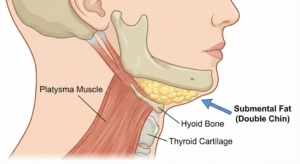
Bone structure: the illusion of fat
In some cases, there is very little fat under the chin at all. Instead, a receding or under-projected chin causes the neck tissues to fold backward, creating the appearance of fullness.
Here, the issue isn’t excess tissue — it’s lack of structural support. The neck may look fleshy or undefined, but pinching the area reveals minimal fat.
Treating this as a fat problem often leads to disappointment. Removing fat where there is already little volume is very unlikely to achieve any visible change, while addressing chin projection or jaw support can dramatically improve the profile without touching the fat pad.
A recessed chin often exaggerates neck fullness, and fat removal alone will not help the profile.
Jowls and skin laxity: sagging, not fat
Jowls are caused by skin and soft tissue descent, not by submental fat. They appear along the sides of the jawline rather than centrally under the chin and tend to worsen with age as collagen and elastin decline.
When jowls are mistaken for a double chin, fat-reduction treatments may do very little, because treating the area under you chin isn’t addressing the problem.
In these cases, treatments that focus on lifting, tightening, or reducing jowls are more appropriate.
Sagging tissue along the jawline will not respond to fat reduction and may appear worse if fat is removed incorrectly.
Why diagnosis matters before treatment
Each of these concerns — submental fat, bone, and jowls — requires a different approach. Treating the wrong one doesn’t just limit results; it can actively worsen facial balance.
This is why experienced clinicians assess:
- Where fullness sits (central vs lateral)
- How pinchable the tissue is
- Chin projection and jaw structure
- Skin quality and elasticity
Only after identifying the dominant factor does it make sense to discuss treatment options.
Related topics:
5 ways to remove a double chin
If you don’t have time to read a full medical breakdown of every option, this section gives you the short answer.
There are dozens of products, tools, and procedures marketed for double chin removal, but in clinical practice, only a handful reliably change the appearance of the under-chin area. Based on effectiveness, predictability, cost, and downtime, these are the five most common approaches.
5. Gua Sha, massage & facial exercises
These methods are widely shared on social media and appeal to people looking for natural or at-home solutions. They can temporarily reduce fluid retention, which may make the area look tighter for a short time.
However, they do not remove submental fat. Any visible improvement is subtle and temporary, and results disappear once the routine stops. Best suited for people prone to fluid retention, not true double chin removal.
Patients feel disappointed with natural methods when visible fat remains unchanged.
4. Weight loss
For people whose double chin is partly related to overall weight gain, fat loss can reduce under-chin fullness. That said, submental fat is often genetically resistant and may persist even after significant weight loss.
Importantly, weight loss cannot target one area specifically, and it does not address loose skin or structural causes.
3. Fat freezing
Fat freezing reduces fullness exposing fat cells to extreme cold, causing them to break down. It is usually used for larger areas, with treatments taking about 30-45 minutes, and multiple sessions often recommended.
2. Non-surgical fat reduction (fat dissolving)
Non-surgical double chin removal with injections has become the modern standard for most patients. These treatments directly target fat cells without surgery and can permanently reduce submental fat when performed correctly.
Fat dissolving treatments allow for more precise sculpting or small areas. Downtime is moderate (mainly characterised by swelling), and results develop gradually over weeks.
1. Surgical double chin removal (liposuction)
For people with significant under-chin fat and good skin elasticity, liposuction remains the most immediate and dramatic option. It physically removes fat in a single procedure.
The trade-offs are higher cost, aneesthesia, recovery time, and surgical risks. While effective, it’s not the first choice for many patients seeking minimal downtime and convenience.
Patients feel disappointed with surgery when downtime outweighs the benefit for mild fat.
Which option is “best”?
The best treatment isn’t universal — it depends on whether your concern is fat, skin laxity, bone structure, or a combination of all three, as well as your budget, and tolerance for risk and downtime.
Related topics:
Check your suitability
Natural methods: Can you remove a double chin naturally?
Searches for how to get rid of a double chin naturally are incredibly common. From facial exercises and jaw workouts to Gua Sha, rollers, and lymphatic massage, there’s no shortage of at-home techniques promising to slim the area under the chin without medical treatment.
These approaches can have some limited benefits, particularly when it comes to muscle tone and fluid retention. Exercises that engage the neck and lower face work the platysma muscle, which can improve firmness and posture over time. Massage techniques such as Gua Sha or lymphatic drainage can also reduce puffiness by encouraging fluid movement, which may temporarily reduce the under chin.
However, it’s important to be clear about what these methods cannot do. Natural techniques do not remove the submental fat pad — the pocket of fat that sits beneath the chin. Fat cells in this area do not shrink or disappear through massage, facial exercises, or topical products. This is why results from natural methods tend to be subtle, short-lived, and highly dependent on consistency.
In practice, natural approaches are best viewed as supportive rather than corrective. They can help maintain skin tone, reduce swelling, and complement professional treatments, but they will not produce meaningful or permanent double chin removal on their own.
Verdict: natural methods are useful for maintenance and overall skin health, but they are not an effective solution for removing under-chin fat.
If you can physically pinch submental fat between your fingers, natural methods will not remove it—no matter how consistent you are.
Related topics:
Non-surgical double chin removal: The modern standard
Over the past decade, non-surgical double chin removal has become the preferred choice for most patients. The reason is simple: people want visible, lasting improvement without surgery, scars, or extended downtime. Modern non-surgical treatments can target fat, skin laxity, or both, allowing clinicians to tailor treatment precisely to the cause of the double chin rather than defaulting to a one-size-fits-all surgical approach.
Non-surgical options are particularly appealing for those with mild to moderate submental fullness, those who want gradual, natural-looking changes, or those who are not ready for invasive procedures. The key is choosing the right modality for the underlying issue — fat, skin, or structural support.
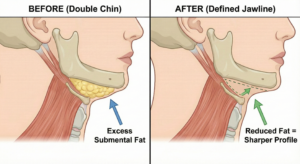
How reducing submental fat improves the appearance of a double chin.
1. Fat dissolving treatment (The gold standard)
Fat dissolving treatments are widely regarded as the most effective non-surgical treatment for under-chin fat. They use a compound based on deoxycholic acid, a substance that naturally occurs in the body and helps break down dietary fat. When injected into the submental fat pad, it selectively destroys fat cells, which are then cleared by the body over time.
This approach allows for highly precise sculpting of the under chin, making it ideal for contouring and definition rather than bulk reduction alone. Because fat cells are permanently removed, results are long-lasting once treatment is complete. Most patients require a series of sessions, spaced several weeks apart, to achieve optimal results, but downtime is minimal aside from temporary swelling.
2. Chin fat freezing (CoolSculpting)
Chin fat freezing uses controlled cooling to destroy fat cells beneath the chin. The treated fat cells are gradually eliminated by the body over several weeks to months. This method is non-invasive and does not involve injections, which appeals to patients who prefer a completely needle-free option.
Fat freezing tends to work best for larger areas of fat, but it is less precise than injections when it comes to sculpting fine contours. Results can be more variable, and some patients require multiple sessions to see noticeable change.
There is also a risk of paradoxical adipose hyperplasia with fat freezing – where treatment causes fat cells to grow. With some evidence showing up to a 1 in 50 risk, this makes fat freezing an unappealing choice for many people.
If you’re weighing your options, you can explore the differences in more detail in our Injections vs. Freezing Comparison.
3. Skin tightening (HIFU / RF)
In some cases, what appears to be a double chin is actually skin laxity rather than fat. Skin tightening treatments such as HIFU (high-intensity focused ultrasound) or radiofrequency (RF) work by heating the deeper layers of skin to stimulate collagen production and tissue contraction.
These treatments do not remove fat. Instead, they aim to improve firmness and definition, making them best suited for patients with minimal fat but loose skin — often described as a “turkey neck.” In the right candidates, skin tightening may improve the neck profile without addressing fat at all.
Other options to address loose skin include collagen stimulating treatments – often providing better results with fewer treatments than HIFU or RF.
Together, these non-surgical options form the modern standard for double chin treatment, offering targeted solutions with far less disruption than traditional surgery.
Summary
Pinchable fat present → fat dissolving treatments
Loose skin without fat → skin tightening
Fat and skin laxity → staged combination treatment
Related topics:
Surgical double chin removal: Liposuction & lifts
Surgical options for double chin removal typically involve liposuction and various forms of neck lifts. Liposuction targets and physically removes excess fat deposits under the chin through small incisions, while surgical lifts tighten loose skin and underlying tissues to improve under chin definition.
The biggest advantage of surgery is the immediate and dramatic reduction of large volumes of neck fat and sagging skin in a single procedure. For those with significant submental fullness or severe skin laxity, surgery often provides the most comprehensive results.
However, surgery comes with important drawbacks: it requires general anesthesia, leaves small but permanent scars, and usually involves a recovery period of about two weeks, during which patients must wear a compression headband to reduce swelling and support healing.
Because of these factors, surgical removal is best suited for patients who have substantial bulk under the chin and can commit to the downtime and aftercare, as well as the much higher costs, and the risks. For many, non-surgical treatments offer a less invasive alternative, but when dramatic change is needed, surgery remains the gold standard.
Related topics:
Brands explained: Kybella, Lemon Bottle & Aqualyx
When exploring double chin removal, you’ll encounter a variety of brand names like Kybella, Lemon Bottle, and Aqualyx. These names refer to different formulations of fat-dissolving injections designed to target and reduce submental fat.
Though the names differ, Kybella and Aqualyx products generally contain similar active ingredients, based on deoxycholic acid, which works by breaking down fat cells so the body can naturally eliminate them. Understanding that these are essentially different brands of the same type of treatment can help you focus on choosing a qualified provider rather than getting caught up in brand marketing. Neither product is available in Australia, but there are other options that are similar if you want to dissolve fat.
Lemon Bottle is the only outlier – it primarily contains Riboflavin, has no supporting medical evidence, and is not approved for use in reducing unwanted fat.
What does the recovery look like?
One of the most common experiences after double chin injections is noticeable swelling, often nicknamed the “bullfrog” phase due to the puffiness under the chin. This swelling is a normal part of the body’s inflammatory response as it breaks down fat cells.
Typically, swelling peaks within the first 3 days and then gradually subsides. During this time, the neck area may feel tight. After this initial phase, the treated area enters a retraction period lasting up to 6 weeks, during which the skin tightens and the fat cells are naturally eliminated, revealing a slimmer, more contoured chin.
Related topics:
How much does double chin removal cost?
The cost of removing a double chin varies widely depending on the method you choose.
Non-surgical options such as fat-dissolving injections typically range from $800 to $3,200, depending on the number of sessions needed. Surgical treatments like liposuction or neck lifts usually start at around $8,000 – $18,000 (respectively) and can increase based on the complexity of the procedure, skill and experience of the surgeon, and clinic location.
Related topics:
Real results: What can you expect?
Many people seek double chin removal to achieve a cleaner, more defined under chin and slimmer neck profile. Non-surgical fat dissolving treatments like deoxycholic acid injections gradually reduce submental fat, revealing a smoother contour that enhances your overall facial harmony.
How results develop
Unlike surgery, which provides immediate fat removal, non-surgical treatments work gradually. You can expect swelling and tenderness for several days after each session, with visible slimming usually starting to appear within 4 to 6 weeks as the body metabolises the destroyed fat cells. Most patients require 2 to 4 treatment sessions spaced several weeks apart for optimal results.
Results develop as the body clears destroyed fat cells and inflammation settles. Skin then retracts gradually over several weeks. This biological process explains why outcomes look natural rather than abrupt.
The look
Results from fat dissolving treatments tend to be natural and subtle, avoiding an overdone or artificial appearance. The jawline becomes more defined, and the area under the chin appears firmer and less bulky. Because the process leads to low-grade inflammation, skin quality often improves due to collagen stimulation, leading to a tighter, more youthful neck contour.
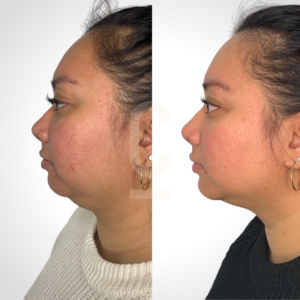
Before and after a series of fat dissolving treatments to reduce the appearance of under chin fullness.
Permanence of results
Once fat cells are destroyed and metabolised, they do not regenerate. This means the results are long-lasting, provided your weight remains stable. Non-surgical treatments do not stop ageing or skin laxity, so skin tightening procedures may be advised over time as the natural ageing process progresses. Importantly, fat dissolving does not speed up these changes.
Surgical results comparison
Surgical options like liposuction offer immediate and often more dramatic fat removal with a shorter overall treatment timeline but involve anesthesia, incisions, and a recovery period. These methods can be ideal for patients with significant submental fat or loose skin that needs addressing.
Related topics:
FAQ: Your top double chin fat dissolving questions answered
Curious about double chin removal? Here are some of the most common questions we hear — answered quickly to get you started.
Does it hurt?
Most patients experience only very mild pressure during the injection process, which is brief and well-tolerated, so long as appropriate anaesthetic is used.
Is it safe?
Yes. Fat dissolving treatments are medically approved in many countries around the world and performed by trained professionals to ensure safety and effectiveness.
Can men do it?
Absolutely. Double chin removal is popular with both men and women and can be tailored to suit your unique facial structure.
Related topics:
Searching online for “double chin fat removal near me”?
Curious about whether you’re suitable for double chin fat dissolving? Explore our double chin treatment and start your journey.