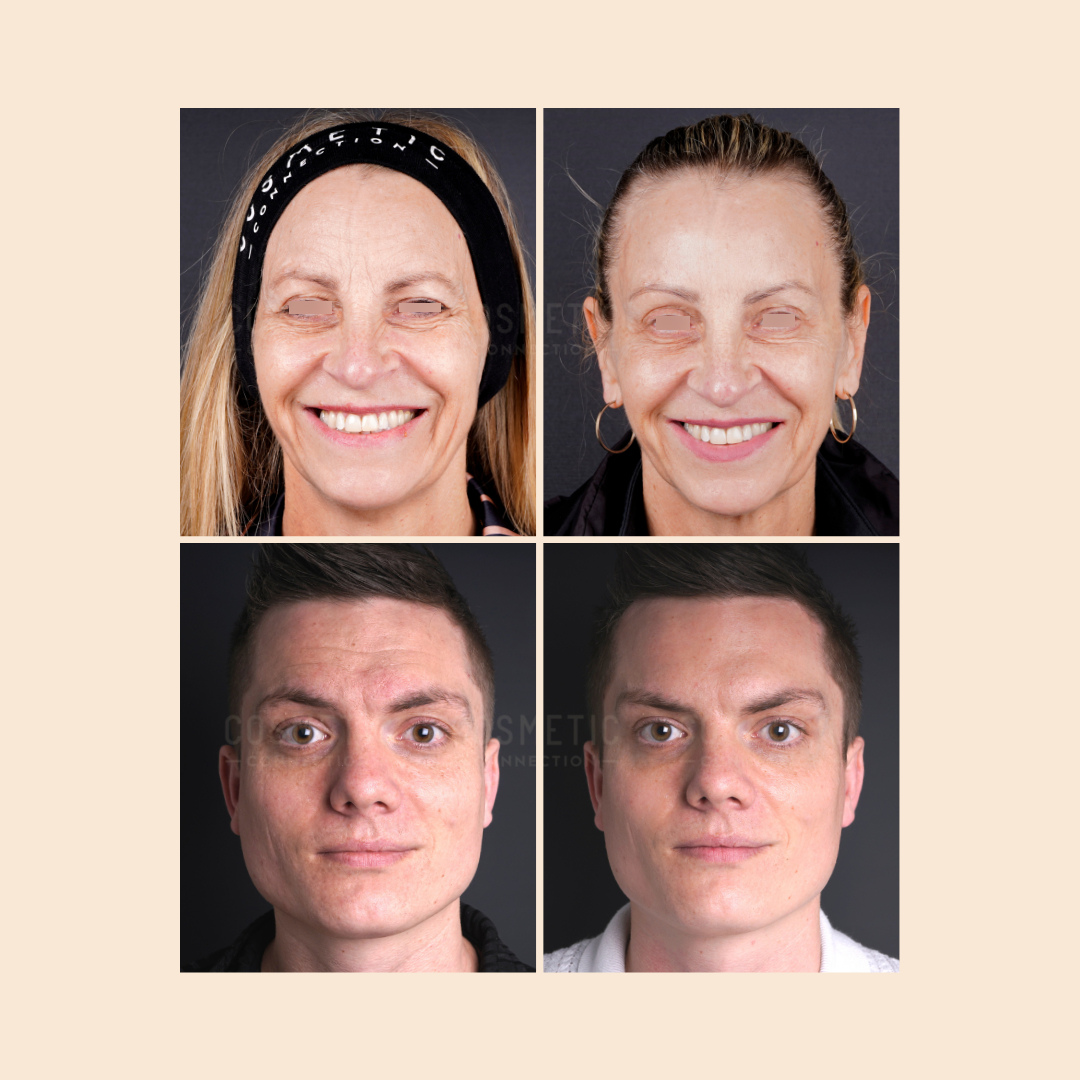
Forehead wrinkles and frown lines are the two most commonly treated upper face concerns in non-surgical cosmetic medicine — and they are frequently confused with each other. They look similar, appear in the same general region of the face, and are often treated in the same appointment. But they are caused by different muscles, follow different patterns, and require different clinical considerations. Understanding the distinction helps you have a more informed conversation about what treatment options make sense for your situation.
Quick answer: Forehead wrinkles are horizontal lines across the forehead caused by the frontalis muscle, which lifts the brows. Frown lines are vertical or diagonal lines between the eyebrows caused by the corrugator supercilii and procerus muscles, which draw the brows inward and downward. The two muscle groups are anatomical antagonists — they work in opposite directions — which means treating one area without considering the other can affect the balance of the whole upper face.
The anatomy behind each concern
The simplest way to understand the difference is to think about which facial expressions create each set of lines.
Forehead wrinkles form when you raise your eyebrows — in surprise, concern, or when compensating for heavy upper eyelids. The muscle responsible is the frontalis, a broad, flat muscle running horizontally across the full width of the forehead. When it contracts, it pulls the skin of the forehead upward, creating horizontal creases. Over time and with repeated use, these creases become more visible even when the face is at rest.
Frown lines form when you frown, concentrate, or squint — when the brows pull together and downward. The muscles responsible are the corrugator supercilii (a paired muscle that originates near the nose bridge and inserts into the brow) and the procerus (which sits between the brows and pulls the skin between them downward). Their contractions create vertical or diagonal lines — the “11s” — in the glabellar region between the eyebrows.
| Feature | Forehead wrinkles | Frown lines |
|---|---|---|
| Location | Across the forehead | Between the eyebrows |
| Line direction | Horizontal | Vertical or diagonal |
| Muscles involved | Frontalis | Corrugator supercilii, procerus |
| Expression that creates them | Raising eyebrows | Frowning, squinting, concentrating |
| Muscle function | Brow elevator | Brow depressors / medial brow drawing |
| Anatomical relationship | Antagonist to corrugator/procerus | Antagonist to frontalis |
Why they need to be considered together
Here is the nuance that most people do not realise: the frontalis and the corrugator/procerus muscles are functional antagonists. They work in opposite directions. Research published in the Yonsei Medical Journal (2023) studied 30 participants using 3D skin displacement analysis and found that in 83.3% of participants, contraction of the frontalis also displaced the glabellar skin upward — demonstrating a direct mechanical relationship between the two muscle groups. When one group is active, the other is comparatively less active. When one is weakened, the other may compensate.
This has a practical implication for treatment. If the frontalis is significantly relaxed without adequately addressing the glabella, the corrugator and procerus muscles may become more active by comparison — and glabellar lines may appear more prominent. Conversely, treating the glabella without considering the frontalis can affect brow position. This is why experienced clinicians assess and plan the upper face as a whole rather than treating each area in isolation.
In our clinical experience, most people presenting with either concern have activity in both areas. Treating them together typically produces more balanced, natural-looking results than treating either one alone.
How line depth and type differ between the two areas
Frown lines and forehead wrinkles also tend to behave differently in terms of how quickly they progress and how deeply they etch into the skin.
The corrugator and procerus muscles are generally stronger than the frontalis and are used more forcefully in daily life — in concentration, close screen work, emotional expression, and squinting against light. As a result, frown lines in the glabellar region often become static (visible at rest) earlier and tend to be deeper when established than forehead wrinkles of comparable age. Deep static frown lines — a pronounced vertical crease between the brows — can be persistent even after muscle relaxant treatment, and may require a combination approach to significantly reduce at rest.
Forehead wrinkles, while highly variable between individuals, tend to progress more gradually in most people. However, in people who habitually use their frontalis strongly — particularly those with heavier brows or upper eyelids who rely on the frontalis to hold their brow position — forehead lines can develop and deepen quickly.
Does the treatment differ?
The treatment modality — muscle relaxant treatment — is the same for both concerns. However, the dose, placement, and approach differ significantly between the two areas, and the clinical considerations for each are distinct.
For the forehead, the primary clinical challenge is balancing adequate relaxation of the frontalis with preserving enough muscle activity to keep the brows in a natural position. Over-treating the frontalis can cause brow heaviness or an unwanted dropping of the brow. The lower third of the frontalis, in particular, needs to be treated cautiously in most patients. This is one reason why the forehead is generally treated conservatively in people who are new to treatment.
For frown lines, the corrugator and procerus muscles can typically be treated more aggressively because they are depressors — relaxing them tends to allow the brow to sit in a slightly more elevated, open position, which most people find aesthetically pleasing. The risk in over-treating this area is less about brow drop and more about the potential for product diffusion into the muscles around the eye.
The two areas are frequently treated in the same appointment as part of a coordinated upper face plan, with the clinician calibrating each area to achieve overall balance rather than treating each site independently.
Get started
Which should you treat first?
In most cases, both areas are assessed and treated together. If someone is new to treatment and wants to start cautiously, the glabellar area — the frown lines — is often prioritised first. This is because the corrugator and procerus muscles can typically be treated at higher doses without the brow-lowering risk associated with the frontalis, and because frown lines are often what people find most bothersome initially.
However, treating the glabella alone without addressing the frontalis in someone who has activity in both areas can create an imbalance — the relaxed glabella may cause the frontalis to work harder to maintain brow position, potentially making forehead lines more prominent by comparison. For this reason, we typically recommend treating both areas together once a person is comfortable with the process.
The right approach depends on your individual anatomy, what your concerns are, and what you are hoping to achieve. Our consultations at our clinics are designed to give you a clear picture of what treatment makes sense for your specific situation.
How to know which concern you have
Most people have both to some degree, though one tends to bother them more than the other. A simple way to assess each at home:
- Forehead wrinkles: Raise your eyebrows as high as you can and hold for a few seconds, then relax completely. If horizontal lines are visible when your face is fully relaxed, you have some degree of static forehead wrinkles. If lines only appear when you raise your brows and disappear when you relax, they are predominantly dynamic.
- Frown lines: Frown or squint deliberately, then let your face fully relax. If vertical lines between the brows remain visible at rest, you have some degree of static frown lines. If lines only appear when you frown and disappear completely at rest, they are predominantly dynamic.
In either case, the most useful assessment is not the one you do at home in the mirror — it is a clinical assessment by a qualified practitioner who can evaluate your muscle strength, skin quality, and anatomy together. That combination of factors, not the lines alone, is what determines the best treatment approach.
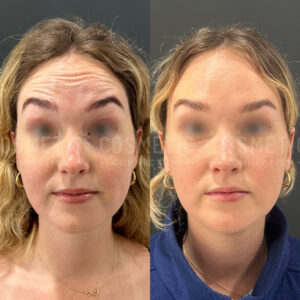
Before and after treatment for forehead lines.
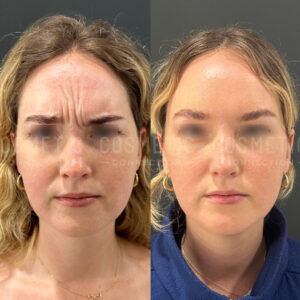
Before and after treatment for frown lines.
Frequently asked questions
Are forehead wrinkles and frown lines treated with the same product?
The treatment category — muscle relaxant treatment — is the same for both areas. However, the dose, placement, and clinical approach differ between the forehead and glabellar region. A clinician who treats both areas will calibrate each individually based on your anatomy and goals.
Can treating one area make the other look worse?
Yes — this is a real consideration. Treating the frontalis (forehead) significantly without addressing the glabella can make frown lines appear more prominent. Treating the glabella without the frontalis can cause the frontalis to compensate and forehead lines to appear more pronounced. This is why most experienced clinicians assess and plan both areas together rather than treating each in isolation.
Do frown lines and forehead wrinkles cost more to treat together?
Treating both areas in the same appointment is generally more cost-effective than treating them separately, and typically produces better results because the clinician can calibrate the two areas in relation to each other. At Cosmetic Connection, our flat-fee pricing provides full transparency about cost before you arrive.
Why do my frown lines look deeper than my forehead wrinkles even though I frown less than I raise my eyebrows?
The corrugator and procerus muscles involved in frown lines are typically stronger than the frontalis muscle that creates forehead wrinkles. Muscle strength, not just frequency of use, is a significant factor in how quickly and deeply lines form. Genetics also plays a role — some people simply have stronger glabellar muscles and develop pronounced frown lines earlier than their forehead lines.
How long before I see results from treating both areas?
Results typically become visible within three to seven days of treatment, with full effect at approximately two weeks. Both areas follow a similar timeline. Duration of effect is typically three to four months for each area.
References
- Kwon IJ, Lee W, Moon H-J, Lee SE. (2023). Dynamic Evaluation of Skin Displacement by the Frontalis Muscle Contraction Using Three-Dimensional Skin Displacement Vector Analysis. Yonsei Medical Journal, 64(7), 440–447. https://pmc.ncbi.nlm.nih.gov/articles/PMC10307676/
- Bar O, Valiukevičienė S. (2025). Skin Aging and Type I Collagen: A Systematic Review of Interventions with Potential Collagen-Related Effects. Cosmetics, 12(4), 129. https://www.mdpi.com/2079-9284/12/4/129
- Zargaran D, Zoller F, Zargaran A, et al. (2022). Complications of Cosmetic Botulinum Toxin A Injections to the Upper Face: A Systematic Review and Meta-Analysis. Aesthetic Surgery Journal, 42(5), NP327–NP336. https://academic.oup.com/asj/article/42/5/NP327/6530404
- Cancer Council Australia. UV Radiation Prevention Policy. https://www.cancer.org.au/about-us/policy-and-advocacy/prevention/uv-radiation