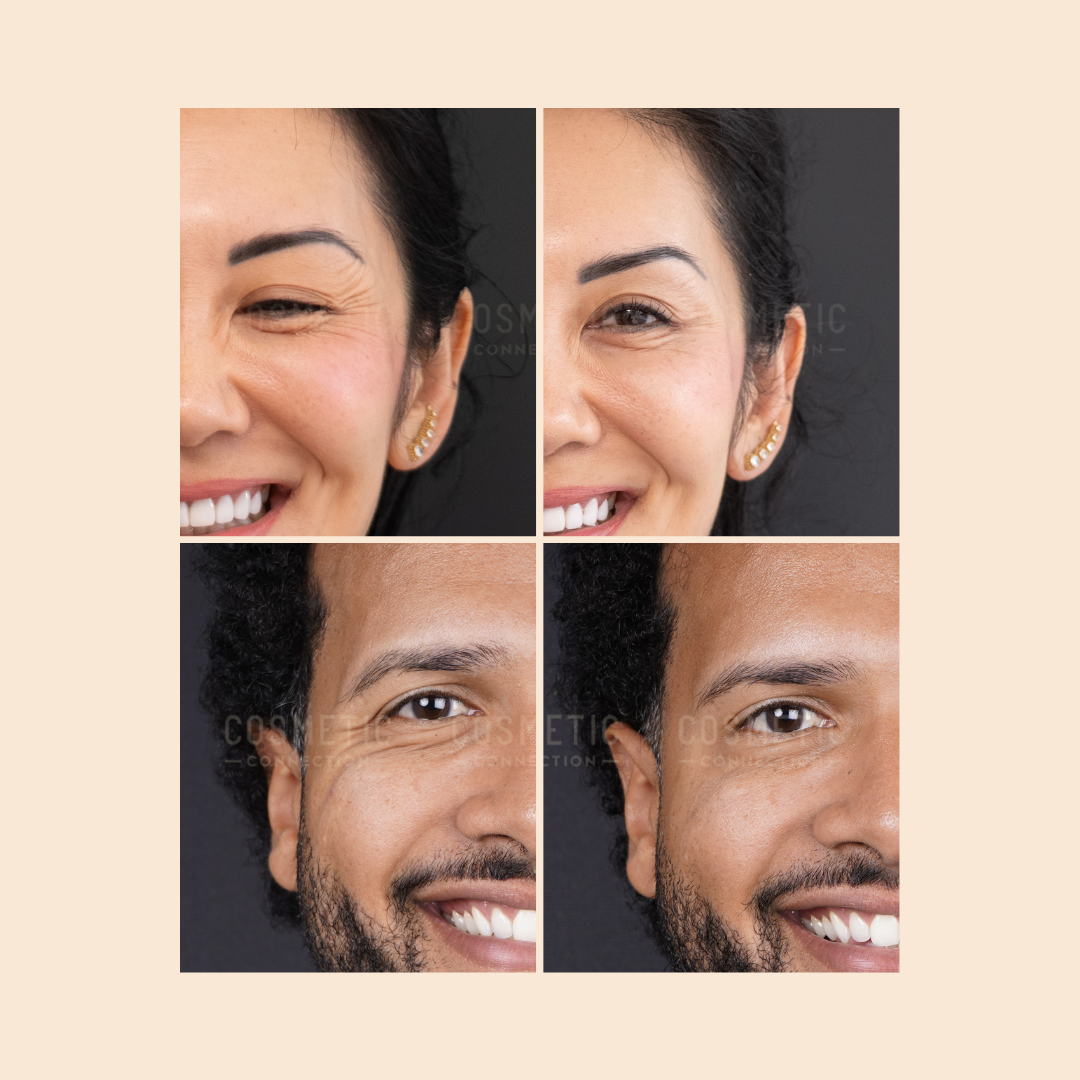
Before and after images for crow’s feet treatment are everywhere — and most of them are misleading. Perfect lighting, maximum expression changes, and cherry-picked results create expectations that don’t reflect what the average person experiences. This post explains what realistic crow’s feet treatment results actually look like, what changes to expect and in what timeframe, and why the most important measure is how your face looks in everyday life.
Quick answer: For most people, crow’s feet treatment produces a clear softening of lines — not a complete elimination. Dynamic lines (visible with movement) improve most dramatically. Static lines (visible at rest) improve more gradually and may require a combination approach. The result should look like a rested, refreshed version of you — not a different face.
Why crow’s feet results are harder to photograph than other treatments
Results in the periorbital area are notoriously difficult to capture in before and after photography. The lines are subtle. Lighting direction changes their visibility dramatically. And the most meaningful changes — how much a line deepens when you smile, or how prominent it is in natural light — are dynamic, not static.
This creates a gap between what patients experience in the mirror and what a photograph captures. In our clinical experience, people who are most satisfied with their crow’s feet results are those who notice the difference in daily life — when they catch their reflection without squinting at it — rather than those who compare clinical photos.
This is important context when evaluating before and after images online. The most impressive-looking results often involve the highest-dose, highest-risk approach to muscle relaxation — one that sacrifices some natural expression for maximum visual effect in a static photo. That trade-off is rarely worth it.
What changes after muscle-relaxing treatment for crow’s feet
Changes begin to appear within 5–14 days. Most patients notice that crow’s feet are significantly softer when they smile or squint, and that the lines are less prominent at rest if there was already a mild static component.
What typically changes:
- Depth of the line when smiling or squinting — significant reduction
- Prominence of lines at rest — partial improvement for early static lines
- Skin texture in the area — often smoother as repeated folding is reduced
- Overall eye area appearance — typically described as more rested and open
What typically doesn’t change with muscle-relaxing treatment alone:
- Deep static lines etched firmly into the skin at rest — these require volume-restoring treatment or a combination approach
- Under-eye hollowing or bags — a separate concern addressed by different treatment
- Skin laxity or hooding of the upper eyelid — outside the scope of this treatment
For a full comparison of which treatment addresses which crow’s feet concern, see crow’s feet treatment options compared.
What changes after volume-restoring treatment for crow’s feet
Volume-restoring treatment produces an immediate result that continues to settle and integrate over 2–4 weeks. The change is most noticeable in the resting appearance — lines that were visible when the face was completely relaxed become significantly less prominent.
This approach does not reduce muscle activity, so dynamic lines — those appearing with movement — are not directly affected unless muscle-relaxing treatment is used alongside it.
Sundaram et al. (2022), in a consensus statement published in Plastic and Reconstructive Surgery, note that combined treatment of the periorbital area with both muscle-relaxing and volume-restoring approaches produces superior outcomes to either treatment in isolation for patients with mixed dynamic and static lines.
The timeline of results: what to expect week by week
| Timeframe | Muscle-relaxing treatment | Volume-restoring treatment | Collagen stimulation |
|---|---|---|---|
| Day 1–3 | No visible change yet | Immediate volume — some swelling normal | Mild redness, no visible change |
| Day 5–7 | Early softening begins | Swelling settling, result emerging | Redness resolved |
| Day 10–14 | Full result visible | Product integrating, natural result | No visible change yet |
| Month 1–2 | Full result maintained | Settled, natural-looking result | Early collagen stimulation underway |
| Month 3–6 | Gradual return of movement | Maintained | Progressive visible improvement |
| Month 6+ | Lines returning — maintenance due | Maintained — typically 9–18 months total | Ongoing improvement continues |
What do crow’s feet treatment results look like?
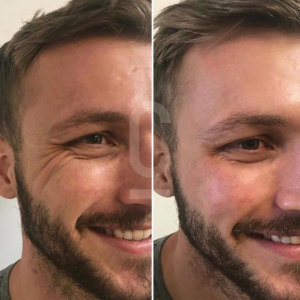
Before and after crow’s feet treatment with a multi-modality approach, targeting both structure and expression.
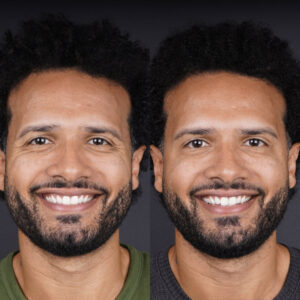
Before and after treatment for crow’s feet wrinkles.
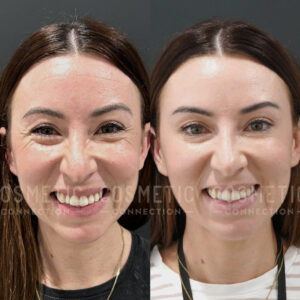
Before and after treatment for crow’s feet wrinkles.
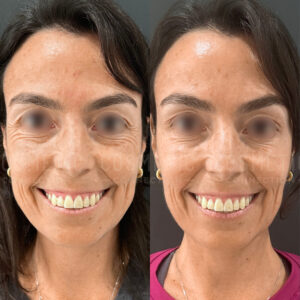
Before and after treatment for crow’s feet wrinkles.
How results change with repeated treatment over time
One of the most clinically interesting patterns we observe is what happens to crow’s feet over multiple rounds of consistent muscle-relaxing treatment. Many patients find that their lines progressively soften over time — not just during the treatment window, but at baseline before the next appointment.
The mechanism is well supported: by consistently reducing the folding action of the orbicularis oculi, the skin gets ongoing periods of rest from the repetitive movement that deepens static lines. Over 12–24 months of consistent treatment, many patients develop a resting appearance closer to their treated appearance without increasing the amount of treatment used.
Mmany patients achieve a stable improvement over time that requires less extensive treatments to maintain than their initial results.
This is why starting treatment while lines are still predominantly dynamic — before they become deeply etched at rest — produces the best long-term outcomes with the least intervention. It is also why consistency matters more than any single treatment session.
The most common reasons results don’t match expectations
In our clinical experience, dissatisfaction with crow’s feet results almost always traces back to one of these factors:
- Unrealistic expectations set by edited before and after photography — heavily filtered or lit images create benchmarks that real results cannot match
- Mismatched treatment for the type of lines — treating static lines with muscle-relaxing treatment only, or vice versa
- Under-treatment in an attempt to look “natural” — insufficient product to achieve a noticeable change, resulting in a result that is imperceptible
- Over-treatment of the muscle — excessive muscle relaxation that affects the natural smile crinkle, creating an unnatural-looking eye area
- Comparing results in clinical lighting to daily-life experience — clinical lighting reveals lines more harshly than everyday environments; a result that looks minimal in clinical photos may look excellent in the mirror at home
The antidote to most of these is a thorough pre-treatment discussion that aligns your expectations with what the chosen treatment can actually achieve for your anatomy.
If you’re ready to get a clear picture of what’s achievable for your situation, the next step is to get started with a consultation. You can also learn about our approach and what makes a Cosmetic Connection assessment different before booking.
Get started
Frequently asked questions
How long until I see results from crow’s feet treatment?
For muscle-relaxing treatment, most patients begin to notice a difference within 5–7 days, with the full result visible at around 14 days. Volume-restoring treatment produces an immediate result that continues to settle over 2–4 weeks. Collagen-stimulating treatment builds progressively over 3–6 months.
Will my result look natural?
With a calibrated approach, yes. The goal of crow’s feet treatment is to soften the lines without eliminating the natural expression of the eye area. A well-placed muscle-relaxing treatment softens crow’s feet while preserving the natural smile crinkle. Over-treatment is the cause of unnatural results — not the treatment itself.
How long do results last?
Muscle-relaxing treatment results typically last 3–4 months before the muscle gradually resumes full activity. Volume-restoring results last 9–18 months. Collagen-stimulating results can persist for 12–24 months. All are temporary and require ongoing maintenance.
Do results get better after multiple treatments?
For many patients, yes. Consistent muscle-relaxing treatment over 12–24 months often leads to a progressive reduction in the depth of static crow’s feet at baseline, as the ongoing periods of muscle rest reduce the folding that deepens the lines over time.