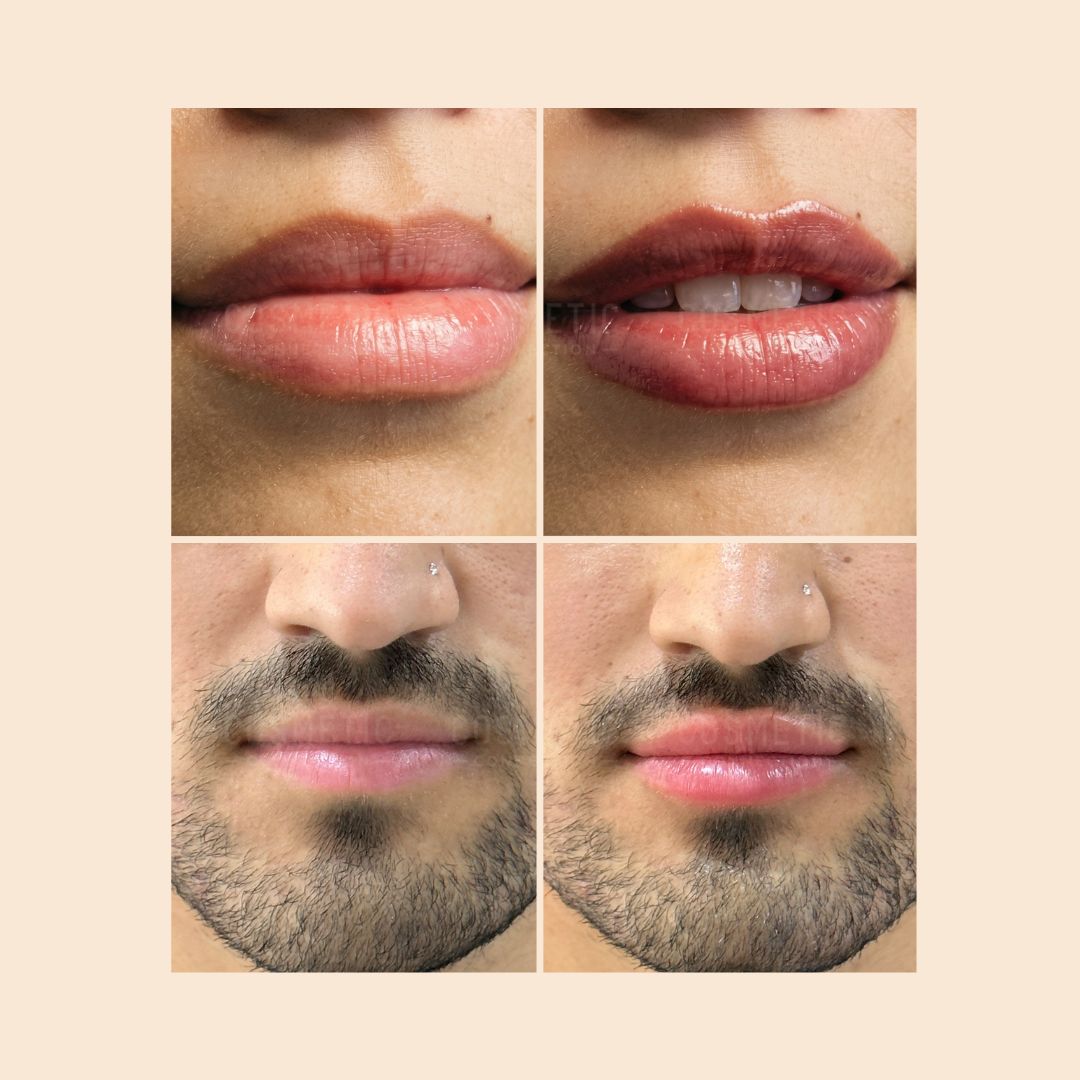
Migration, where an cosmetic substance moves from its intended location into surrounding tissue, is one of the most common concerns people research before considering lip enhancement. This guide explains what migration is, what causes it, how common it actually is, how to prevent it, and what to do if it occurs.
Quick answer: Migration of cosmetic lip treatments is uncommon when appropriate volumes and correct technique are used. It is most commonly associated with repeated large-volume treatments over time. When it does occur, it is fully reversible. The most effective prevention is choosing an experienced clinician who takes a conservative, anatomy-led approach from the outset.
What is migration in the context of lip enhancement?
Migration refers to the movement of a cosmetic treatment from its intended placement within or around the lip into the surrounding perioral tissue, typically above the upper lip border, creating a blurring or puffiness above the vermillion border rather than within the lip itself.
It is sometimes called the “shelf” effect or “duck lip” migration, where instead of the lip appearing fuller, the tissue above the lip appears swollen or protuberant. In more pronounced cases, the natural definition between the lip border and the skin above is lost.
Migration is distinct from swelling, swelling is temporary and resolves within days. Migration is a structural displacement of the cosmetic substance that persists and does not resolve on its own without intervention.
What causes migration?
| Cause | Explanation | Preventability |
|---|---|---|
| Excessive volume administered over time | Repeated large-volume treatments accumulate product that the lip tissue cannot contain — excess product migrates upward above the border | High — conservative, staged treatment prevents this |
| Incorrect treatment depth | Product placed in the wrong anatomical plane is more prone to migration than product placed precisely within the correct tissue layer | High — technique-dependent; experienced clinicians place product correctly |
| Product with poor structural properties | Low-density or poorly cross-linked gels spread more readily than products selected specifically for lip use | High — product selection is a clinical decision |
| Repeated treatment without dissolution of prior product | Accumulating multiple sessions of product without allowing sufficient breakdown increases total product volume beyond what the anatomy supports | High — managed by periodic assessment and dissolution when indicated |
| Massage or pressure applied soon after treatment | External pressure in the first days after treatment can displace product before it has fully integrated | High — avoided through correct aftercare |
How common is migration?
Migration is significantly less common than social media representation suggests. The before-and-after images of migrated product that circulate online are not representative of the typical outcome of well-administered lip enhancement. They represent the outcome of specific errors in technique, volume, or product selection.
In experienced clinical practice with conservative volumes, correct product selection, and appropriate treatment depth, migration is an uncommon complication. It becomes more common in the context of very high accumulated volumes over multiple years, which is why practitioners who take a staged, anatomy-led approach produce lower migration rates over time than those who consistently administer maximum volumes.
Is migration dangerous?
No, despite what is represented online, migration is not the problem it’s made out to be. It is very distinct for general overfilling, where too much product has been placed.
Migration is rare in experienced hands, causes no health problems, resolves on its own as the product wears off, and can be easily treated by reversing the migrated treatment.
How to prevent migration
- Choose an experienced clinician with a conservative approach — ask directly about their approach to volume and whether they ever recommend against treatment
- Start with a lower volume and build gradually over multiple sessions rather than maximising volume at the first appointment
- Allow sufficient dissolution of accumulated product periodically if you have been receiving treatment for multiple years
- Follow aftercare instructions — particularly avoiding massage and pressure in the first 2 weeks
How to know if you have migration
Subtle, early migration is almost undetectable. Most cases of migration are not visible until the later stages. Some common signs of mild migration are also natural anatomical appearances in natural lips, so the picture must be viewed in context. Some signs that you may have migration include:
- Regular treatments over a number of years
- Feeling like your results are wearing off quickly
- Decreasing upper lip definition
- White pillows below your lower lip
- A horizontal crease above your top lip, often seen as a shadow
What to do if migration has already occurred
If migration has occurred, the appropriate management is to either wait for the treatment to wear off, or dissolution of the existing product followed by reassessment and a corrected treatment plan. Dissolution uses an enzyme that breaks down the result rapidly. Within 24 to 48 hours of dissolution, the affected tissue returns to baseline and migration resolves.
After full dissolution, the anatomy is reassessed and a corrected treatment plan, using appropriate volume, correct technique, and suitable product, is implemented. In most cases, the result of a well-planned treatment after dissolution is significantly better than the migrated outcome, and the risk of re-migration is low when the root cause is addressed.
For a complete guide to the dissolution process, see our post on reversing lip enhancement treatments.
If you want to discuss lip enhancement, request a consultation with our clinical team. We’ll assess your lips using our 3 pillar framework, and provide fair, honest guidance on how to avoid migration, or manage it if it has occurred.
Get the decide guide
Frequently asked questions
Can migration happen after just one treatment?
Migration after a single, correctly administered first treatment is unusual. When it does occur after a single session, it is almost always the result of incorrect treatment depth or excessive volume for the individual anatomy — both of which are technique and clinical judgment issues, not inherent risks of the treatment category.
Does migration look different from swelling?
Yes. Post-treatment swelling is diffuse, symmetric, and resolves progressively over 5 to 10 days. Migration presents as a persistent puffiness or fullness above the upper lip border — typically asymmetric or localised — that does not resolve with time. If the puffiness above your lip is still present at your 2-week review, raise it with your practitioner for assessment.
Is migration permanent?
No. Migrated cosmetic treatments are fully reversible. Dissolution is effective, quick, and returns the affected tissue to baseline within 24 to 48 hours. There is no permanent structural change from migrated product.
Can I get lip enhancement again after migration has been treated?
Yes. After full dissolution and a settling period of typically 2 to 4 weeks, new treatment can be planned with a corrected approach. Many patients who have experienced migration go on to have excellent results after dissolution and re-treatment with a more conservative, anatomy-led plan.