Reversal of cosmetic lip enhancement is one of the most important safety features of the treatment category, and one of the least well understood. This guide explains when and why reversal is performed, what the procedure involves, what to expect during and after dissolution, and how to plan re-treatment once the area has settled.
Quick answer: Volume-restoring lip treatments can be fully reversed using an enzyme. Results of dissolution are visible within 24 to 48 hours and the lips return to their natural baseline. Reversal is used for emergency vascular management, aesthetic correction, and pre-treatment clearance of prior product. PDO thread and Rejuran treatments are not reversible in the same way.
Why reversal is performed
There are three distinct clinical contexts in which reversal of cosmetic lip treatment is appropriate:
- Emergency reversal: in the event of vascular occlusion — where the substance enters or compresses a blood vessel — immediate administration of a reversal agent is the primary management. Time is critical; delayed reversal significantly increases the risk of permanent tissue damage. This is the most urgent context and should be treated as a medical emergency.
- Aesthetic reversal: if a patient is unhappy with the result of treatment, whether due to volume, shape, asymmetry, or migration, elective reversal returns the lips to their pre-treatment baseline. After full dissolution and a settling period, new treatment can be planned with a corrected approach.
- Pre-treatment clearance: patients who present with significant accumulated product from prior providers, particularly where migration has occurred or where the anatomy cannot be reliably assessed through existing product, may require dissolution before new treatment can be appropriately planned.
What hyaluronidase does
Hyaluronidase is a naturally occurring enzyme that catalyses the breakdown of hyaluronic acid. Synthetic derivatives are used to break down the product used in cosmetic treatments. When placed into the treated area, it disrupts the structural bonds of the gel, causing it to break down rapidly and be reabsorbed by the surrounding tissue. The result is visible within hours and largely complete within 24 to 48 hours.
The reversing agen also acts on naturally occurring hyaluronic acid in the surrounding tissue. This is why there can be a brief period of looking “worse than baseline” immediately after dissolution before the tissue normalises. This typically resolves within a few days.
What happens during a dissolution appointment
- Assessment: the practitioner evaluates the existing product including its location, volume, and distribution to determine appropriate dose and placement
- Treatment: The reversal agent is placed into the same areas where the original product was placed; the procedure takes 5 to 15 minutes
- Immediate observation: some reduction in volume is typically visible immediately; full effect is seen at 24 to 48 hours
- Review: a follow-up assessment at 48 to 72 hours allows confirmation that dissolution is complete; additional hyaluronidase may be needed if residual product remains

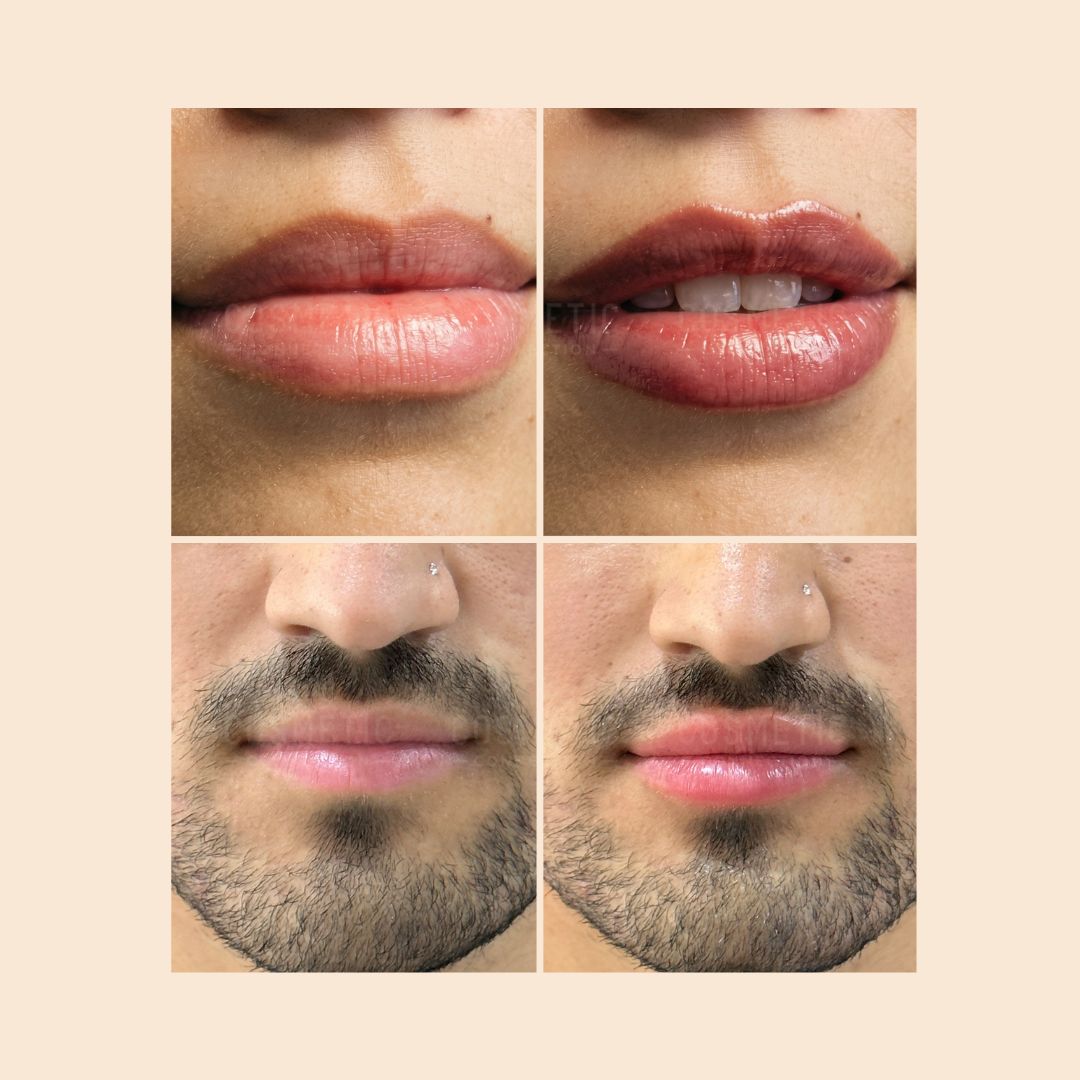
Before and after lip dissolving.
What to expect after dissolution
| Timeframe | What to expect |
|---|---|
| Immediately after | Some redness, swelling, and tenderness at treatment sites; some volume reduction visible immediately |
| Hours 2–12 | Volume reduces progressively; lips may appear slightly deflated relative to baseline as the enzyme also acts on surrounding natural tissue |
| 24–48 hours | Most dissolution complete; lips approaching or at their natural baseline |
| 3–5 days | Any temporary effect on natural tissue resolves; lips at true natural baseline |
| 2–4 weeks | Appropriate window for reassessment and new treatment planning |
Re-treatment after dissolution
Most patients can receive new treatment 2 to 4 weeks after dissolution, once the tissue has fully settled and the natural baseline anatomy is clear. Attempting re-treatment too soon, before the dissolving enzyme has fully cleared and the tissue has normalised, risks interaction between residual dissolver and the new product.
Re-treatment after dissolution is an opportunity to approach the anatomy correctly from the outset. A thorough consultation, conservative volume, correct technique, and a 2-week review plan all contribute to a better outcome after dissolution than was achieved in the original treatment.
If you’re interested in improving the appearance of your lips and want to understand your options, request a consultation with our clinical team. We’ll assess your lips using our 3 pillar framework, and provide fair, honest guidance.
Get started
Frequently asked questions
Does dissolution hurt?
Most patients find it manageable with the appropriate use of numving. The procedure is typically quicker than the original lip volume treatment.
Will my lips look worse than before I started after dissolution?
There is typically a brief period in the first 24 to 48 hours after dissolution where the lips may appear slightly deflated or flat relative to the true natural baseline. This occurs because the reversal has a temporary effect on surrounding natural tissue.
Keep in mind that if you’ve had treatment for a long time, dissolving it will reveal your lips’ true natural baseline, which may have changed due to the normal aging process since you started treatments.
How much does dissolution cost?
Dissolution pricing in Australia typically ranges from $700 to $1000 for a single session. Clinics that treat their own patients’ complications typically absorb or discount this cost as part of their complication management process. When dissolving product from a different provider, the full fee usually applies.
Can PDO threads or Rejuran be dissolved?
Not in the same way as traditional cosmetic treatments. PDO threads dissolve naturally over 6 to 12 months and cannot be chemically dissolved. Individual threads that extrude to the surface can be physically removed at the clinic. Rejuran effects diminish naturally over time and cannot be reversed with a dissolution agent.