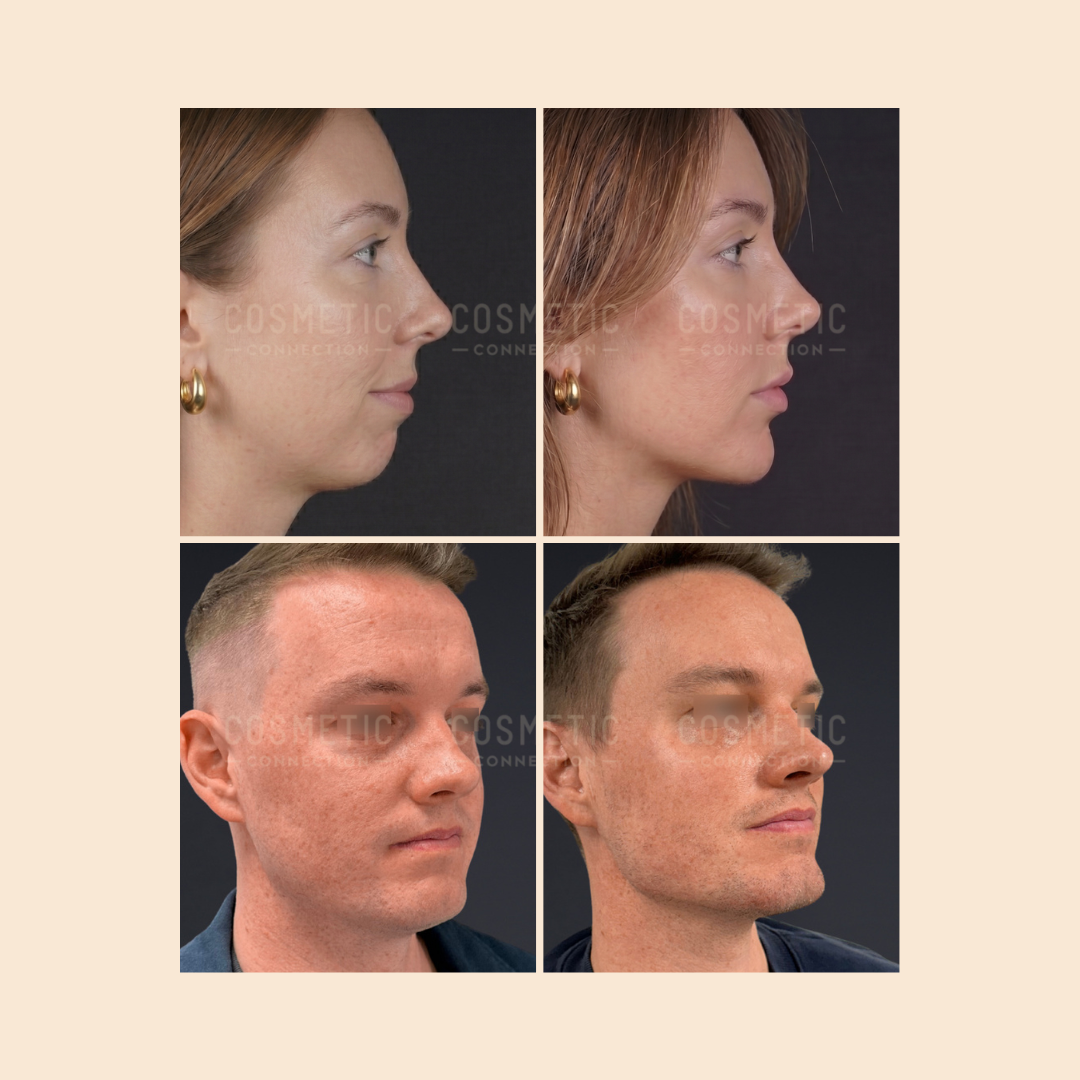
Concerns about jawline contouring going wrong are legitimate — and worth understanding clearly before you proceed. This guide covers what adverse outcomes actually look like, how common they are, and what they reveal about the provider choices that lead to them. The goal is not to alarm, but to help you make a well-informed decision about where and with whom you get treated.
Quick answer: The most common adverse outcomes from jawline contouring are bruising, swelling, and temporary asymmetry — all self-resolving within one to two weeks. Serious complications are rare and most often linked to insufficient clinical experience or inadequate pre-treatment assessment. Choosing a doctor-led clinic with a suitability-first approach significantly reduces the likelihood of a poor outcome.
The difference between side effects and complications
Not every unwanted outcome is a complication. It helps to understand the distinction.
Expected side effects are predictable, temporary, and part of normal recovery. Bruising, mild swelling, and tenderness for one to three days after jawline contouring are expected and resolve on their own. They are not a sign that something has gone wrong.
Complications are outcomes outside the expected recovery — things that require clinical assessment or intervention. In jawline contouring, these can include prolonged or asymmetric swelling, uneven results once settled, nodules or lumps under the skin, or — in rare and serious cases — vascular events that require prompt management.
Understanding this distinction matters because most of the concern people have about “jawline contouring gone wrong” is actually concern about unexpected side effects rather than true complications. True complications exist but are substantially less common than social media suggests.
The most common adverse outcomes
Bruising and swelling
These are the most common outcomes and are expected in the majority of patients to some degree. Swelling along the jawline typically peaks at 24–48 hours and resolves within one to two weeks. Bruising follows a similar timeline. Neither indicates a problem — they are a normal tissue response to treatment.
Temporary asymmetry
Uneven swelling is extremely common and frequently causes asymmetry that looks alarming in the first week. In almost all cases, this resolves as swelling settles. The two-week mark is the right time to assess the result — not the first few days.
Lumps or firmness
Palpable firmness along the jawline in the first few weeks is normal and reflects the product settling into the tissue. True lumps that persist beyond four to six weeks are less common and should be reviewed by the treating practitioner.
Unsatisfying result
An outcome that does not match the patient’s expectation is probably the most common genuine adverse experience — and the one most preventable through a thorough pre-treatment consultation. Unrealistic expectations, inadequate assessment of the starting anatomy, or a mismatch between what was planned and what the patient actually wanted all contribute. This is a clinical process failure as much as a technical one.
Serious complications: rare but real
The most serious potential complication in any facial cosmetic treatment is a vascular event — where product inadvertently enters or compresses a blood vessel. In the jawline, the facial artery and its branches are in proximity to treatment zones, and this risk is one of the reasons provider experience and clinical training matter significantly here.
Vascular events are rare in experienced hands. When they occur, prompt recognition and management — using appropriate reversal agents — is critical. A clinic that has the materials on hand, staff trained to recognise the signs, and a clear escalation protocol is meaningfully better positioned to manage this risk than one that does not.
This is one of the strongest arguments for choosing a doctor-led clinic for lower face treatment. The ability to recognise a vascular event early and act decisively is part of the clinical skill set that separates a doctor-led provider from a lower-oversight setting.
Get started
What “jawline contouring gone wrong” images online usually show
Many of the alarming images circulating online under this search are not examples of poor clinical outcomes — they are examples of immediate post-treatment swelling photographed at one to two days, or over-treatment performed at low-cost, high-volume settings where clinical assessment was inadequate.
This matters because it skews perception of the risk profile. A temporary bruise photographed at 48 hours looks very different to the same area at two weeks. And a result from a provider who treated without proper assessment is not representative of outcomes from a clinic that assesses suitability thoroughly before proceeding.
Context is everything when evaluating this kind of content. The question to ask is not “does this exist?” — it does — but “under what circumstances does it happen, and are those circumstances present at the clinic I am considering?”
Why provider choice is the single most important risk factor
The common thread in most genuine jawline contouring complications is not the product used — it is the provider who used it. Specifically: insufficient anatomical knowledge, inadequate pre-treatment assessment, volume placed without regard to the individual anatomy, and no protocol for managing the unexpected.
At Cosmetic Connection, all jawline contouring is doctor-led, assessed for suitability before any treatment is planned, and delivered with complication management capability on hand. Our guide to choosing a jawline contouring provider covers the specific criteria that separate a trustworthy clinic from one that is not.
What to do if you are unhappy with your jawline contouring result
If you have had jawline contouring and are unhappy with the outcome, the first step depends on the timeline.
In the first two weeks: wait. Swelling and asymmetry that appears alarming in the first few days almost always resolves. Assess the result at two weeks before taking any action.
After two weeks: contact the treating clinic for a review appointment. Most reputable providers include a follow-up review as part of their standard process. If the clinic is unresponsive or unhelpful, seek an independent clinical review.
If the result is genuinely unsatisfactory after the settling period: the treatment can be reversed. Non-surgical jawline contouring is not permanent — this is one of its significant advantages over surgical alternatives.
Get started
Frequently asked questions
How common is it for jawline contouring to go wrong?
True complications from jawline contouring are rare in experienced clinical settings. The most common adverse experiences — bruising, swelling, temporary asymmetry — are expected outcomes, not complications. Serious complications are rare, particularly in doctor-led settings with appropriate clinical protocols.
Can jawline contouring be fixed if it goes wrong?
In most cases, yes. Non-surgical jawline contouring is reversible — the treatment can be dissolved if the outcome is genuinely unsatisfactory after the settling period. Temporary side effects resolve on their own. Serious complications require prompt clinical management, which is why provider choice matters.
What are the signs that something has actually gone wrong?
Signs that warrant prompt clinical contact — rather than watchful waiting — include sudden severe pain in the treated area, skin blanching or colour changes, progressive rather than improving swelling after 48 hours, or any visual symptoms. These are not common, but they are the signs that require immediate attention rather than waiting for a scheduled review.
Is jawline contouring safer at a doctor-led clinic?
We believe so, particularly in the lower face. The jawline sits adjacent to vascular structures where the capacity to recognise and manage an adverse event promptly makes a meaningful difference. A doctor-led clinic with specific lower face experience and complication management protocols on hand operates to a higher clinical standard than one without these features.