Choosing the right provider for jawline contouring is one of the most important decisions in the process — more important than the specific product used or the price. This guide covers the criteria that actually matter, why they matter specifically in the lower face, and what separates a provider worth trusting from one that is not.
Quick answer: Look for a doctor-led clinic with demonstrated experience in lower face anatomy, a suitability-first consultation process, transparent pricing, and a clear protocol for managing complications. The jawline is a complex anatomical area — the provider’s clinical credentials and experience matter more here than they do in many other treatment areas.
Why the provider matters more for jawline treatment than many other areas
The jawline is not a straightforward treatment area. The lower face contains important vascular structures — including the facial artery and its branches — that sit close to the typical treatment zones. Misplaced treatment can cause complications that range from bruising to, in rare cases, more serious events requiring prompt clinical management.
Beyond safety, the jawline is also an area where anatomical nuance determines the quality of the result. The angle of the jaw, the ramus, the pre-jowl area, and the chin each respond differently to treatment. A provider who understands how these zones interact — and how they relate to the rest of the face — will produce a meaningfully better result than one applying a generic protocol.
This is not meant to alarm. In the hands of an experienced, doctor-led clinical team, jawline contouring is a safe and well-established procedure. The point is simply that the provider’s qualifications and experience matter, and they are worth investigating before you book.
What to look for: the essential criteria
Doctor-led, not just doctor-overseen
There is a meaningful difference between a doctor who performs the treatment and a doctor who is remotely supervising a nurse who performs it. In lower face treatment specifically, where anatomical complexity is higher and the consequences of misplacement are greater, we believe doctor-led treatment is the appropriate standard.
A suitability-first consultation process
A provider who is willing to treat you without a proper assessment is not a provider who has your best interests at the centre of their practice. A genuine suitability assessment involves looking at your anatomy, understanding your concern, identifying what is driving it, and honestly advising whether treatment is appropriate — including saying no when it is not.
At Cosmetic Connection, no treatment is planned until a full clinical assessment has been completed. In some cases that assessment leads us to recommend a different approach to the one the patient came in for. That is a feature, not a limitation.
Transparent pricing confirmed before treatment
Per-unit or per-millilitre pricing creates a structural incentive to use more product than is clinically necessary. Flat-fee pricing — where the cost is confirmed at consultation and does not change on the day — removes that incentive and means you know exactly what you are committing to. Our flat-fee pricing model is built on this principle.
Demonstrated lower face experience
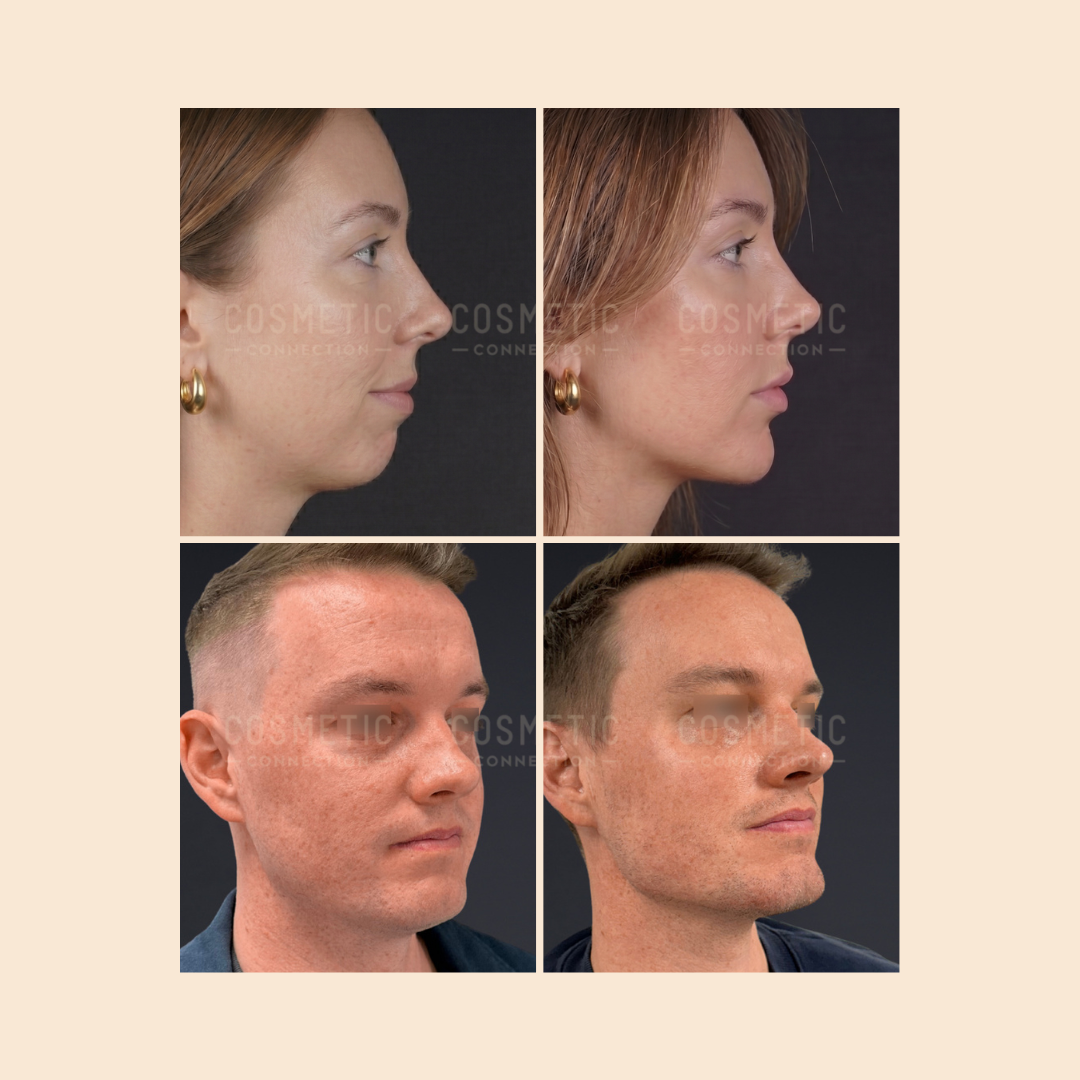
Ask to see before and after results specific to jawline treatment. Look for consistency across different face types and concerns, not just the best-case examples. A clinic that publishes a range of realistic outcomes — including cases that are strong but not dramatic — is one that is not selecting only its most impressive results.
A clear complication management protocol
Ask what the clinic’s protocol is if something goes wrong. A provider who can answer this clearly and specifically — who has the materials needed for complication management on hand, who has a direct line for after-hours queries, and who offers follow-up appointments — is one operating to a higher standard of care than one who cannot answer the question.
Get started
Red flags to watch for
| Red flag | Why it matters |
|---|---|
| No consultation required before treatment | Suitability has not been assessed — treatment is not personalised to your anatomy |
| Nurse-only model with no on-site doctor | Reduced oversight in a complex anatomical area |
| Limited before and after images | Lack of experience |
| No clarity on complication management | Indicates the clinic has not prepared for unexpected outcomes |
Questions to ask at your consultation
A good consultation is a two-way process. Here are questions worth asking any provider you are considering:
Who performs the treatment — a doctor or a nurse? What is the doctor’s specific experience with lower face treatments? What happens if I am not happy with the result? What is your protocol if I have a complication? Is there a follow-up appointment included? How is the fee structured — flat-fee or per-unit?
A provider who answers these questions clearly and without defensiveness is one worth considering. A provider who deflects, minimises, or cannot answer them is not.
Where to find a provider in Australia
For those in Sydney and Melbourne, Cosmetic Connection offers doctor-led jawline contouring consultations at our clinics, with flat-fee pricing confirmed at consultation and a suitability-first approach to every patient.
For people in other cities or regions, the same criteria apply. Look for AHPRA registration, doctor-led treatment, a verifiable track record, and pricing transparency. Professional bodies such as the Australasian College of Cosmetic Surgery and Medicine (ACCSM) provide searchable directories of qualified practitioners.
Get started
Frequently asked questions
Does it matter if my provider is a doctor or a nurse for jawline contouring?
We believe it does, particularly in the lower face. The jawline sits adjacent to complex vascular anatomy, and the ability to recognise and manage complications promptly is higher in a doctor who performs these treatments regularly. Nurses can be highly skilled practitioners, but the regulatory threshold for doctors — and the clinical training underpinning it — provides an additional layer of oversight that matters in complex anatomical areas.
How do I know if a clinic’s before and after photos are genuine?
Look for consistency across a range of cases — not just the most dramatic. Standardised lighting, consistent head position, and results that show natural variation (including cases that are good but not extraordinary) are indicators of genuine documentation. Ask the clinic directly whether the images are of their own patients taken in-clinic.
Should I choose the cheapest option for jawline contouring?
Not on price alone. Lower price often reflects lower clinical oversight, less experienced practitioners, or higher patient volume with less individual assessment time. The cost of correction if something goes wrong can exceed the initial saving. Price should be one factor among several — not the primary one.
What qualifications should my jawline contouring provider have?
At minimum, look for a registered medical practitioner (AHPRA registration) with specific training and documented experience in facial cosmetic treatment. Fellowship of the Australasian College of Cosmetic Surgery and Medicine (FACCSM) is a recognised credential in this space. Ask directly about lower face-specific experience rather than general cosmetic training.