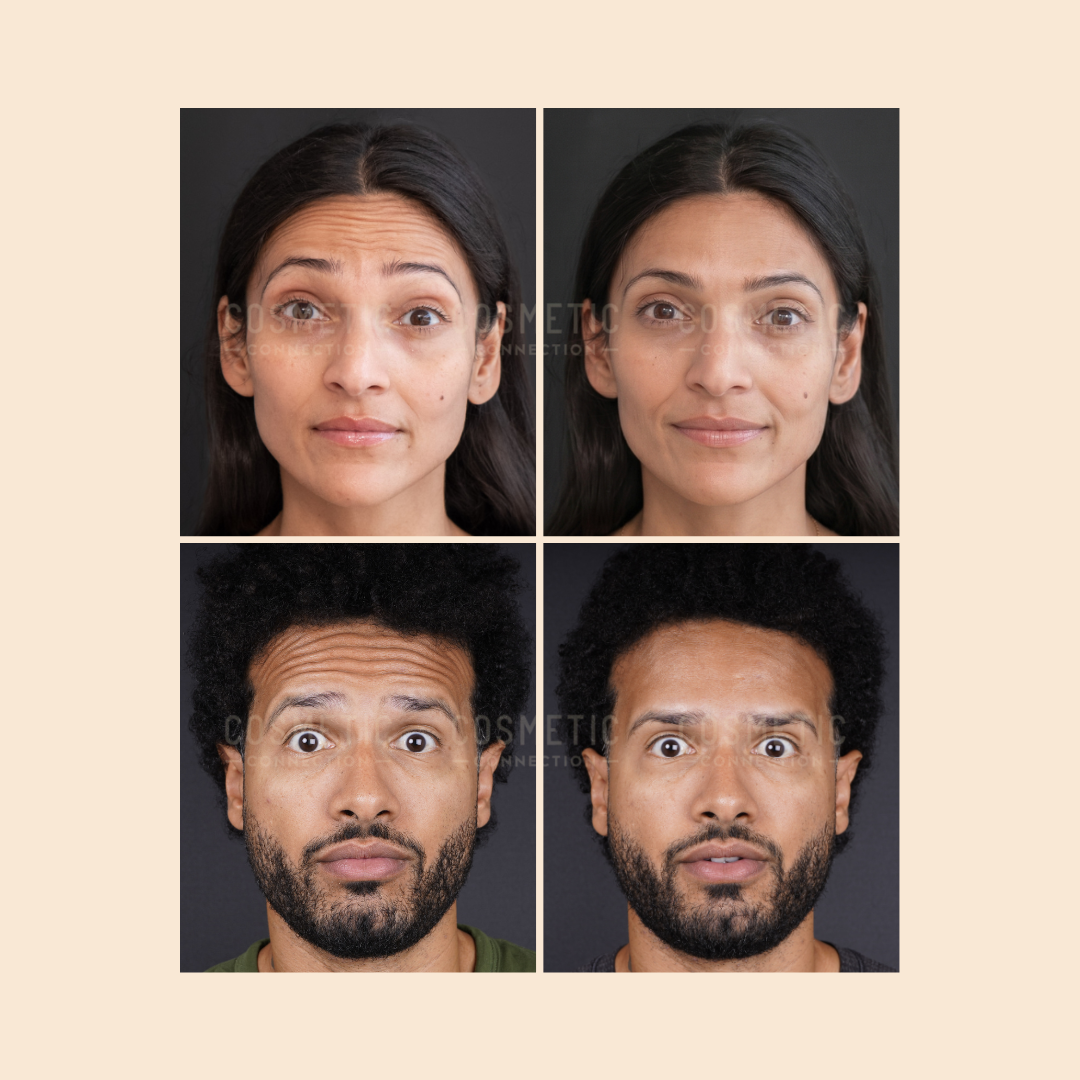
One of the most common questions we hear is: “Am I too young to be thinking about this?” The answer depends less on age than on what your lines are doing. Whether your forehead wrinkles are best addressed through prevention, active treatment, or a combination of both comes down to where you currently sit in the progression from dynamic to static lines — and what you want to achieve. This post explains the difference, helps you identify where you are, and outlines what each stage typically calls for.
Quick answer: Preventing forehead wrinkles from forming is possible — primarily through consistent sun protection and starting muscle relaxant treatments while lines are still dynamic. Treating forehead wrinkles once they have become static is still effective but typically requires more than a single approach. The earlier you start, the simpler the treatment picture tends to be.
Understanding the stages — where your wrinkles sit now
Forehead wrinkles follow a predictable progression in most people, though the pace varies significantly based on genetics, sun exposure history, lifestyle, and muscle strength.
In the early stage, lines only appear when you raise your eyebrows and disappear completely when your face relaxes. These are dynamic wrinkles — a normal expression of muscle movement, not a sign that anything has gone wrong. At this stage, the skin still has enough elasticity and collagen to fully recover between each contraction.
In the middle stage, lines begin to linger after you relax your face — they do not disappear immediately the way they used to. This reflects the skin beginning to hold the crease rather than fully recovering. This is the transitional phase between dynamic and static wrinkles, and it typically arrives sometime in the 30s for most people, though it can arrive earlier with significant UV exposure or in people with strong frontalis activity.
In the established stage, lines are visible at rest even when the face is completely relaxed. These are static wrinkles — they represent the accumulated effect of years of muscle use on skin that has progressively lost structural support. They are harder to resolve completely than dynamic lines, and often require more than muscle relaxant treatment alone.
What prevention looks like — and who it is for
Prevention is most relevant for people who are in the early stage — where lines only appear with expression — or who have not yet developed noticeable lines but have a family history of prominent forehead wrinkles or a lifestyle that involves significant sun exposure.
The strongest evidence-backed preventative measure is consistent daily sun protection with broad-spectrum SPF. UV radiation drives collagen breakdown and accelerates the transition from dynamic to static wrinkles. Cancer Council Australia identifies Australia as having some of the highest UV radiation levels in the world — yet ABS data from the 2023–24 summer found only 38.1% of Australians used sunscreen on most days. The cumulative skin damage from decades of inadequate sun protection is one of the most significant contributors to early and accelerated wrinkle formation in the Australian population.
Starting muscle relaxant treatments while lines are still dynamic is the most effective cosmetic preventative strategy available. By keeping the frontalis muscle moderately relaxed between treatments, you reduce the number and depth of creases the overlying skin experiences. Over time, this allows the skin to maintain better structural integrity than it would have with unrestricted daily muscle use. Many people who begin treatment in their late 20s or early 30s find that their lines remain largely dynamic — and therefore more easily managed — for considerably longer than they would have otherwise.
In our clinical experience, the people who require the least intensive treatment over the long term are those who began early, maintained consistently, and supported their skin with appropriate sun protection. Prevention is not about starting treatment prematurely — it is about starting at the right time, which for many people is before lines become static.
What treatment looks like — and who it is for
Active treatment is for people whose lines have already progressed beyond the purely dynamic stage — where lines linger after expression or are visible at rest. The approach depends on how far along the progression has moved.
For transitional lines — where lines linger after expression but are not yet fully static — muscle relaxant treatments are typically highly effective. Reducing frontalis activity allows the skin time to recover between contractions, and many people in this stage see lines soften progressively with consistent treatment over several sessions.
For established static lines, muscle relaxant treatments remain the first-line approach, but full resolution of lines at rest is less predictable. The treatment stops the lines from deepening further and typically produces visible improvement, but a residual crease at rest is a realistic expectation in many cases. This is where a combination approach — muscle relaxant treatment alongside skin quality or collagen stimulating treatment — may produce a more complete result. Our approach is always to assess what is achievable in your specific situation and give you an honest picture of expected outcomes before proceeding.
For a full overview of treatment options — including what each approach involves and how they work — read our comprehensive forehead wrinkles treatment guide. For an understanding of how forehead wrinkles relate to frown lines and why both often need to be addressed together, see our forehead wrinkles vs frown lines comparison.
Get started
The case for starting earlier rather than later
There is a meaningful asymmetry in the effort required at different stages. Someone who starts muscle relaxant treatments while their forehead lines are still dynamic typically needs less treatment volume, sees more complete results, and requires less complex planning than someone who starts after lines have become deeply static. The skin is easier to maintain than it is to reverse.
This does not mean everyone should rush into treatment at the first sign of a line. Dynamic wrinkles in youth are entirely normal and not a clinical problem. The appropriate time to consider treatment depends on whether the lines are progressing, whether they bother you, and whether prevention versus treatment aligns better with your goals. These are the conversations we have in every consultation.
A useful rule of thumb: if you notice that lines are starting to linger after your face relaxes — not fully disappearing the way they used to — that is generally the right time to consider treatment if you want to prevent them from becoming static. If lines are already static, treatment is still worthwhile, but the goal shifts from prevention to management.
What to expect from a consultation
At our clinics, a consultation for forehead wrinkles begins with understanding your concerns and goals — not with a treatment recommendation. We assess where your lines are in the dynamic-to-static progression, evaluate your muscle strength and skin quality, discuss what treatment can realistically achieve in your situation, and give you an honest view of the options.
We never recommend treatment that is not clinically appropriate, and we never push for more treatment than is needed. Our approach is suitability-first — which means the consultation outcome might be a recommendation to proceed, a recommendation to wait, or a recommendation to start with sun protection and skincare and revisit in twelve months. All of those are valid outcomes.
You can start by completing our booking form and selecting the option to explore your suitability and get a treatment plan. From there, we will guide you through the rest.
Frequently asked questions
Is there a minimum age for forehead wrinkle treatment in Australia?
Cosmetic treatments in Australia are available to adults aged 18 and over. Age alone is not the determining factor for whether treatment is appropriate — what matters more is whether lines are present, how they are progressing, and what the person’s goals are. Some people in their early 20s have dynamic lines that would benefit from early preventative treatment; others in their 30s do not yet have lines that warrant treatment. A clinical assessment is the most accurate way to determine what is right for your situation.
Will starting treatment early mean I need it forever?
Muscle relaxant treatments are not permanent, and stopping treatment at any time is always an option. If treatment is discontinued, the muscle gradually returns to its normal level of activity and lines will continue to develop at the rate they would have without treatment. Starting early does not create a dependency — but it does mean that if you stop, the lines that would have developed had you not treated may appear over time. Many people choose to maintain treatment long-term because they prefer consistent results, not because stopping is unsafe.
Are there non-treatment approaches worth trying first?
Daily broad-spectrum SPF is the most evidence-supported non-treatment preventative measure for forehead wrinkles. A good skincare routine that supports skin hydration and barrier function may also help. Topical retinoids (available via a doctor or dermatologist) have evidence supporting their role in improving skin quality and reducing fine lines over time. These approaches are worth implementing regardless of whether you choose cosmetic treatment — they address the underlying skin quality factors that influence wrinkle progression.
How do I know if my lines are dynamic or static?
Raise your eyebrows fully, hold for a few seconds, then let your face fully relax. If lines are still visible after your face has been completely relaxed for 30 seconds, they are at least partially static. If they disappear completely, they are predominantly dynamic. Many people have a mix — lines that are dynamic in the upper forehead but partially static in the lower forehead where the muscle is more active.
Does sun damage affect how well treatment works?
Yes — significant sun damage and associated collagen loss can affect the completeness of results from muscle relaxant treatments, particularly for static lines. UV-damaged skin has reduced elasticity and structural support, which means it has less capacity to smooth after the underlying muscle is relaxed. This is one reason why sun protection is important both as a preventative measure and as a complement to active treatment.
Can lifestyle changes slow the progression of forehead wrinkles?
To a meaningful degree, yes. Consistent sun protection is the most impactful lifestyle factor. Not smoking, maintaining adequate hydration, managing chronic stress, and using appropriate skincare can all contribute to slower progression. However, no lifestyle measure completely prevents wrinkle formation — genetics and cumulative muscle use will always play a role. Lifestyle measures are best thought of as reducing the rate of progression rather than preventing it entirely.
References
- Bar O, Valiukevičienė S. (2025). Skin Aging and Type I Collagen: A Systematic Review of Interventions with Potential Collagen-Related Effects. Cosmetics, 12(4), 129. https://www.mdpi.com/2079-9284/12/4/129
- Cancer Council Australia. UV Radiation Prevention Policy. https://www.cancer.org.au/about-us/policy-and-advocacy/prevention/uv-radiation
- Australian Bureau of Statistics. (2024). Sun protection behaviours, Nov 2023 to Feb 2024. https://www.abs.gov.au/statistics/health/health-conditions-and-risks/sun-protection-behaviours/latest-release
- Kwon IJ, Lee W, Moon H-J, Lee SE. (2023). Dynamic Evaluation of Skin Displacement by the Frontalis Muscle Contraction Using Three-Dimensional Skin Displacement Vector Analysis. Yonsei Medical Journal, 64(7), 440–447. https://pmc.ncbi.nlm.nih.gov/articles/PMC10307676/