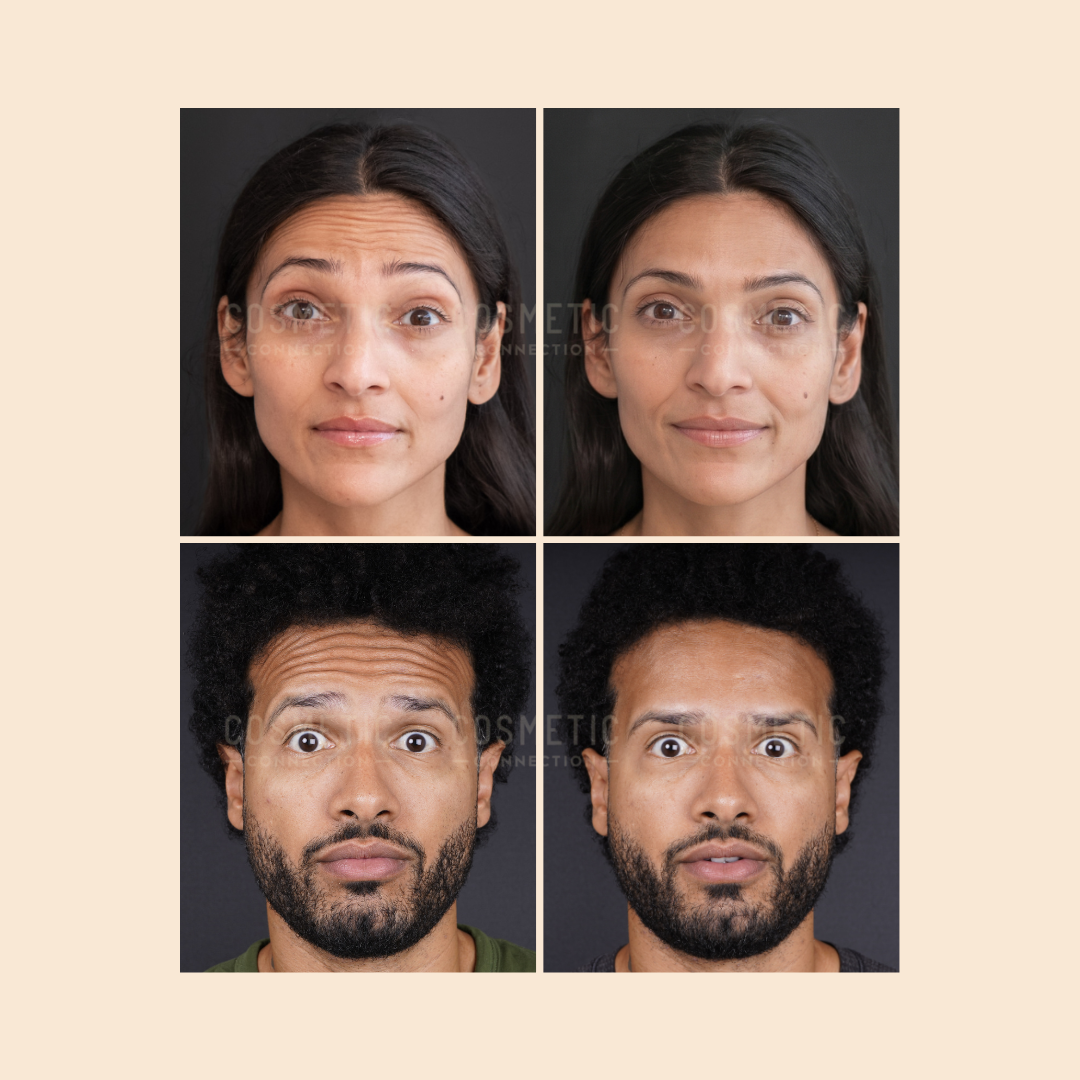
Forehead wrinkles are horizontal lines that develop across the upper face as a result of repeated muscle movement, progressive collagen loss, and cumulative sun damage. They are among the earliest visible signs of ageing for many people, and one of the most common concerns we see at Cosmetic Connection — in people as young as their mid-20s through to those well into their 60s. This guide covers everything you need to know: what causes forehead wrinkles, how they differ from frown lines, what treatments work and when to consider them, what results look like, and what treatment costs in Australia.
Quick answer: Forehead wrinkles are caused by repeated contraction of the frontalis muscle over time, combined with age-related collagen loss and UV-driven skin damage. They begin as dynamic lines that only appear with expression, then become static lines visible at rest. Non-surgical muscle relaxant treatments are the most established option, with results typically lasting three to four months. The right approach depends on whether your lines are dynamic, static, or a combination of both.
What causes forehead wrinkles?
Forehead wrinkles develop from two processes working together: repeated muscle movement and declining skin quality.
The frontalis muscle runs horizontally across the forehead and contracts every time you raise your eyebrows — during surprise, concentration, or when compensating for heavy upper eyelids. Each contraction creates a temporary crease in the overlying skin. When you are young and skin is elastic, those creases disappear the moment your face relaxes. Over time, the skin loses its ability to fully spring back, and those temporary lines become more permanent.
The skin quality component is driven primarily by collagen loss. A 2025 systematic review published in Cosmetics confirmed that as skin ages, collagen synthesis progressively declines, leading to dermal thinning, reduced elasticity, and wrinkle formation. This process is accelerated by UV radiation. According to Cancer Council Australia, Australia experiences some of the highest UV radiation levels in the world due to our proximity to the equator and high frequency of clear-sky days — meaning photoageing is a more significant driver of wrinkle formation here than in many other countries. Despite this, ABS data from the 2023–24 summer found that only 38.1% of Australians used sunscreen on most days, meaning the majority of the population continues to accumulate UV-related skin damage throughout their lives.
Other contributing factors include sleep position (side sleeping creates repeated pressure on the forehead), stress, dehydration, and smoking — all of which either accelerate collagen breakdown or reduce the skin’s ability to repair itself.
Dynamic vs static forehead wrinkles — why the distinction matters
Understanding whether your forehead wrinkles are dynamic or static is the most important step in treatment planning. The two types look similar but behave differently, and they respond to different treatments.
Dynamic wrinkles only appear when the frontalis muscle contracts — when you raise your eyebrows or animate your face. When your face is completely at rest, the skin is smooth. Dynamic wrinkles respond very well to muscle relaxant treatments, which reduce the strength of the muscle contraction and allow the skin above it to smooth out.
Static wrinkles are visible even when your face is fully relaxed. They represent lines that have become etched into the skin over time as collagen loss has reduced the skin’s ability to hold a smooth resting position. Static wrinkles are harder to resolve completely and typically require a combination approach — muscle relaxant treatment to prevent further deepening, combined with treatments that address skin quality and volume.
Most people start with dynamic wrinkles in their 20s or early 30s that gradually transition to static lines. The earlier treatment begins, the more effectively muscle relaxant treatments can prevent that transition from occurring. Static lines often develop as the brows become heavy. This must be considered when discussing not just treating forehead lines, but also non-surgical brow lifting.
| Feature | Dynamic wrinkles | Static wrinkles |
|---|---|---|
| Visible at rest? | No — only with expression | Yes — even when relaxed |
| Primary cause | Frontalis muscle contraction | Collagen loss + cumulative muscle use |
| Typical onset | Mid-20s onwards | Mid-30s onwards |
| Best treatment | Muscle relaxant treatment | Combination approach |
| Preventable? | Yes, with early intervention | Partially, with early intervention |
How forehead wrinkles differ from frown lines
Forehead wrinkles and frown lines are both upper face concerns, but they involve different muscles and create different patterns. Understanding the distinction matters because treatment planning often needs to address both areas together.
Forehead wrinkles are horizontal lines created by the frontalis muscle, which runs across the full width of the forehead and lifts the eyebrows. Frown lines — also called glabellar lines or the “11s” — are the vertical or diagonal lines that form between the eyebrows, created by the corrugator supercilii and procerus muscles, which draw the brows inward and downward.
Research published in the Yonsei Medical Journal (2023) established an important anatomical relationship between these two muscle groups: in 83.3% of study participants, contraction of the frontalis muscle also produced upward displacement of the glabellar skin. This means the two muscle groups are functionally linked — treating the forehead without considering the glabella can produce unbalanced results, and vice versa. In our clinical experience, most people presenting with forehead wrinkles also have some degree of frown line activity, and the two areas are commonly assessed and planned together.
For a full comparison of how forehead wrinkles and frown lines differ — and how that affects treatment — see our guide to forehead wrinkles vs frown lines. For everything specific to frown lines, read our frown lines treatment guide.
Treatment options for forehead wrinkles
Several non-surgical treatment approaches are available for forehead wrinkles in Australia. The most appropriate option depends on whether your lines are dynamic, static, or a combination of both, as well as your skin quality, age, and goals.
Muscle relaxant treatments
Muscle relaxant treatments are the most established and most commonly used approach for forehead wrinkles. They work by temporarily reducing the activity of the frontalis muscle, which prevents it from creating the repeated creasing that deepens lines over time. When the muscle is relaxed, the overlying skin smooths out.
A 2022 systematic review and meta-analysis published in the Aesthetic Surgery Journal analysed 4,268 treatment sessions and found the overall complication rate for upper face cosmetic muscle relaxant treatments to be 16%, with the vast majority of reported events being mild and transient — most commonly temporary headache or minor localised skin responses at the treatment site. No severe treatment-related complications were identified across the included studies.
Results from muscle relaxant treatments for forehead wrinkles typically become visible within three to seven days, with full effect at approximately two weeks. The duration of effect is typically three to four months, after which the muscle gradually regains its activity and lines may return. With consistent maintenance treatments, many people find the underlying lines soften progressively over time.
One clinical nuance worth understanding: the frontalis is also the primary muscle that lifts the brows. Treating it requires careful assessment of how much of the muscle can be relaxed without allowing the brows to drop. This is why the forehead is often one of the more technically involved areas to treat well — dose and placement need to be tailored to the individual’s anatomy.
Skin quality treatments
For static wrinkles — lines that remain visible at rest — muscle relaxant treatments alone are often not enough. Treatments that address skin quality and dermal structure may be considered alongside or between muscle relaxant appointments. These include collagen stimulating treatments and skin hydration treatments, which work to improve the skin’s structural integrity rather than address the muscle activity that created the lines.
In our approach, we typically start with an assessment of how much of the line is driven by muscle movement versus how much is a structural skin quality issue. This shapes which combination of treatments, if any, makes sense for each individual.
Combination approaches
For people with established static lines or significant skin quality concerns alongside dynamic wrinkles, a combination approach may produce the best outcomes. This might involve muscle relaxant treatment to address the dynamic component, combined with a collagen stimulating or skin remodelling treatment to address the structural component. Our approach is always to recommend the minimum effective treatment, not the maximum available.
Get started
What results look like — and what to expect
For dynamic forehead wrinkles treated with muscle relaxant treatments, most people see a significant reduction in line depth when they animate their face, and a noticeable reduction in resting lines where those had begun to form. The forehead typically looks smoother and less creased, and many people report looking more rested rather than looking like they have had something done.
Results are not the same for everyone. People with deep static lines that have been present for many years will see less complete resolution than people who begin treatment when lines are still primarily dynamic. Skin quality, genetics, sun damage history, and how regularly someone maintains their treatments all affect outcomes.
In our clinical experience, the people who achieve the most consistent results are those who start treatment when lines are still predominantly dynamic, maintain a regular treatment schedule, and address underlying skin quality factors in parallel. Those who come to us with deeply established static lines can still see meaningful improvement, but it is important to have realistic expectations about what is achievable.
A realistic timeline for most people: visible improvement within one to two weeks of treatment, full effect by two to four weeks, and results maintained for three to four months. Regular maintenance is typically recommended every three to four months to maintain results and, over time, to prevent lines from deepening further between appointments.
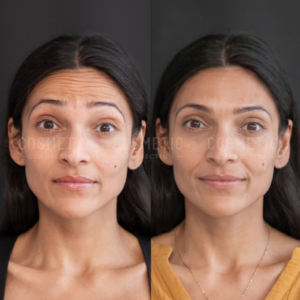
Before and after treatment for forehead wrinkles.
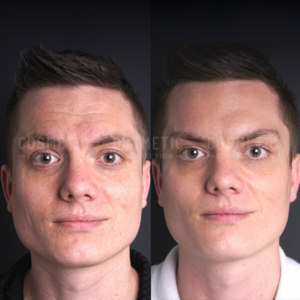
Before and after treatment for forehead wrinkles.
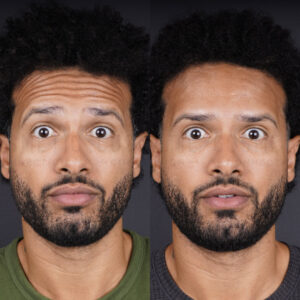
Before and after treatment for forehead wrinkles.
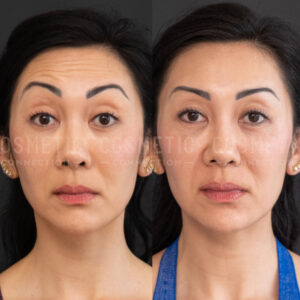
Before and after treatment for forehead wrinkles.
How much does forehead wrinkle treatment cost in Australia?
The cost of forehead wrinkle treatment in Australia typically ranges from $500 to $2,000 per appointment. Where you land in that range depends on several factors: the seniority and qualifications of the treating clinician, the clinic’s location and level of expertise, the specific treatment modality used, and the extent of the area being treated.
Muscle relaxant treatments for the forehead alone tend to sit at the lower end of this range. Combined upper face treatments — addressing the forehead, frown lines, and lateral eye area together — typically sit higher. Combination treatments that include skin quality work alongside muscle relaxant treatment will generally cost more than a single-modality appointment.
It is worth asking any clinic you consider whether they charge per area, per unit, or as a flat fee. Flat-fee pricing provides clarity about what you will pay before you arrive. At Cosmetic Connection, we use a flat-fee model, so there are no surprises about cost at the appointment. You can find full pricing details on our flat-fee services page.
Cosmetic treatments are not covered by Medicare or private health insurance in Australia. Some clinics offer payment plan options — it is worth asking about this if upfront cost is a consideration.
Suitability — who is and isn’t a good candidate
Muscle relaxant treatments for forehead wrinkles are suitable for most healthy adults. The ideal candidate is someone with dynamic wrinkles — lines that appear primarily with expression — who wants to prevent those lines from deepening and becoming static over time.
People who are pregnant or breastfeeding are not suitable candidates. Those with certain neuromuscular conditions, or who are taking medications that interact with the treatment, may also not be suitable. A thorough suitability assessment before any treatment is essential — this is something we prioritise at every consultation at Cosmetic Connection.
Some people are not ideal candidates for the reasons above, and others may have expectations that do not align with what treatment can realistically achieve. Our approach is to give you an honest assessment of what is achievable in your specific situation before any treatment takes place.
One consideration specific to the forehead: people who rely heavily on their frontalis muscle to keep their brow position where they want it — often those with heavier upper eyelids or a naturally lower brow position — need careful assessment before treating this area. Over-treating the frontalis in these individuals can result in brow heaviness. This is a nuance that requires clinical judgement and experience, not a one-size-fits-all approach.
Prevention — can forehead wrinkles be avoided?
Some degree of forehead wrinkling is a normal part of ageing. However, there is a meaningful difference between someone whose lines are appropriate for their age and someone whose lines have deepened significantly faster than they otherwise would have.
The most evidence-backed preventative measures include consistent daily sun protection with broad-spectrum SPF, which helps limit UV-driven collagen breakdown; not smoking; maintaining adequate hydration; and beginning muscle relaxant treatments before lines become static. Beginning treatment when lines are still dynamic is one of the most effective ways to prevent them from becoming permanent.
For a detailed discussion of prevention versus treatment, when to start, and what preventative treatment looks like in practice, read our guide to forehead wrinkles: prevention vs treatment.
Get started
Frequently asked questions
At what age do forehead wrinkles typically start?
Dynamic forehead wrinkles — lines that appear when you raise your eyebrows — can become noticeable as early as the mid-20s, particularly in people who are very expressive or who have significant sun exposure history. Static lines that are visible at rest typically develop from the mid-30s onwards, though this varies considerably between individuals.
Will treating forehead wrinkles make me look unnatural?
When performed well and at appropriate doses, muscle relaxant treatments for the forehead should leave you looking more rested and refreshed, not frozen or expressionless. The most important variable is the skill and experience of the person performing the treatment. A good clinician will assess your individual anatomy and use the minimum dose needed to achieve the result you are looking for, rather than maximising relaxation.
How long do results last?
Results from muscle relaxant treatments for forehead wrinkles typically last three to four months. This varies between individuals based on muscle strength, metabolism, and how active the muscle is in daily life. With regular maintenance, many people find their results extend slightly over time as the muscle adapts.
Can forehead wrinkles be treated without muscle relaxant treatments?
Dynamic wrinkles — lines driven by muscle movement — respond most effectively to muscle relaxant treatments. Skincare products, facial exercises, and other non-injectable approaches may offer modest improvements in overall skin quality but are unlikely to significantly reduce established forehead lines. For static wrinkles, some skin quality treatments may provide improvement, but results are typically more limited than with muscle relaxant treatment.
Is there downtime after forehead wrinkle treatment?
Muscle relaxant treatments for the forehead involve minimal downtime. Most people return to normal activities immediately after the appointment. Minor redness or a small mark at the treatment site can occur but typically resolves within a few hours. We recommend avoiding vigorous exercise, heat exposure, and lying flat for several hours after treatment.
Do forehead wrinkle treatments hurt?
Most people describe the sensation as a mild pinch. The forehead is generally well tolerated. Numbing cream is not typically required, though it can be applied if preferred. Any discomfort resolves immediately after treatment.
References
- Bar O, Valiukevičienė S. (2025). Skin Aging and Type I Collagen: A Systematic Review of Interventions with Potential Collagen-Related Effects. Cosmetics, 12(4), 129. https://www.mdpi.com/2079-9284/12/4/129
- Cancer Council Australia. UV Radiation Prevention Policy. https://www.cancer.org.au/about-us/policy-and-advocacy/prevention/uv-radiation
- Australian Bureau of Statistics. (2024). Sun protection behaviours, Nov 2023 to Feb 2024. https://www.abs.gov.au/statistics/health/health-conditions-and-risks/sun-protection-behaviours/latest-release
- Kwon IJ, Lee W, Moon H-J, Lee SE. (2023). Dynamic Evaluation of Skin Displacement by the Frontalis Muscle Contraction Using Three-Dimensional Skin Displacement Vector Analysis. Yonsei Medical Journal, 64(7), 440–447. https://pmc.ncbi.nlm.nih.gov/articles/PMC10307676/
- Zargaran D, Zoller F, Zargaran A, et al. (2022). Complications of Cosmetic Botulinum Toxin A Injections to the Upper Face: A Systematic Review and Meta-Analysis. Aesthetic Surgery Journal, 42(5), NP327–NP336. https://academic.oup.com/asj/article/42/5/NP327/6530404