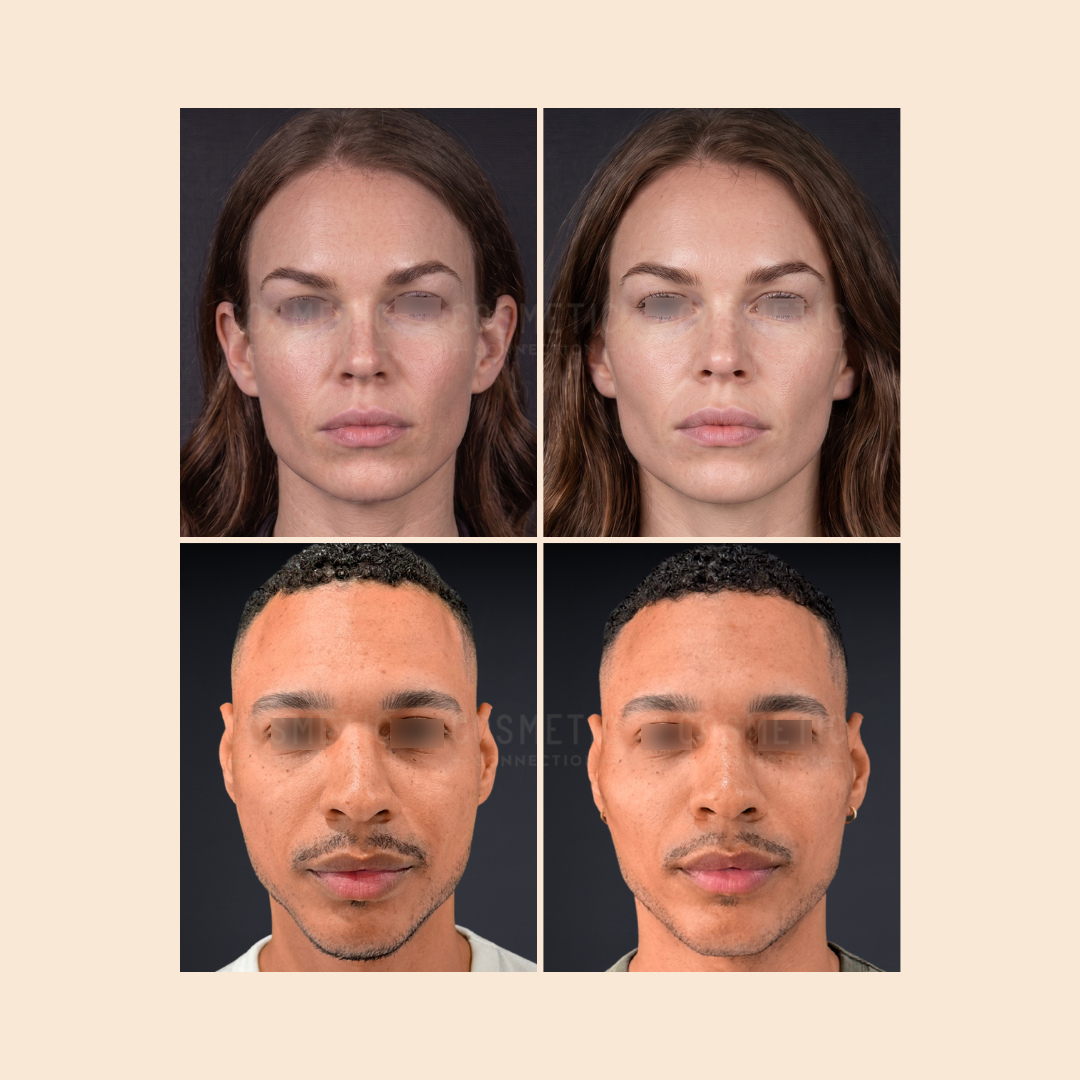
Facial balancing is suitable for a wide range of people — but not everyone, and not for every concern. Understanding whether you’re a good candidate before you book a consultation saves time and helps you arrive with realistic expectations about what non-surgical treatment can and cannot achieve for your face.
Quick answer: You are likely a good candidate for facial balancing if you have concerns about facial proportion and symmetry that have a meaningful impact on how you feel about your appearance, and if your expectations are grounded in improvement rather than perfection. People at any adult age can be candidates. Some concerns are better suited to surgical treatment, and a proper clinical assessment will identify which category yours falls into.
Who tends to benefit most from facial balancing
In our experience at Cosmetic Connection, the people who get the most meaningful results from facial balancing tend to share a few common characteristics — not in terms of age or appearance, but in terms of what they are trying to achieve and how they are approaching it.
| Profile | Why facial balancing tends to help |
|---|---|
| You have a specific proportion concern that you’ve been aware of for years | Structural imbalances — such as a weak chin, prominent nose or underdeveloped mid-face — that have always been present often respond well to non-surgical treatment, sometimes dramatically so |
| You’ve noticed changes in your face over the past few years that you want to address before they become more significant | Early intervention — particularly for mid-face volume changes — often requires less treatment to achieve a meaningful result than waiting until changes are more advanced |
| You’re bothered by noticeable asymmetry between sides of your face | Strategic treatment placement can meaningfully reduce visible asymmetry without making either side look unnatural |
| You want natural-looking improvement — not a dramatic change | Non-surgical facial balancing produces subtle, coordinated results. It is not suited to people whose goal is transformation |
Concerns that respond well to facial balancing
The following concerns are well-suited to non-surgical facial balancing treatment:
- A chin that is underdeveloped, recessed, or appears short relative to the rest of the face
- Cheeks that are flat or have lost volume, creating a sunken or two-dimensional appearance
- A jaw that appears overly wide or square — particularly when driven by muscle size rather than bone structure
- A jaw that appears too narrow, creating a long-looking face
- Facial asymmetry between sides — differences in cheek projection, jawline contour, or chin position
- Lip proportion that seems off relative to the rest of the lower face
- A nose that appears more prominent than it is because surrounding structures are underdeveloped
The last point is worth expanding on. In our experience, a meaningful number of people who present with concerns about their nose also have a structural proportion issue elsewhere — most commonly an underdeveloped chin and small lips — that is making the nose appear more prominent than it objectively is. Treating the chin, rather than the nose, can resolve the concern more effectively. Our non-surgical rhinoplasty guide explores this relationship in detail.
Similarly, concerns about a heavy lower face or double chin are often connected to the broader question of facial proportion. Our guide to double chin treatment covers how lower face concerns intersect with overall facial balance.
When facial balancing is not the right solution
Non-surgical facial balancing is not suitable for every concern, and it is important to understand its limitations before pursuing treatment.
Situations where non-surgical treatment is unlikely to achieve a satisfying result include:
- Significant skeletal asymmetry — where the bones on one side of the face are substantially different in size or position to the other side. Non-surgical treatment can reduce the appearance of mild to moderate asymmetry; it cannot correct a significant structural skeletal difference
- Substantial skin laxity or sagging — loose skin that has separated from underlying structures is not adequately addressed by volume restoration alone and may require a surgical approach
- A very large or significantly deviated nose — non-surgical reshaping works well for specific nose concerns but has clear limits. Someone wanting to substantially reduce nose size or correct a significant deviation is better suited to surgical rhinoplasty
- Goals that require dramatic transformation rather than refinement — non-surgical treatments make subtle improvements. If the goal is dramatic change, surgical options may be more appropriate
At Cosmetic Connection, we will tell you directly if your concern falls outside what non-surgical treatment can reliably address. Our suitability-first approach is built around this principle. You can read more about how we approach treatment decisions on our our difference page.
How suitability is assessed at Cosmetic Connection
A suitability assessment at Cosmetic Connection is a structured clinical process, not a sales conversation. It involves:
- A detailed discussion of your concerns — what you’ve noticed, when it started, and what outcome you’re hoping for
- A multi-angle assessment of your facial anatomy — front, side, and three-quarter views across all three facial thirds
- An honest evaluation of whether your concern can be adequately addressed non-surgically and what a realistic result looks like
- A treatment recommendation if appropriate — or a clear explanation of why treatment is not recommended
Get started
Frequently asked questions about facial balancing suitability
Can men get facial balancing?
Yes. Facial balancing is equally appropriate for men. The treatment goals and aesthetic principles are different — masculine facial proportions favour stronger definition in the jaw and chin, greater facial width, and different relationships between the facial thirds — but the clinical approach and treatment types used are the same. The result should look like a more defined, proportionate version of your own face, not a feminised or altered one.
Is facial balancing suitable if I’ve had cosmetic treatment before?
In most cases, yes. We assess your current situation at consultation, including any previous treatment, and factor this into the recommendation. Where previous treatment needs to be dissolved before a new plan can be implemented effectively, we will say so directly.
I’m in my early 20s — is it too soon to consider facial balancing?
Not if you have a genuine structural concern. Natural proportion issues — such as a weak chin or flat midface — exist independently of ageing and can be addressed at any adult age. We do assess younger patients carefully to ensure expectations are appropriate and treatment is genuinely warranted rather than driven by comparison to heavily filtered or edited images.
Do I need to have multiple concerns to be a candidate, or can one issue be addressed on its own?
One concern is enough. Not every facial balancing plan addresses multiple areas. Some people come in with a single, well-defined concern — a weak chin or a jawline imbalance — and that is all that needs addressing. The “balancing” refers to the assessment approach, not necessarily the number of areas treated.