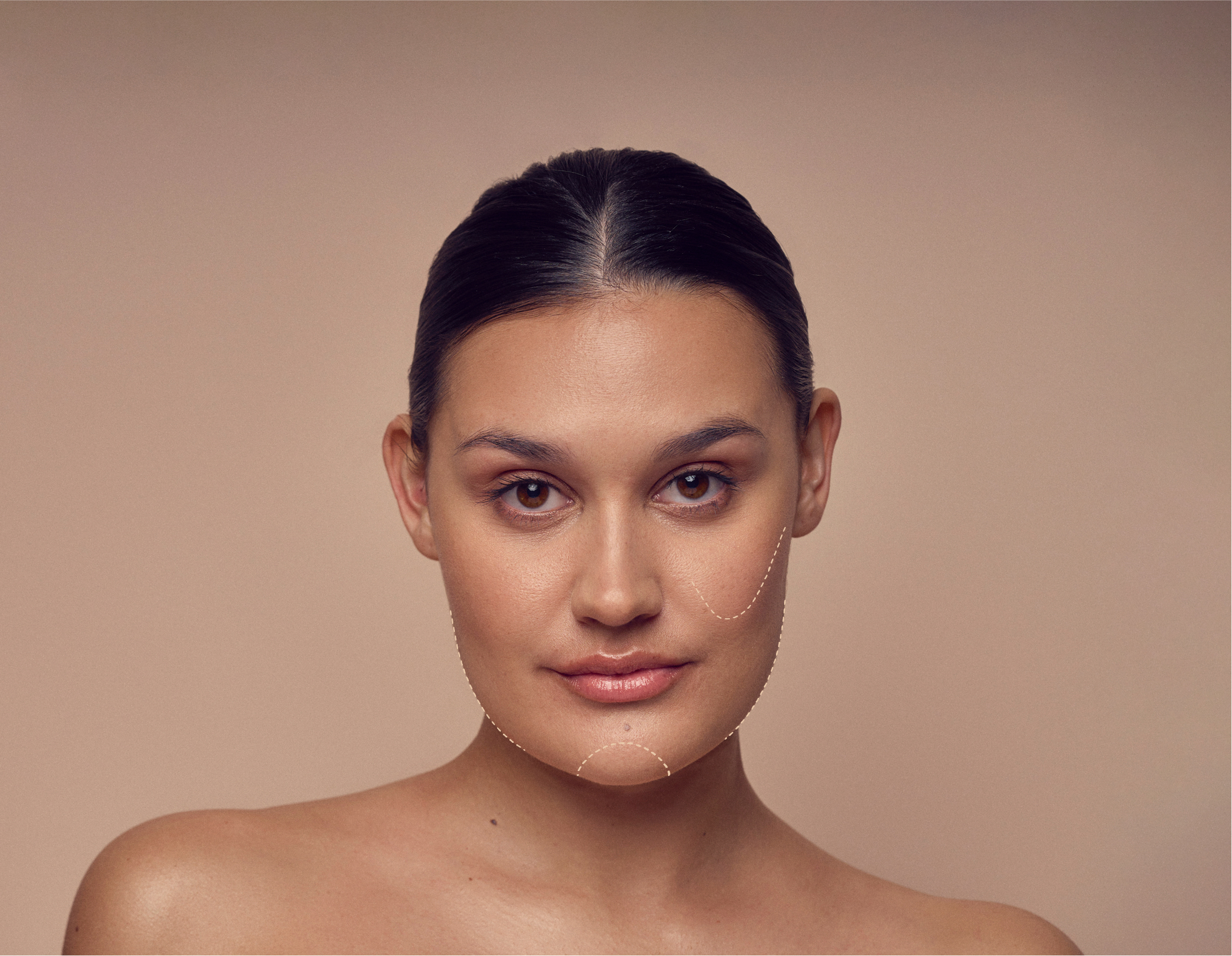
Cheek treatment does not lift jowls. This is a claim that circulates widely in cosmetic medicine — and it’s inaccurate in a way that sets patients up for disappointment. What cheek volume treatment can do is improve the appearance of the lower face by rebalancing facial proportions. That’s a real and meaningful effect, but it’s not the same thing as a lift — and understanding the difference matters before you book a consultation.
Quick answer: Cheek volume treatment improves the proportional relationship between the mid-face and lower face, which can make jowls appear less prominent by restoring balance to the overall face. It does not mechanically lift or tighten jowl tissue. If jowls are your primary concern, the most appropriate treatment is one that directly addresses the lower face — not the cheeks.
Where the “cheek filler lifts jowls” claim comes from
The idea that cheek treatment lifts the jowls emerged from early theoretical models in cosmetic medicine that proposed a mechanical relationship between mid-face volume and lower face tissue position. The reasoning was intuitive: if you restore structural support higher up the face, the tissue below it might follow.
Clinical experience and a more precise understanding of facial anatomy have since shown this to be an oversimplification. The soft tissue compartments of the face are separated by retaining ligaments and fascial planes — they don’t behave like a curtain that lifts when you pull the fabric higher up. Adding volume to the mid-face does not transmit a lifting force to the jowl fat pads or lower face tissue. The two regions are structurally independent in this respect.
What does change is the visual impression created by better mid-face proportion. And that’s a real, documented, clinically meaningful effect — just not a mechanical lift.
What cheek treatment actually does for the lower face
The lower face and mid-face are visually connected even though they’re structurally independent. When the mid-face loses volume, several things happen simultaneously that affect how the lower face reads:
- The cheeks flatten and lose projection, removing the structural visual anchor of the mid-face
- The nasolabial folds deepen as the tissue transition between mid-face and lower face loses support
- The relative prominence of the lower face — including the jowls — increases as the mid-face recedes
- The face as a whole takes on a bottom-heavy appearance
When cheek volume is restored, these relationships shift. The mid-face regains its structural visual presence. The nasolabial folds appear softer because the transition above them has improved. The lower face looks more proportionate because it’s now being compared to a fuller mid-face rather than a depleted one. The jowls may appear less prominent — not because they’ve moved, but because the face is now more balanced overall.
This is a proportional rebalancing effect. It’s real, it’s visible, and patients consistently notice it. But it is not a lift, and it does not substitute for treatment that directly addresses the lower face when that’s where the primary concern lies.
Age-related mid-face fat compartment changes involve both volume loss and inferior migration — the tissue shifts downward rather than simply depleting. This pattern explains why restoring mid-face volume produces a visual rebalancing effect: you’re partially reversing the upward-to-lower redistribution that has occurred over time. The effect on the lower face is perceptual, not structural.
What actually causes jowls
Understanding what produces jowls is the clearest way to understand why cheek treatment cannot address them directly.
Jowls form through a combination of:
- Skin laxity — reduction in collagen and elastin causes the skin to lose its ability to resist the downward pull of gravity
- Fat pad descent — specific jowl fat pads descend below the mandibular border over time, creating the characteristic lower face heaviness
- Bone resorption — the mandible reduces in size and projection with age, reducing the structural scaffold that holds overlying tissue in position
- Ligament relaxation — the retaining ligaments that hold facial tissue in place lose tension with age, allowing downward migration
None of these mechanisms are influenced by adding volume to the cheeks. Skin laxity, fat pad descent, bony atrophy, and ligament relaxation require treatment approaches directed at the lower face — not the mid-face.
When cheek treatment is and isn’t the right conversation
The most important clinical determination is whether jowls are the primary concern or a secondary concern that sits alongside mid-face changes.
| Presentation | Primary treatment consideration | Role of cheek treatment |
|---|---|---|
| Mid-face volume loss with some lower face heaviness | Cheek volume treatment | Primary — proportional rebalancing will influence lower face appearance |
| Jowls as primary concern with good mid-face volume | Jowl contouring treatment | Not indicated — cheek treatment will not address the concern |
| Both mid-face and lower face concerns | Combined approach — cheeks and jowls addressed as a plan | Supportive — addresses mid-face component while lower face is treated directly |
| Significant skin laxity with jowling | Surgical assessment warranted | Limited — non-surgical treatment has ceilings in the context of significant laxity |
The pattern we see most commonly in practice is a patient with genuine mid-face volume loss who is also noticing the lower face becoming heavier, and who has heard that cheek treatment will address both. In these cases, restoring mid-face volume does produce a meaningful improvement in how the lower face reads — but it should be presented honestly as a proportional effect, not a jowl treatment.
For patients where jowls are a standalone or primary concern, the appropriate starting point is a consultation that considers the lower face directly. Our jowl contouring and lifting treatment page explains what non-surgical lower face treatment involves. For patients considering the face more broadly, our facial balancing guide provides a framework for thinking about how different areas relate to each other — which is often the more useful starting point than focusing on a single feature.
Get the decide guide
Non-surgical options that directly address jowls
Where jowls are a genuine concern — either as a standalone issue or alongside mid-face changes — the non-surgical options that directly address the lower face include:
Jowl contouring treatment
Prescription medicines placed strategically along the mandibular border and pre-jowl area can restore definition to the jawline and reduce the visual prominence of jowls by improving the transition between the lower face and jaw. This approach addresses the contour rather than the laxity, and works best in patients with early to moderate jowling rather than significant skin laxity. For a full overview, see our jowl contouring treatment page.
Collagen stimulating treatment
For patients with early to moderate skin laxity contributing to jowling, collagen stimulating treatments can improve skin quality and tissue support over time. Results develop gradually and are not as immediately dramatic as direct contouring, but can complement contouring treatment in a combined plan.
Surgical facelift
For patients with significant jowling and skin laxity, non-surgical options have real limitations. A surgical facelift is the most effective intervention for significant lower face descent and is worth discussing with a plastic surgeon if the degree of concern is significant. This is a conversation we have openly at consultation — we don’t recommend non-surgical treatment where surgery is clearly the more appropriate answer.
What to ask at your consultation
If you’re attending a cheek treatment consultation with jowl concerns, the questions worth asking directly are:
- Is mid-face volume loss genuinely contributing to how my lower face looks — or are the jowls an independent concern?
- If I have cheek treatment, what realistic change can I expect in the appearance of my lower face?
- Is my lower face concern best addressed in the cheeks, the lower face directly, or both?
- Are there limits to what non-surgical treatment can achieve for my degree of jowling?
A clinician who answers these questions directly — including acknowledging the limits of what cheek treatment can do — is one whose recommendations you can trust. A clinician who tells you cheek treatment will lift your jowls without qualification is telling you something that isn’t accurate.
At Cosmetic Connection, this kind of direct, honest assessment is the standard we hold at every consultation. You can read more about our approach on our our difference page, and find our clinic locations at our locations page.
For a complete overview of cheek volume treatment — including its benefits for mid-face proportion and what results look like — see our cheek volume treatment guide. For patients considering whether to start with the cheeks or the lower face, our facial balancing guide provides a useful way to think about the face as a whole.
Get the decide guide
Frequently asked questions
Will cheek treatment make my jowls look better?
It may — but not by lifting them. If mid-face volume loss is contributing to a bottom-heavy appearance, restoring that volume rebalances the proportional relationship between the mid-face and lower face. Jowls can appear less prominent as a result. This is a visual effect produced by better overall facial balance, not a structural change to the jowl tissue itself. If jowls are your primary concern, a lower-face-specific treatment is more likely to produce meaningful change.
Why do some clinics say cheek filler lifts jowls?
The claim originated from early theoretical models in cosmetic medicine that have since been shown to be an oversimplification. The facial soft tissue compartments don’t behave in a way that allows volume in the mid-face to mechanically lift tissue in the lower face. What clinicians often observe — and sometimes describe loosely as a lift — is the proportional rebalancing effect described above. The distinction is clinically important and worth asking your treating doctor to explain clearly.
What’s the best non-surgical treatment for jowls?
For early to moderate jowling, lower face contouring using prescription medicines along the mandibular border is the most direct non-surgical approach. Collagen stimulating treatments can complement this where skin laxity is a contributing factor. For significant jowling with meaningful skin laxity, non-surgical treatments have real limitations and a surgical consultation is worth pursuing. The appropriate answer depends on the individual’s degree of concern and anatomy — which is why an in-person assessment is always the first step.
Can you treat both the cheeks and jowls at the same appointment?
Yes — and in cases where both mid-face volume loss and lower face jowling are present, addressing them together as part of a treatment plan often produces a more cohesive result than treating either area in isolation. The consultation determines which areas are contributing most to the concern, what the appropriate approach for each is, and what the treatment plan looks like across one or more appointments.
Is there a non-surgical treatment that actually lifts the face?
Non-surgical treatments can improve the appearance of facial support and contour — but the term “lift” as applied to non-surgical treatment is often used loosely and should be understood as a visual or proportional effect rather than a mechanical one. Procedures that directly tighten skin or repositions tissue require surgical intervention. Non-surgical options produce meaningful cosmetic improvement within their appropriate scope — the key is having an honest assessment of what that scope is for your specific concern.