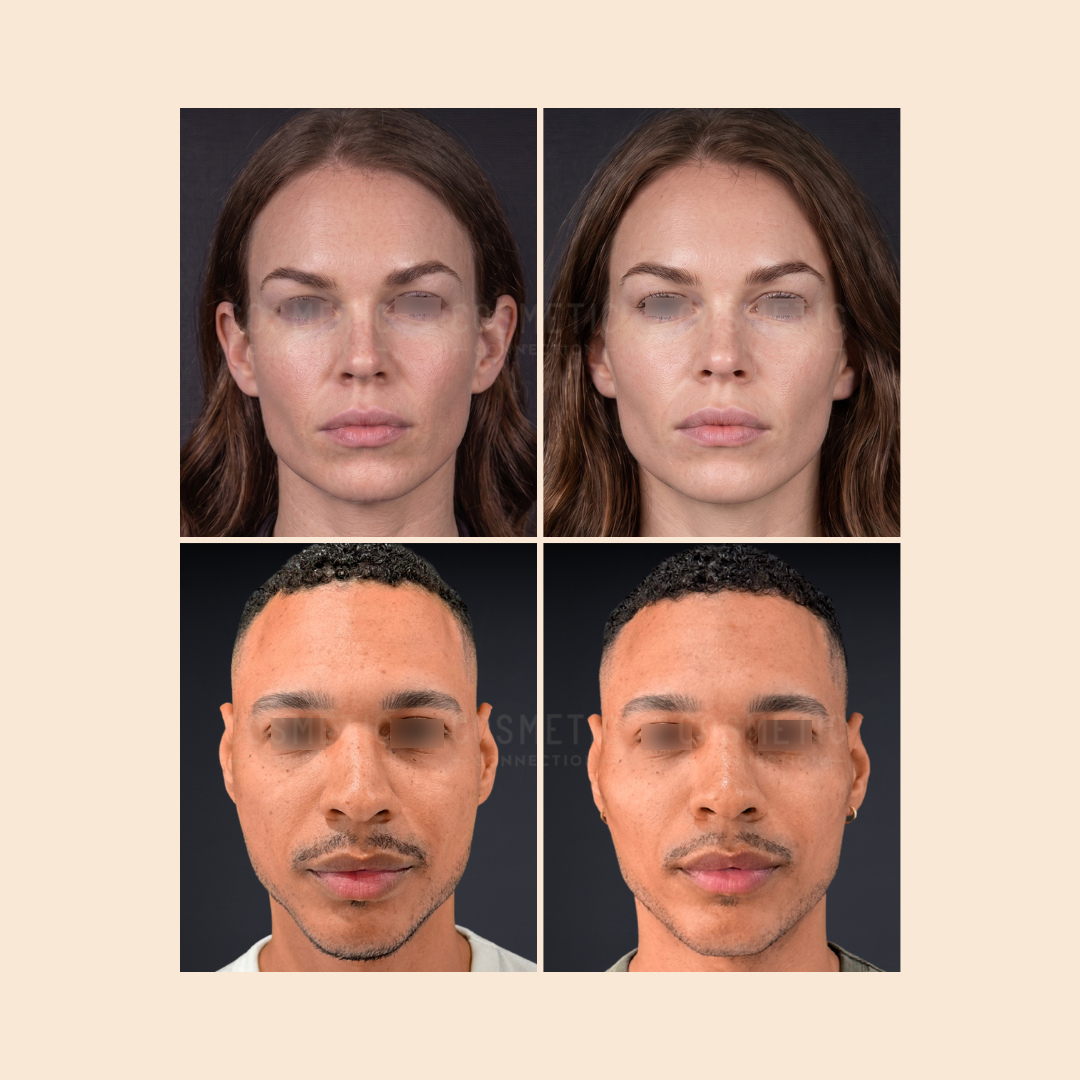
Cheek volume treatment is a non-surgical cosmetic procedure that restores or adds volume to the mid-face using prescription medicines administered by a doctor. It addresses hollowness, loss of definition, and the structural changes that come with ageing — and when done well, it produces results that look entirely natural.
If you’ve noticed your cheeks looking flatter, your face appearing more tired than it used to, or shadows forming beneath your eyes where there weren’t any before, you’re likely seeing the early signs of mid-face volume loss. This guide explains what causes those changes, what treatment involves, what results look like, and how to decide if it’s right for you.
Quick answer: Cheek volume treatment uses prescription medicines to restore volume, definition, and structural support to the mid-face. It can address hollowness, refine contours, support the under-eye area, and improve overall facial proportion. Treatment is non-surgical, takes around 30–45 minutes, and results typically last 12–24 months depending on the approach used.
What happens to your cheeks as you age
The cheeks are one of the first areas of the face to show the effects of ageing — not because the skin changes first, but because the structural foundation beneath it does.
Your mid-face is supported by a series of distinct fat compartments that sit at different depths beneath the skin. As you age, these compartments lose volume and shift position. Research published in Dermatologica Sinica (2023) found that deep mid-face fat compartments decrease in thickness by approximately 26–36% between the youngest and oldest age groups studied — a significant structural change that directly affects the appearance of the cheeks and surrounding areas.
A separate computed tomography study published in the Journal of Cosmetic Dermatology (2022), involving 262 patients, confirmed that this fat volume loss occurs in both men and women and progresses measurably over time. The upper and middle compartments lose width, while volume in the lower compartment can increase — reflecting a downward shift of tissue rather than simple deflation.
This is why mid-face volume loss tends to produce a cluster of changes rather than one isolated sign. Hollowness develops beneath the eyes. The cheeks flatten. The nasolabial folds deepen. The face begins to look drawn or tired in a way that doesn’t match how you feel. These changes are structural, not superficial — which is why surface-level skin treatments don’t address them.
Other factors can accelerate this process. Significant weight loss, prolonged high-intensity exercise, and certain medications can all contribute to earlier or more pronounced volume loss in the mid-face.
What cheek volume treatment actually does
Cheek volume treatment works by restoring or adding structure to the mid-face at the tissue depth where volume has been lost. The goal is not to make the cheeks look filled or overdone — it’s to recreate the proportions and support that were present before volume loss occurred.
There are two main treatment approaches used at our clinics, and in some cases both are used together as part of a broader treatment plan.
Volume restoration
The first approach uses prescription volumising treatments to replace lost volume in targeted fat compartments. These treatments are placed at the appropriate depth to support the overlying tissue, improve mid-face projection, reduce hollowness beneath the eyes, and soften the transitions between facial features. Results are immediate and refine further over the following two weeks as the treatment integrates with surrounding tissue.
A 2025 systematic review and meta-analysis published in Medicina — which included 14 studies and 748 participants — found that volumising treatments for mid-face augmentation produced significantly higher improvement rates compared to control groups, with a risk ratio of 3.27 (95% CI: 2.26–4.75). Moderate-to-severe adverse events were rare and not statistically different from control groups.
Collagen stimulation
The second approach uses collagen stimulating treatments that work differently to volumising options. Rather than adding immediate volume, they stimulate the body’s own collagen production over several weeks and months. Results develop gradually, last longer, and produce improvements in skin quality and texture alongside volume restoration. This approach suits patients who want progressive, natural-looking change over time rather than immediate correction.
In some treatment plans, both approaches are combined — collagen stimulation to rebuild the underlying structural environment, and targeted volumising treatment for more precise contouring in specific areas.
What cheek treatment can and can’t do
Understanding this clearly before treatment is something we consider essential. Unrealistic expectations are the most common source of dissatisfaction with any cosmetic treatment, and the cheek area is no exception.
Cheek volume treatment is well-suited to:
- Restoring lost mid-face volume that has reduced the fullness or projection of the cheeks
- Reducing hollowness beneath the eyes by providing structural support to the tear trough region
- Improving mid-face definition and contouring for a more balanced facial appearance
- Refining facial proportions — particularly the relationship between the mid-face and lower face
- Adding subtle projection or definition in patients who never had significant natural cheek volume
Cheek volume treatment is not suited to:
- Mechanically lifting sagging skin — volume can improve the appearance of the lower face by rebalancing facial proportions, but it does not physically lift tissue
- Replacing the results of a surgical facelift in patients with significant skin laxity
- Correcting concerns primarily caused by skin quality changes rather than volume loss
A point worth addressing directly: it is sometimes suggested that cheek treatment “lifts” the jowls or lower face. This framing is misleading. What mid-face volume treatment can do is improve the balance of facial proportions — restoring mid-face structure can make the lower face appear more defined and harmonious by comparison. This is a visual effect created through better facial balance, not a mechanical lift. Our clinical approach is to be precise about this distinction, because patients who understand it make better decisions about whether cheek treatment alone addresses their concern, or whether jowl contouring is the more relevant treatment for their lower face.
For a broader look at how the cheeks relate to overall facial proportion, our facial balancing guide is a useful companion read.
Get started
Who is a good candidate for cheek volume treatment
Suitability for cheek volume treatment is always assessed in person — there is no reliable way to determine this from a description or a photograph alone. That said, the following situations are the ones we see most often in practice.
Volume loss from ageing
The most common presentation. Patients in their mid-30s onward notice progressive flattening of the cheeks, increased hollowness beneath the eyes, and deepening of the lines that run from the nose to the corners of the mouth. This group typically responds well to volume restoration, and results often look the most natural because they reflect what was previously there.
Structural hollowness
Some patients have always had naturally lean or hollow cheeks and want to add volume they never had. This is a different clinical scenario from volume restoration — the goal is augmentation rather than replacement — and it requires a different approach to placement and quantity. Suitability depends on anatomy, and not everyone with naturally lean cheeks will benefit from treatment in the same way.
Men seeking mid-face definition
Cheek volume treatment is as relevant for men as it is for women — the anatomy is the same, and the concerns are often similar. What differs is the aesthetic goal. Most men seeking cheek treatment are looking for sharper definition and more angular mid-face structure rather than soft volume or lift. The lateral cheekbone and the transition between the mid-face and lower face are the areas most commonly addressed, producing a result that reads as stronger facial structure rather than treated.
Men also tend to present with volume loss that has gone unaddressed for longer — often because the concern has been dismissed as just ageing rather than something worth addressing. In our experience, men who do pursue treatment are typically looking for a result that is completely undetectable. A conservative, anatomy-led approach achieves this consistently.
Volume loss from weight changes
Significant weight loss — including loss associated with GLP-1 medications — can cause earlier and more pronounced mid-face volume loss than ageing alone. A 2024 systematic review published in Aesthetic Surgery Journal Open Forum found that the most significant fat reduction following major weight loss occurred along the mid-cheek region, and that patients over 40 were more susceptible to visible facial changes. Cheek volume treatment is frequently considered by this group as part of addressing what is sometimes called “face ageing” associated with rapid weight change.
Patients considering the non-surgical vs surgical question
Some patients present having researched both non-surgical cheek treatment and surgical cheek implants. They are suitable candidates for a detailed comparison consultation that sets out the relevant differences — longevity, reversibility, recovery, and outcomes — so they can make an informed decision. We cover this in detail in our comparison of cheek volume treatment versus surgical augmentation.
What the treatment involves
At our clinics, every cheek volume treatment begins with a thorough assessment. We evaluate mid-face anatomy, skin quality, the relationship between the cheeks and surrounding structures, and whether the cheeks are the primary concern or whether the issue is being driven by changes elsewhere in the face.
This matters because the mid-face doesn’t exist in isolation. Addressing the cheeks without considering how they relate to the under-eye area, the nasolabial folds, the jawline, and the overall facial proportion can produce results that look out of context. Our approach is concern-based rather than area-based — we plan treatment around your specific presentation, not a standard protocol.
Treatment itself is straightforward. Topical numbing is applied prior to the procedure. Treatment is then placed at the appropriate depth using either a fine needle or a blunt-tipped cannula, depending on the area being addressed and the technique best suited to your anatomy. The procedure typically takes 30–45 minutes. Most patients return to normal activity the same day, with the most common post-treatment effects being mild swelling and occasional bruising that settles within a few days to two weeks.
Results from volumising treatment are visible immediately and continue to refine over two weeks. Results from collagen stimulating approaches develop over 6–8 weeks as new collagen is produced, with optimal results typically visible at 3–6 months.
How long results last
Longevity varies between patients and depends on the treatment approach used, the areas treated, individual metabolism, and lifestyle factors. As a general guide:
| Treatment approach | Typical longevity | Key characteristic |
|---|---|---|
| Volumising treatment | 12–18 months | Immediate results; fully reversible |
| Collagen stimulating treatment | 18–24+ months | Gradual results; stimulates natural collagen |
| Combined approach | 18–24 months | Immediate structure + long-term quality improvement |
Areas with less tissue movement — such as the lateral cheekbone — tend to maintain results longer than areas of higher movement closer to the mouth. Individual metabolism plays a role too; some patients metabolise treatments more quickly than others. Maintenance treatments, typically at a reduced quantity, are a practical approach for patients who want to sustain results over time.
Cheek treatment cost in Australia
The cost of cheek volume treatment in Australia ranges from approximately $1,500 to $3,000 per appointment, depending on the treatment approach, the amount of treatment required, and the specific areas being addressed.
This range reflects the variation in clinical scenarios — a patient requiring subtle restoration in one area will typically sit at the lower end, while a patient needing more significant volume correction across the mid-face will require more treatment and sit higher in the range. At Cosmetic Connection, we use a flat-fee pricing model — you can review our current pricing before your appointment so there are no surprises.
For a detailed breakdown of what influences cost and what to look for when comparing clinics, see our cheek treatment cost guide.
Choosing the right clinic and approach
The cheek area is one of the more technique-sensitive areas of the face to treat. The mid-face sits close to important vascular structures, and the difference between a natural-looking result and an overdone one comes down to placement depth, quantity, and an accurate read of the patient’s anatomy.
When assessing a clinic, the questions that matter most are:
- Is the assessment led by a doctor, and does it include a genuine evaluation of your anatomy — or does it jump straight to a treatment recommendation?
- Does the clinician discuss what the treatment can and cannot achieve for your specific concern?
- Is the approach tailored to your face, or is it a standard protocol?
- Are risks discussed clearly, including what happens in the unlikely event of a complication?
At Cosmetic Connection, every cheek consultation is doctor-led and suitability-first. If we don’t think treatment will serve you, we say so. You can learn more about how we approach treatment on our our difference page, or find your nearest clinic on our locations page.
Get started
Frequently asked questions
Is cheek volume treatment painful?
Most patients find the procedure well-tolerated. Topical numbing is applied before treatment, and the medicines used also contain a local anaesthetic. The most common sensation reported is mild pressure during placement. Discomfort varies between individuals and between areas of the face, but significant pain is not typical.
Can cheek treatment be reversed?
Volumising treatments can be partially or fully dissolved using a specific enzyme if you are unhappy with the result or experience a complication. Collagen stimulating treatments are not reversible in the same way — they work by stimulating your body’s own collagen, which cannot be dissolved. This distinction is discussed during your consultation to help you choose the right approach.
Will cheek treatment look natural?
A well-executed cheek treatment should not be detectable. The goal is to restore or enhance what belongs there — not to create a result that looks altered. In our experience, patients who choose restoration of lost volume over dramatic augmentation consistently achieve the most natural outcomes. Over-treatment is the most common reason cheek results look unnatural, which is why we take a conservative, incremental approach.
How is cheek volume treatment different from a surgical cheek implant?
Surgical cheek implants involve inserting a solid silicone implant through an incision inside the mouth or below the lower eyelid. They are permanent, require a recovery period of several weeks, and cannot be adjusted once placed. Non-surgical cheek treatment is temporary, adjustable, reversible, and requires no downtime. The tradeoff is longevity — implants are indefinite, while non-surgical results require maintenance. We cover this comparison in detail in our cheek treatment vs surgical augmentation guide.
Am I too young — or too old — for cheek volume treatment?
Age alone is not a suitability criterion. The relevant question is whether the concern is real, whether treatment addresses it appropriately, and whether the patient has realistic expectations. We see patients across a wide age range for cheek treatment — from younger patients adding definition they want to older patients restoring what has changed. Suitability is always assessed individually.
What is the difference between volumising treatment and collagen stimulation for the cheeks?
Volumising treatment produces immediate results and is placed directly where volume is needed. Collagen stimulating treatment works by triggering your body’s own collagen production over several months — results are gradual but tend to last longer and also improve skin quality. Both are valid approaches, and the best choice depends on your anatomy, timeline, and the type of change you’re looking for. Your doctor will discuss which is more appropriate at your consultation.