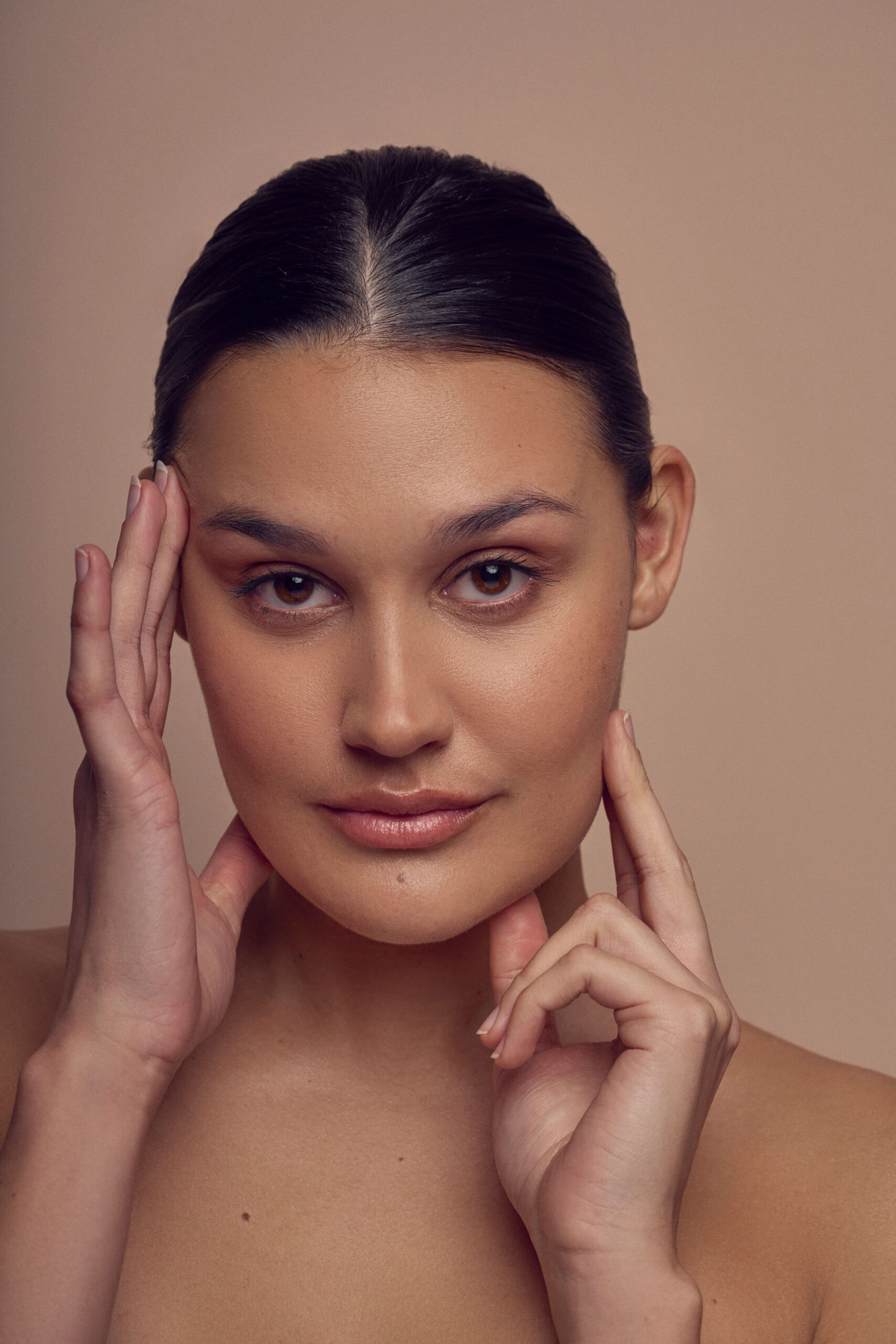
Facial balancing is a non-surgical cosmetic treatment approach that assesses and addresses the proportions, symmetry, and overall harmony of your face. Rather than treating one concern in isolation, the goal is to evaluate the face as a whole and create a natural, cohesive result across multiple areas.
If you’ve noticed something feels “off” about your appearance but can’t quite pinpoint what it is, you’re not alone. Many people seeking facial balancing aren’t looking for a dramatic change — they want their face to make sense again.
This guide covers what facial balancing involves, which treatments are used, what it costs in Australia, how long results last, and how to know whether it’s right for you.
Quick answer: Facial balancing is a non-surgical approach to improving facial harmony. A practitioner assesses your proportions and symmetry across all facial areas, then creates a personalised treatment plan to address the imbalances that are bothering you. In Australia, a facial balancing treatment plan typically costs between $2,000 and $4,000 depending on the areas treated.
What is facial balancing?
Facial balancing is a treatment philosophy, not a single procedure. The core idea is that your face should be evaluated as a connected whole — not as a collection of isolated features to be treated individually.
Subtle structural relationships between features drive most of what people perceive as imbalance. A chin that is slightly underdeveloped can make a nose appear larger than it actually is. Flat or hollow cheeks can make the lower face look heavier. These imbalances often have nothing to do with the feature that appears most prominent — addressing the surrounding structures can resolve the concern more effectively than treating the obvious area directly.
Aesthetic medicine uses well-established anatomical frameworks to guide this kind of assessment. A 2014 study published in The Scientific World Journal found that faces perceived as attractive consistently demonstrated uniformity in the facial thirds (the division of the face into upper, middle, and lower zones) and the facial fifths (the horizontal division of the face into five equal widths). The goal of facial balancing is not to impose a mathematical ideal onto your face — it is to identify where your proportions deviate in ways that are bothering you, and address those specifically.
At Cosmetic Connection, facial balancing follows a suitability-led process. We assess your face from multiple angles, identify which areas are driving the imbalance you’re experiencing, and build a treatment plan around your anatomy and goals — not a template.
What treatments are used in facial balancing?
Facial balancing uses two main categories of non-surgical cosmetic treatment: muscle-relaxing treatments and volume-restoring treatments. Some treatment plans use both. The right combination depends entirely on which concerns are being addressed.
| Treatment type | How it works | Common facial balancing uses | How long it lasts |
|---|---|---|---|
| Reducing treatments | Reduces areas that are too full or prominent. | Jaw slimming, under chin fullness. | 3–5 months or permanent depending on modality |
| Structure-adding treatments | Adds volume or structure to specific areas | Chin projection, cheek definition, lip proportion, jawline definition, non-surgical nose reshaping | 12-18 months |
| Combination approach | Uses both treatment types in a single coordinated plan | Full facial balancing plans addressing proportions, symmetry, and volume simultaneously | Varies by method |
How the three-part facial assessment works
A well-structured facial balancing consultation assesses three things: volume, proportions, and symmetry. Each informs a different part of the treatment plan.
Volume assessment identifies where the face has lacks fullness or structural support — most commonly the chin, cheeks, and jaw. Research published in PubMed Central confirms that each facial third ages at a different rate, which means treatment requirements can vary depending on your unique presentation.
Proportions assessment examines the relationship between different facial features. The most commonly assessed proportions are the vertical thirds (forehead, mid-face, lower face) and the horizontal fifths (the five equal widths across the face from ear to ear). A practitioner who understands these relationships can identify why something looks imbalanced and address it at a structural level rather than treating the feature that appears most prominent. Profile assessment looks at the relationship between the nose, lips, and chin projection.
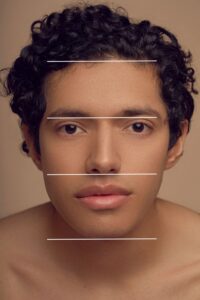
Horizontal thirds.
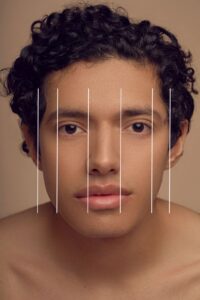
Vertical fifths.
Symmetry assessment looks at the difference between the left and right sides of the face. Perfect symmetry does not exist and is not the goal. Noticeable asymmetry that bothers you is a legitimate concern, and strategic treatment placement can reduce the visible difference between sides without making either side look altered.
At Cosmetic Connection, this three-part assessment happens before any treatment recommendation is made. Our suitability-first approach means we will tell you clearly whether treatment is likely to achieve what you’re hoping for, and what a realistic outcome looks like for your specific anatomy.
How much does facial balancing cost in Australia?
Facial balancing costs in Australia vary significantly depending on how many areas are being treated and the volume of product required. The following gives a realistic indication of what to expect.
| Treatment scope | What’s typically included | Approximate cost range (AUD) |
|---|---|---|
| Single area | One targeted concern — for example, chin reshaping or jaw slimming only | $2,000 |
| Two to three areas | A targeted combination — for example, chin and cheek definition, or jaw slimming with lip proportion adjustment | $2,000 – $4,000 |
| Full facial balancing plan | Multiple areas in a coordinated plan covering volume, proportions, and symmetry | $4,000+ |
At Cosmetic Connection, we use flat-fee pricing. The cost of your treatment is determined by the outcome, not by the treatment extent. This removes the financial incentive to over-treat, which we believe is a meaningful distinction in how responsible treatment planning works. You can learn more about how our pricing model works on our pricing explained page.
A detailed breakdown of what affects facial balancing costs across different treatment areas is covered in our dedicated guide: how much does facial balancing cost in Australia?
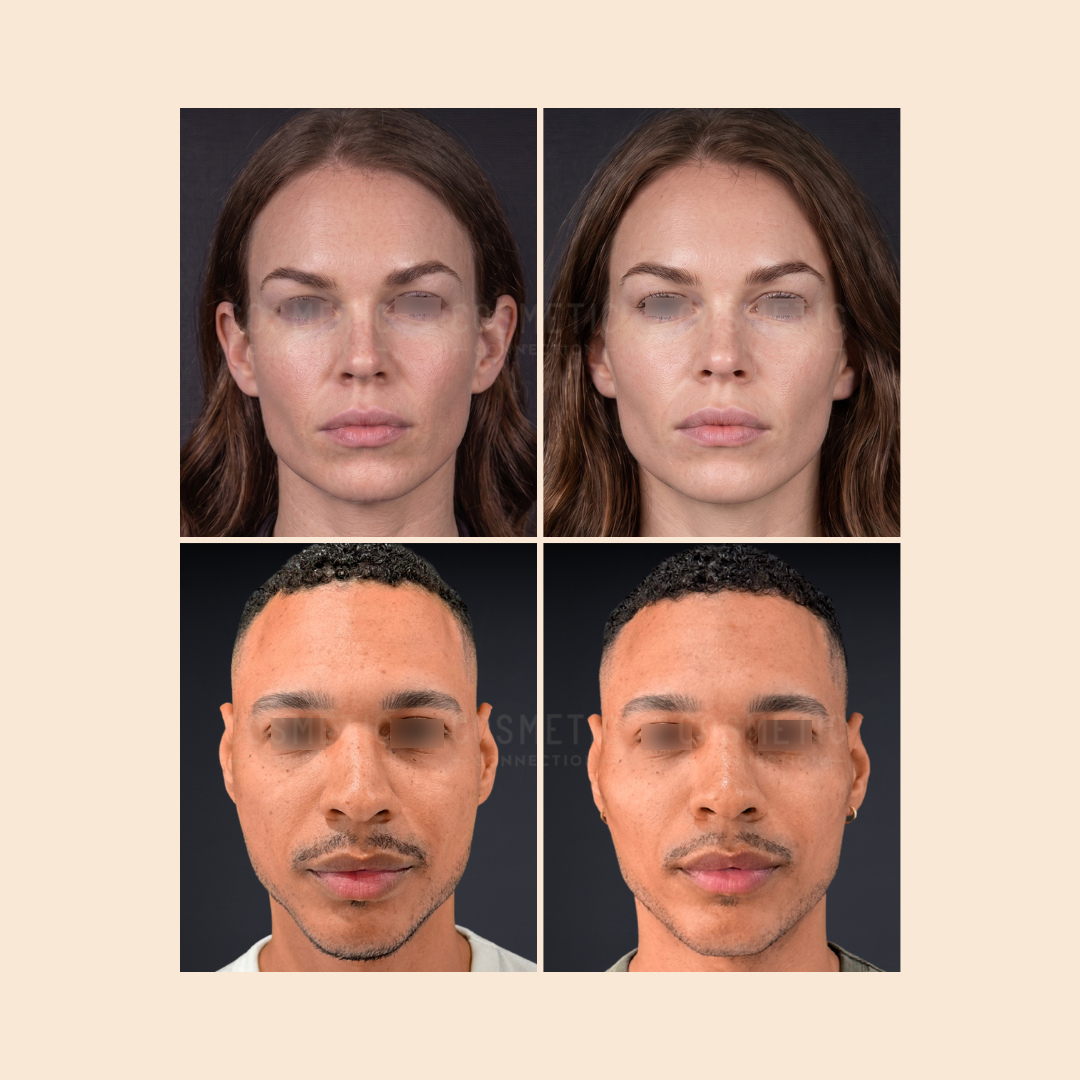
What do facial balancing results look like?
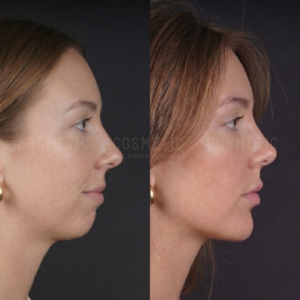
Before and after profile balancing.
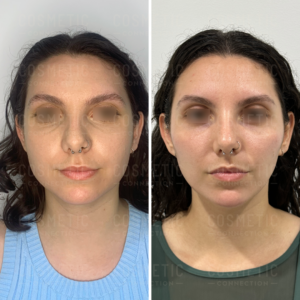
Before and after facial balancing.
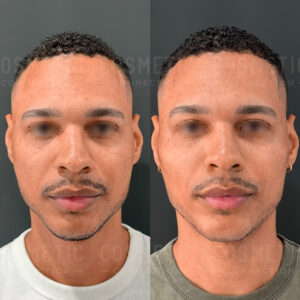
Before and after facial balancing.
Learn more about facial balancing results, and how to appraise before and after photos with our guide to facial balancing results.
How long do facial balancing results last?
Longevity depends on the treatment method:
- Treatments targeting enlarged muscles last 3–5 months, after which maintenance is needed to sustain the result
- Treatments that target excess fat are permanent, although weight changes may cause fluctuations in residual fat volume
- Treatments that target structure generally last 12-18 months
- Most people with combination treatment plans return every 6–12 months for maintenance, depending on the methods they had
Is facial balancing right for you?
Facial balancing is relevant across a wide range of ages and concerns. In our experience at Cosmetic Connection, the people who benefit most tend to fall into several groups:
- People in their 20s and 30s who feel their facial features are naturally disproportionate — a weak chin, underdeveloped mid-face, or a nose that appears prominent due to surrounding structures rather than its actual size
- People in their 30s and 40s noticing emerging imbalance due to ageing-related changes in structure
- People in their 40s and beyond who have experienced more significant facial volume change. They typically want to restore facial balance, rather than correct inherited imbalance.
Not everyone is a suitable candidate. There are situations where the concern a person describes cannot be adequately addressed non-surgically, and we will say so directly at consultation. There are also situations where addressing one area without considering others would create a new imbalance — our assessment process is designed to identify those scenarios before any treatment begins.
You can read more about who tends to benefit and what makes someone a strong candidate in our dedicated guide: am I a good candidate for facial balancing?
Facial balancing vs facial contouring: what is the difference?
These terms are often used interchangeably, but they describe different things in clinical practice.
Facial contouring typically refers to defining or sculpting specific features — commonly the jawline, cheeks, or chin — to create a more structured appearance. The goal is definition in a targeted area. Facial contouring can also be done to achieve a more masculine facial contour, or a more feminine appearance, depending on your preferences. Balancing is a more holistic and unisex approach that works with whatever your baseline anatomical structure is.
Facial balancing takes a broader view. It begins with an assessment of how your features relate to each other and builds a treatment plan around creating harmony across the whole face. A facial balancing plan may include contouring elements, but the starting point is always the relationship between areas rather than the features themselves.
Of course, there is overlap between balancing and contouring, as you can’t do one without the other. The approach primarily comes down to which is the primary goal – optimised definition and structure, or refining the harmony between features and proportions.
A person who presents focused on their lips may actually benefit most from chin treatment first, because a weak chin changes the apparent proportion of the entire lower face, which affects how everything above it looks. This kind of structural thinking is what separates a genuine facial balancing approach from a treatment-by-request model.
Can facial balancing fix facial asymmetry?
To a meaningful degree, yes — with an important qualification. No face is perfectly symmetrical, and perfect symmetry is neither a realistic nor a desirable goal. What non-surgical treatment can do is reduce the noticeable difference between sides in a way that looks as natural.
Common asymmetries that respond well to non-surgical treatment include differences in cheek volume between sides, a chin that sits slightly off-centre, uneven lip volume, and jawline imbalance. Strategic treatment placement can meaningfully reduce these differences.
Some asymmetries have a skeletal basis that cannot be fully corrected non-surgically. In those cases, the goal is improvement rather than elimination of the asymmetry. A qualified practitioner will be clear about what is achievable for your specific anatomy before treatment begins.
How to choose a provider for facial balancing in Australia
Facial balancing is not a standardised procedure with a fixed protocol. The outcome depends heavily on the clinical judgement of the practitioner, which means choosing the right provider matters considerably more here than for routine single-area treatments.
Key things to look for:
- Assessment before treatment. Any provider who recommends specific treatments or product volumes before properly assessing your face from multiple angles is working backwards. The assessment must come first.
- Experience with multi-area treatment planning. Managing the relationships between multiple facial areas simultaneously is a distinct clinical skill. Ask directly how the provider approaches whole-face treatment planning — not just individual treatments.
- Doctor-led clinical oversight. Non-surgical cosmetic treatments carry real clinical risks when not performed or supervised by qualified medical practitioners. At Cosmetic Connection, all treatment is doctor-led — clinical decisions are made by a doctor, not delegated.
- Transparent flat-fee pricing. Per-unit pricing creates a financial incentive to use more product than is clinically appropriate. Look for clinics with treatment-based pricing structures that align the clinic’s interest with yours.
- Before-and-after examples specific to facial balancing. Not just individual area treatments — examples where multiple areas have been addressed together to create a whole-face result.
- Comprehensive scope of practice. If the clinician cannot treat the entire face due to limitations in scope or experience, they cannot achieve true balance. Further, they often over-treat areas to compensate, creating distortion and disharmony.
Get started
Frequently asked questions about facial balancing
Does facial balancing hurt?
Most people find treatment comfortable. Topical numbing cream is applied before any treatment, and some products contain a local anaesthetic. Certain areas are more sensitive than others. Mild swelling, bruising, or tenderness in treated areas for a few days after treatment is normal and expected.
Is facial balancing reversible?
Yes, in most cases. Certain treatments used in facial balancing can be undone if you are unhappy with the result or if your circumstances change.
How long does a facial balancing appointment take?
A consultation and assessment typically takes 15-30 minutes. If treatment proceeds in the same appointment, allow an additional 15-30 minutes depending on how extensive your treatment is. Some people prefer to attend a separate assessment appointment before committing to treatment. Both approaches are available at Cosmetic Connection.
What is the difference between facial balancing and a non-surgical facelift?
A non-surgical facelift typically focuses on lifting and volumising the face to address ageing-related hollowness and volume loss, without emphasis on correction proportions. Facial balancing is different. It is not a treatment for ageing, it works to adjust your underlying proportions and ratios to optimise your appearance. The two approaches can be combined as part of a comprehensive treatment plan.
How many sessions does facial balancing take?
This varies depending on your starting point and goals. Some people achieve their goal in a single session. Others prefer a staged approach — addressing the most significant concern first, then assessing the result before deciding on further treatment. At Cosmetic Connection, you are never pressured into a full treatment plan upfront. You can start with one area and build from there.
What does facial balancing involve step by step?
A facial balancing appointment begins with a concern discussion and multi-angle facial assessment. A treatment recommendation is then made with full pricing confirmed before anything proceeds. Treatment itself is typically completed in 15–30 minutes depending on the number of areas. A review appointment follows at the to assess the result once swelling has fully resolved.