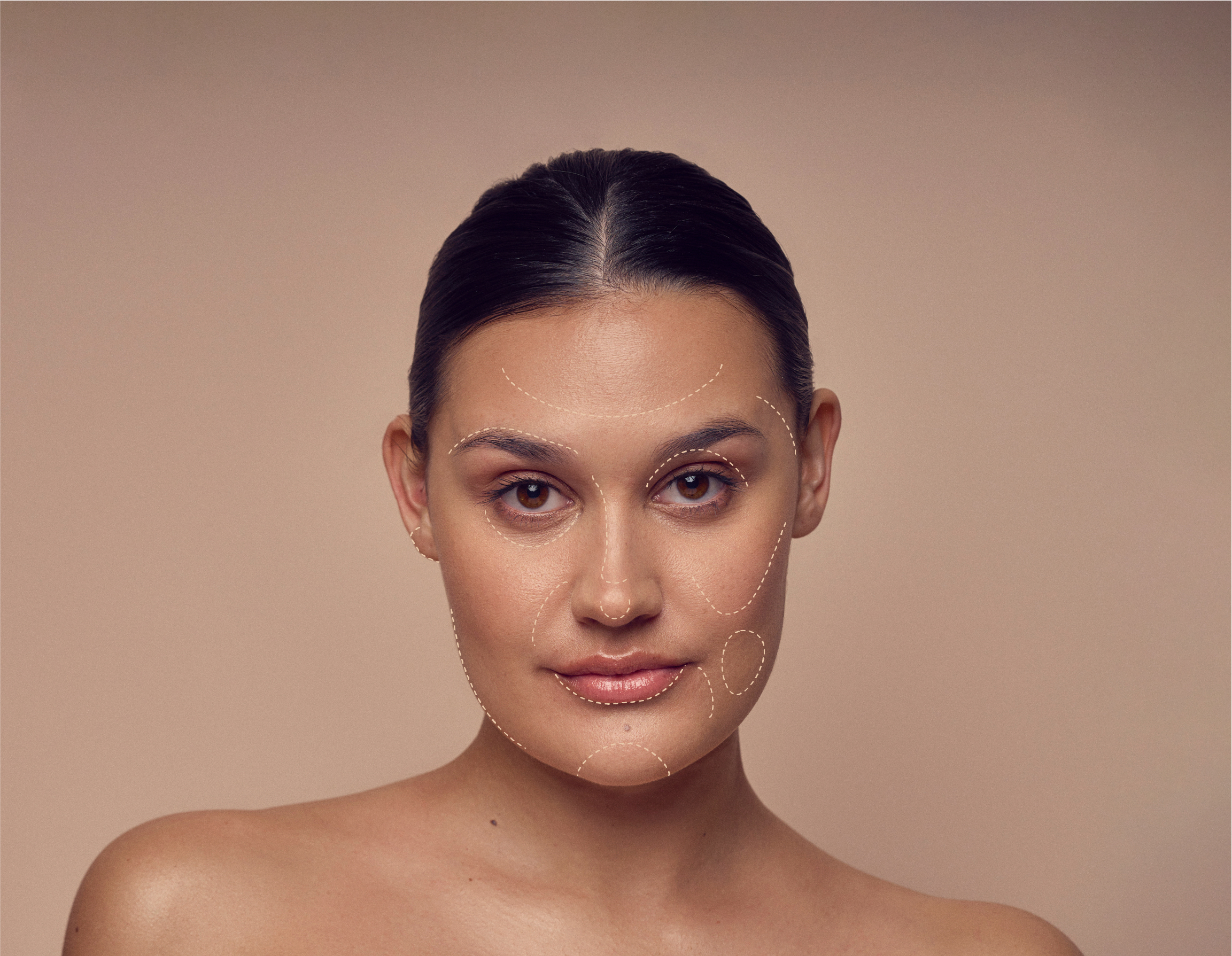
Understanding what facial balancing results actually look like — and what makes a good outcome — is one of the most important steps in deciding whether to pursue treatment. This guide covers what realistic results look like, how to interpret before and after photos, and what factors most influence the quality of your outcome.
Quick answer: Facial balancing results are typically subtle and natural-looking — the goal is a face that appears more proportionate and harmonious, not a face that looks treated. Results vary depending on the areas addressed, the treatment approach, and the skill of the practitioner. The final result becomes fully visible after that period.
What do facial balancing results actually look like?
This is the question most people have when they start researching facial balancing — and the honest answer is that good results are often difficult to spot in photos, because that is precisely what makes them good.
The goal of facial balancing is not to produce a face that looks “done.” It is to produce a face that looks more like a better version of itself — more rested, more proportionate, more harmonious. People who see you regularly often can’t identify what has changed. They notice that you look well, or that something seems different, but they can’t place it. This is the intended outcome.
What results are not: dramatic transformation, obvious enhancement, or a face that looks visibly altered. If that is what you are looking for, non-surgical facial balancing is likely not the right treatment.
Facial balancing before and after results
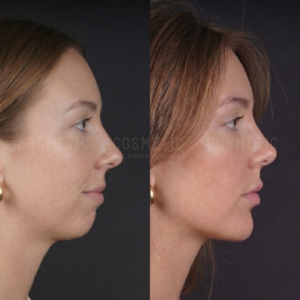
Before and after facial balancing, focussing on the profile.
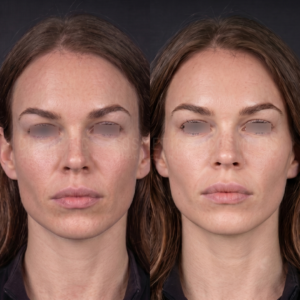
Before and after facial balancing, focussing on the mid-face.
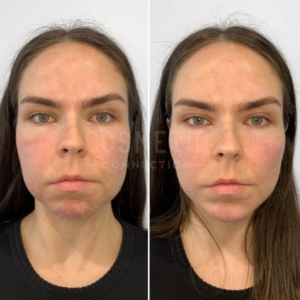
Before and after facial balancing, focussing on the mid and lower face.
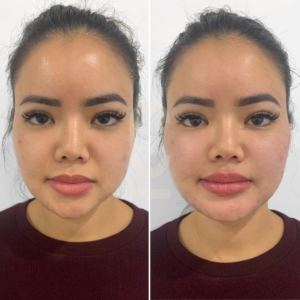
Before and after facial balancing, with a focus on symmetry.
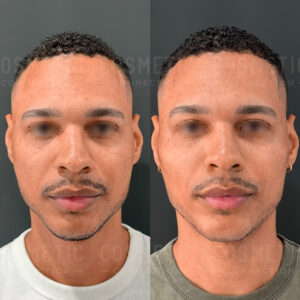
Before and after facial balancing, addressing mid and lower face ratios.
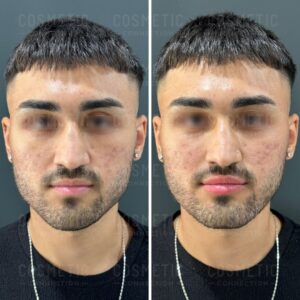
Before and after facial balancing, focussing on the lips, and lower face symmetry.
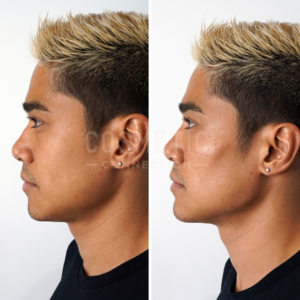
Before and after facial balancing, targeting the nose, cheekbones, chin, and jawline.
Results by area: what changes and by how much
| Area treated | Typical result | How quickly it shows |
|---|---|---|
| Chin | Improved lower face proportion; nose may appear smaller relative to face; overall facial length can look more balanced | Immediate with some swelling; final result at 2–4 weeks |
| Cheeks | Defined cheekbones; optimised mid-face width; improved overall facial structure | Immediate with swelling; final result at 2–4 weeks |
| Jaw | Depending on method: Reduced or increased jaw width; softened or sharpened lower face contour; more tapered or angular face shape | Immediate or 4 weeks; depending on method |
| Lips | Improved proportion of lips relative to lower face; added definition or subtle volume | Immediate with significant swelling; final result at 2 weeks |
| Non-surgical nose reshaping | Smoother profile line; improved symmetry; tip refinement; reduced appearance of bumps or width | Immediate with swelling; final result at 2–4 weeks |
How to assess facial balancing before and after photos
Before and after photos are one of the most valuable tools for evaluating a clinic’s results — but only if you know what to look for. Most people focus on what changed. A more useful exercise is examining how the change was achieved.
Signs of a good result:
- The face looks like a more proportionate version of itself — not a different face
- Changes are visible but not immediately identifiable as treatment
- Multiple areas appear to work together — the result reads as a whole rather than a collection of individual treatments
- Proportions in the after photo are more balanced — the face appears to follow natural anatomical relationships more closely
- Lighting and angle are consistent between before and after — making the result easier to evaluate accurately
Red flags in before and after photos:
- The after photo uses significantly different lighting, angle, or expression — this can create the appearance of change that doesn’t reflect the treatment
- Features look obviously augmented — overdone lips, overly prominent cheekbones, or a chin that looks disproportionately large relative to the rest of the face
- The person looks like someone else rather than a better version of themselves
- Only photos of dramatic improvements are shown — with no examples of subtle, natural results
What most influences the quality of your result
In our experience, the quality of a facial balancing result is determined more by clinical judgement than by any other factor. This includes:
- The accuracy of the initial assessment — identifying the right areas to treat is the foundation of the result. Treating the wrong area, or failing to treat a related area that is driving the concern, produces an incomplete outcome
- Treatment placement precision — where volume-restoring treatment is placed within an area — not just in what area — determines whether the result looks natural or overfilled
- Restraint — the most common cause of unnatural-looking results is too much product. A practitioner who understands when to stop produces better results than one who treats to an aesthetic template rather than to the individual
- Treatment sequencing — in multi-area plans, treating areas in the right order matters. Some results cannot be properly assessed until swelling from an earlier area has resolved, and a phased approach is often more reliable than treating everything at once
This is why the full picture of what to expect from facial balancing results needs to be understood in the context of a complete treatment plan assessment — not just individual before and after photos. Our complete facial balancing guide explains how the assessment and planning process works in detail.
Get started
Frequently asked questions about facial balancing results
Will people be able to tell I’ve had treatment?
Not if the treatment is done well. The goal of facial balancing is to produce results that look natural — people may notice you look refined, but they should not be able to identify that you’ve had a cosmetic treatment. Results that look obviously “done” typically indicate over-treatment or incorrect placement, not facial balancing as intended.
What if I’m not happy with my result?
Some methods we use at Cosmetic Connection can be reversed. Others wear off slowly on their own. We also offer a review appointment to assess your result and discuss options if something isn’t as expected.
How long do facial balancing results last?
This depends on the treatment plan. Most people maintain their results every 12-18 months.
Can I exercise or socialise immediately after facial balancing treatment?
We recommend avoiding strenuous exercise for 24–48 hours after treatment and avoiding any direct pressure on treated areas. Social activities are generally fine — most people return to normal activities the same day. Swelling is typically mild enough that most people are comfortable going out immediately after treatment, though this varies by individual.