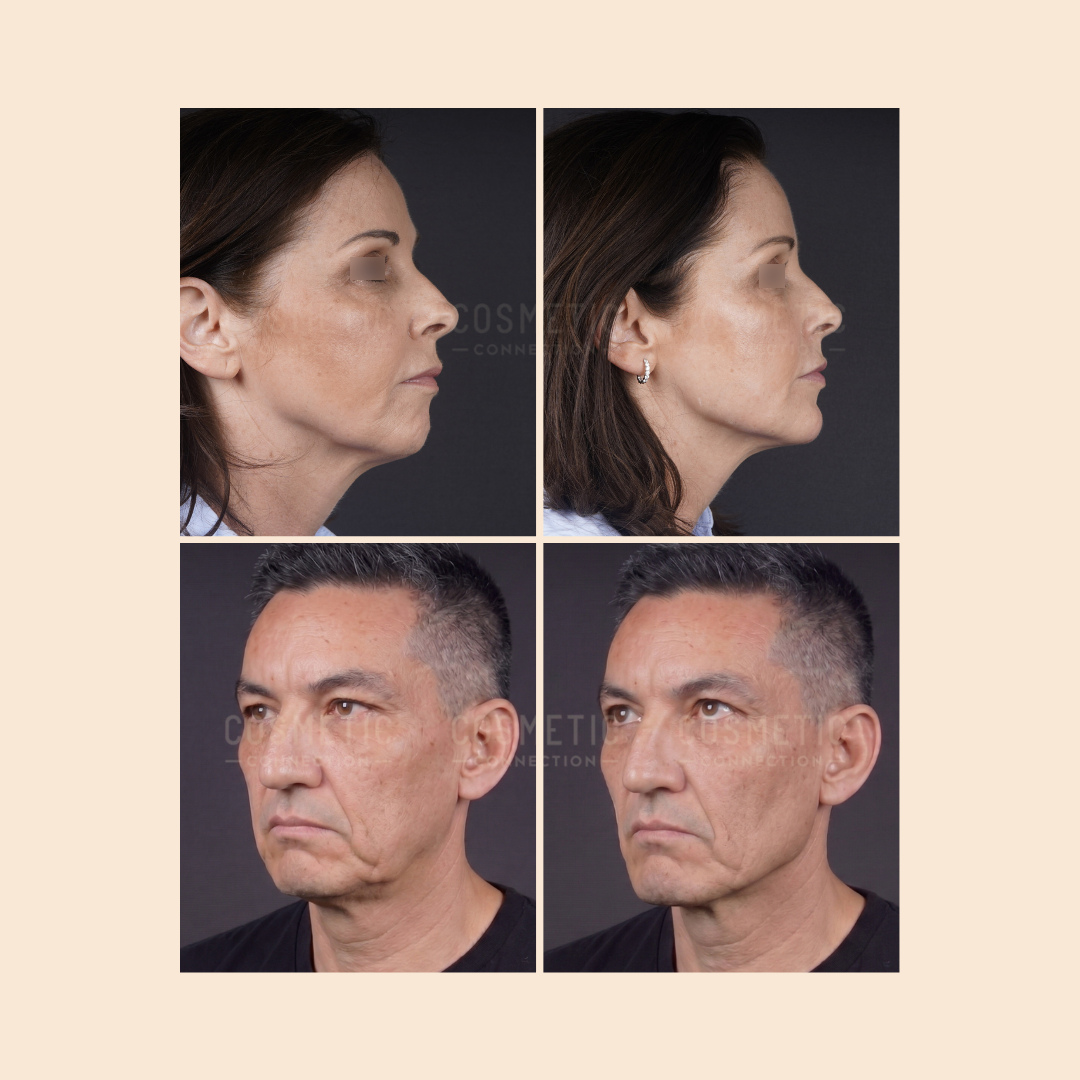
Understanding what jowl treatment can realistically achieve is one of the most important steps before committing to any procedure. Results vary depending on the degree of jowling, the treatment approach used, and individual anatomy — and being clear on this from the start leads to far better experiences and outcomes. This post covers what typical before and after results look like, what drives the variation, and how to assess whether what you are seeing in someone else’s results is relevant to your situation.
Quick answer: Non-surgical jowl treatment typically produces a cleaner, more defined jawline with reduced heaviness along the lower face. Results are visible within one to two weeks and last 12 to 24 months or longer depending on the approach. The degree of improvement depends on how much structural change has occurred and which treatment is used — results are significant in suitable candidates, but not equivalent to surgery in advanced cases.
What changes are visible after non-surgical jowl treatment?
The most consistent change people notice after non-surgical jowl treatment is a restoration of jawline continuity. Where there was previously a break or softness along the lower face — particularly the hollow that forms between the chin and the jowl — the area fills in and the jaw reads as a cleaner, more defined line again.
The jowl itself typically appears less prominent, not because it has been removed, but because the surrounding anatomy has been restored to support it better. When the pre-jowl sulcus is no longer hollow and the mandibular line is re-established, the contrast between the jowl and the jaw is reduced — which is what makes jowling look less significant.
Patients also commonly notice an improvement in the overall balance between the lower face and the rest of their face. Because jowling affects the lower third specifically, restoring definition there often makes the whole face appear more harmonious and rested — without changing features in a way that reads as obviously cosmetic.
How much improvement is realistic?
This depends significantly on the starting point. Patients with early to moderate jowling — where the tissue has softened and there is visible pre-jowl hollowing but the tissue has not significantly descended below the jaw — tend to achieve the most noticeable results from non-surgical treatment.
In these cases, well-planned volume treatment can produce a change that patients describe as meaningful and natural-looking. The jawline returns to something closer to how it looked several years earlier, without appearing altered or done.
For patients with more significant jowling — where tissue has dropped well below the jaw border, or where skin laxity is substantial — non-surgical treatment can still improve the appearance, but the degree of correction is more limited. In these situations, surgery offers more definitive results and is worth considering. Our comparison of non-surgical jowl treatment and facelift is worth reading before making a decision in either direction.
The honest framing: non-surgical treatment addresses the visual impact of jowling effectively in suitable candidates. It does not physically reposition descended tissue the way surgery does. Understanding this distinction before treatment ensures expectations are calibrated correctly.
What influences how good the results are?
Several factors determine where your results sit on the spectrum from moderate improvement to highly significant change:
- Degree of jowling at the outset. Earlier intervention produces more pronounced relative results. Someone with mild jowling who acts early will achieve more dramatic visible change than someone with the same treatment applied to advanced jowling.
- Skin quality. Where skin quality is good — meaning there is adequate elasticity and firmness — it responds well to the underlying volume restoration and the results read more cleanly. Where skin quality is significantly compromised, volume treatment alone may not produce the same result.
- Treatment approach. The specific product used, where it is placed, how much is used, and whether collagen stimulating treatment is combined with volume treatment all affect outcome. A comprehensive lower face plan produces better results than a single-area approach in most patients with moderate jowling.
- Lower face anatomy. The proportions of your chin, jawline, and cheeks all affect how jowl treatment reads. In some patients, addressing cheek descent alongside the jowl area — through cheek contouring — produces significantly better results than treating the jowl in isolation. This is part of what we mean when we talk about facial balancing as an approach rather than single-area treatment.
- Practitioner assessment and technique. Where product is placed matters more than how much is used. Strategic placement in the pre-jowl sulcus and along the mandibular line — rather than directly into the jowl — is what produces the most natural and effective results.
Get started
How quickly do results appear?
Volume-based jowl treatment produces results that are visible relatively quickly. Most patients notice an immediate improvement that settles over a week or so — once any initial swelling from the procedure has resolved.
Collagen stimulating treatment works on a different timeline. Results begin to develop at around six to eight weeks as collagen production is stimulated, and continue improving for three to six months after treatment. This means the result you see immediately after a collagen stimulating session is not the final result — it will continue to improve progressively over the following months.
For patients receiving a combined programme — volume treatment alongside collagen stimulation — the immediate result from the volume component gives a preview of the direction of change, while the collagen stimulating component builds on that over time.
How long do jowl treatment results last?
Volume-based treatment in the jowl and jawline area typically maintains results for 12 to 24 months before a maintenance appointment is recommended. The lower face is a relatively low-movement area compared to, say, the lips — which means product placed here tends to persist longer than in higher-movement zones.
Collagen stimulating treatments generally last 18 to 36 months, and some patients find that successive treatments produce cumulative improvement — meaning each round builds on the collagen foundation laid by the previous one.
Individual factors affect longevity meaningfully. Continued ageing, sun exposure, significant weight changes, and whether you receive maintenance treatment at the right interval all influence how long your results last and how well they hold over time.
The approach we use at our clinics involves concern-based treatment planning — meaning we design each programme around your specific anatomy and what is driving your jowling, rather than applying a standard protocol. This produces more durable outcomes than volume-only or single-session approaches, in our experience.
What do results look like?
Before and after non-surgical treatment for jowls.
Before and after non-surgical treatment for jowls.
Can results look unnatural?
This is a common and valid concern, and it comes up frequently in consultations. The short answer is: yes, jowl treatment can look unnatural — but this is almost always the result of incorrect product placement rather than an inherent risk of the treatment itself.
The most common error in jowl treatment is placing product directly into the jowl tissue in an attempt to fill or soften it. This typically makes jowling worse, not better — adding volume to an area that already has excess tissue creates more fullness below the jaw, which exaggerates the problem.
Correct technique involves placing product in the areas adjacent to and supporting the jowl — restoring the architecture around it rather than adding to it. The jowl contouring treatment approach we use is anatomy-led: assessment comes before any product selection, and placement decisions are made based on what the individual’s lower face actually needs.
Choosing a doctor-led clinic with specific experience in lower face anatomy significantly reduces the risk of outcomes that look unnatural or overcorrected.
Get started
Frequently asked questions
How soon after jowl treatment can I see results?
Most patients see clear improvement immediately, with the full effect seen within one week once initial swelling has settled. Collagen stimulating treatment builds over three to six months, so the final result develops progressively rather than immediately.
What do jowl treatment results look like at 12 months?
At 12 months, most patients with well-planned volume treatment still have good definition along the jawline. Some natural softening of the result may begin toward the 12 to 18 month mark, which is when most patients consider a maintenance appointment. Collagen stimulating treatment tends to hold well at this point and may still be improving.
Do jowl treatment results look natural?
When performed correctly, yes. The goal of non-surgical jowl treatment is restoration of the anatomy rather than alteration of features — which produces results that read as the patient looking fresher or younger, not cosmetically altered. Placement technique is the key determinant of natural-looking results.
What happens if I am not happy with my results?
If you are not satisfied with the outcome, the first step is returning to the treating clinician to discuss your concerns. Volume-based treatment using certain product types can be dissolved if needed, providing a pathway to reversal if the outcome is not what was expected. This is one of the reasons product selection and clinician choice matter — not all products in this category are reversible.
Are jowl treatment results permanent?
No. Non-surgical jowl treatment is not permanent. Results from volume-based treatment last 12 to 24 months in most cases, and collagen stimulating treatment 18 to 36 months. Maintenance treatment is required to sustain results over time. The underlying ageing process continues regardless of treatment.
Will I need more treatment than I initially expected?
In most cases, the treatment plan discussed at your initial assessment is accurate. Occasionally, patients with more complex lower face anatomy — or those who have experienced significant volume loss across multiple areas — find that addressing only the jowl area is not sufficient and that the cheek, chin, or jawline also needs attention. A thorough assessment upfront reduces the likelihood of surprises after the first session.