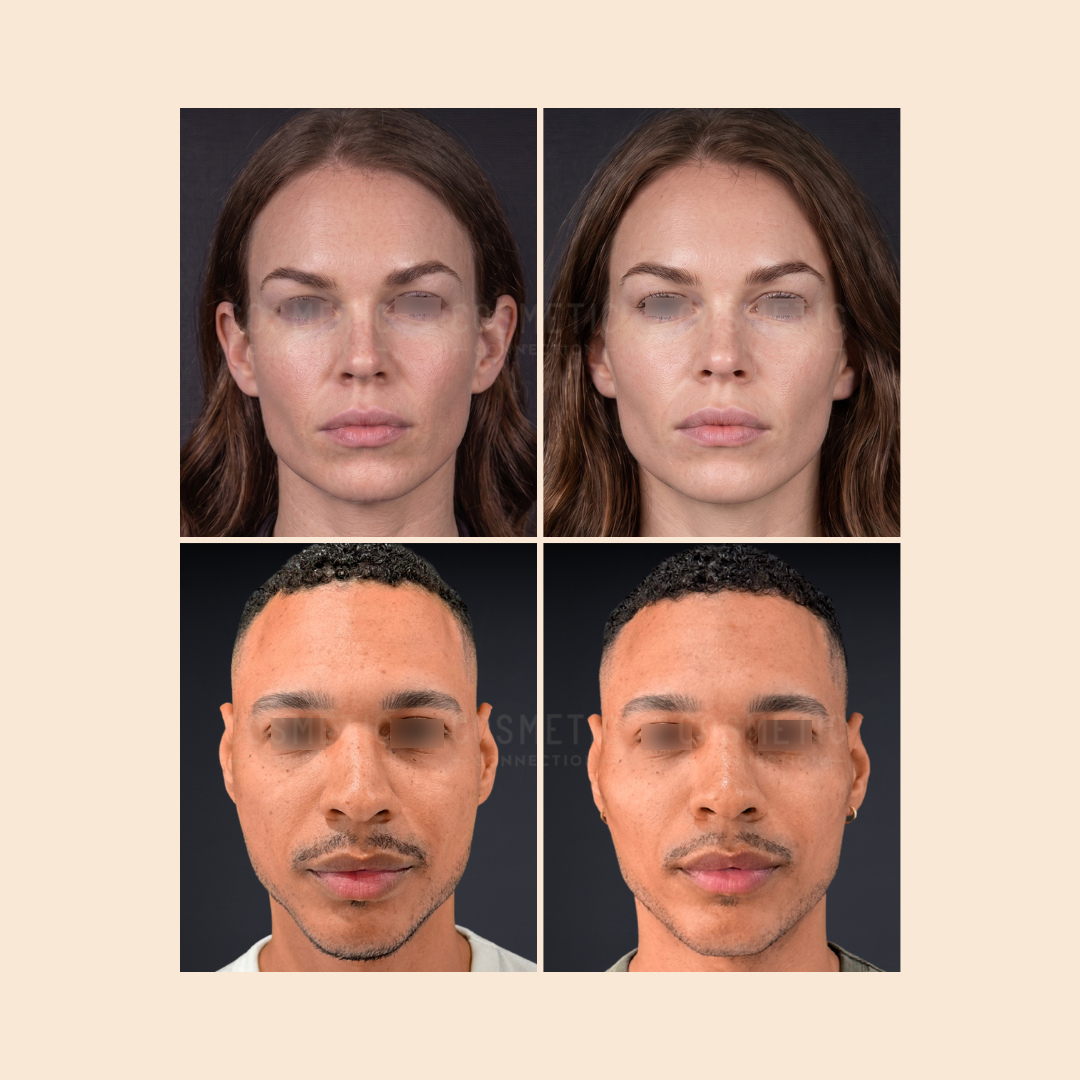
Hollow cheeks and cheek volume loss are often used interchangeably, but they describe different things — and the distinction matters when you’re deciding whether treatment is appropriate and what it might achieve. One is a structural trait. The other is a change that has occurred over time. Understanding which one applies to you shapes everything about how treatment is planned.
Quick answer: Hollow cheeks refers to a facial structure where the mid-face naturally has limited volume — present from early adulthood and part of someone’s characteristic appearance. Cheek volume loss refers to a reduction in mid-face volume that has occurred over time due to ageing, weight change, or other factors. Both can be addressed with non-surgical treatment, but the approach, realistic outcomes, and expectations differ between them.
What hollow cheeks actually means
Hollow cheeks is a structural characteristic — a naturally lean mid-face where the cheekbone is prominent but the soft tissue volume beneath and around it is minimal. Some people have always had this appearance. It’s often associated with a defined, angular facial structure, and for many people it’s a feature rather than a concern.
For others, the same structural characteristic creates a look that reads as gaunt, sharp, or tired — particularly when combined with a lean face overall. The hollowing in this case isn’t new. Photographs from 10 or 15 years earlier show the same characteristic. The person has always looked this way, even if they’re only noticing it now or only now considering doing something about it.
Treating naturally hollow cheeks is a different clinical proposition to treating volume loss. The goal is augmentation — adding something that wasn’t there before — rather than restoration. This requires more careful assessment of how much treatment the anatomy can carry, because the reference point for “natural” is the patient’s own appearance rather than a previous version of it. Getting this wrong produces results that look added rather than belonging.
What cheek volume loss means
Cheek volume loss is a change — a reduction in mid-face soft tissue volume that has occurred over time relative to a previous baseline. The patient can usually identify when it started, or at least when they began to notice it. Photographs confirm it: there’s a visible difference between how the mid-face looks now versus five or ten years ago.
The underlying cause is well-documented. Research published in Dermatologica Sinica (2023) — a cross-sectional study measuring deep fat compartment thickness across age groups — found that the deep medial cheek fat compartment decreases in thickness by approximately 26% between the youngest and oldest study groups, with the suborbicularis oculi fat (the compartment directly beneath the lower eyelid) showing a 36% reduction. These are meaningful structural changes, and they happen progressively in both men and women.
A separate MRI-based study confirmed that this process involves not just volume reduction in upper and middle fat compartments but a downward shift — volume migrates inferiorly rather than simply disappearing. This is why volume loss tends to produce both mid-face hollowing and a heavier appearance in the lower face simultaneously. The fat doesn’t vanish; it relocates.
Other causes can accelerate or compound age-related change:
- Significant weight loss — including that associated with GLP-1 medications — can produce mid-face fat loss disproportionate to overall body change, particularly in people over 40
- High-volume exercise — particularly endurance training — is associated with accelerated facial fat depletion in some individuals
- Smoking — accelerates collagen degradation and skin laxity, compounding the visual effect of volume loss
- Genetics — the rate and pattern of facial fat change varies considerably between individuals and is partially heritable
How to tell which one applies to you
The most reliable way to distinguish between naturally hollow cheeks and acquired volume loss is to look at photographs taken at different ages.
| Indicator | Hollow cheeks (structural) | Volume loss (acquired) |
|---|---|---|
| Old photographs | Same appearance in photos from 10–20 years ago | Visible difference — face looked fuller before |
| When it appeared | Always been present | Gradual onset, often noticed from 30s–50s |
| Under-eye area | May be present but consistent over time | Often worsens as hollowing progresses |
| Nasolabial folds | May be naturally prominent | Often deepened relative to earlier photos |
| Weight changes | Appearance relatively stable through weight fluctuation | May have worsened after weight loss |
| Age of concern | Often noticed in 20s or after dramatic weight change | Typically becomes a concern from mid-30s onward |
In practice, many patients present with a combination — they have always had naturally lean mid-faces, and age-related volume loss has compounded the structural characteristic into something they’re now bothered by. Both elements can be addressed in the same treatment plan, but they require different thinking about placement and quantity.
Why the distinction matters for treatment planning
This distinction matters primarily because it shapes what a realistic outcome looks like and how much change is appropriate.
For volume loss, the reference point for “enough” is the patient’s previous appearance. The goal is to restore structural support and fullness to what was there before. This is usually a conservative amount of treatment, and results tend to look entirely natural because the anatomy already knows how to carry that volume — it had it before.
For naturally hollow cheeks, there is no previous appearance to restore to. The amount of change that looks natural is determined entirely by what the patient’s anatomy can carry — which varies considerably between individuals. Some people with hollow cheeks can achieve meaningful augmentation that looks seamlessly proportionate. Others have anatomy where the treatment quantity required to produce visible change exceeds what the face can carry naturally, and the result risks looking added rather than belonging.
This is exactly the kind of nuance that a proper in-person assessment is designed to surface. At Cosmetic Connection, our approach is suitability-first — we assess whether treatment genuinely serves your concern before we recommend it, and we’re direct about cases where the result may be limited by anatomy. To understand how we structure this assessment, our patient journey page explains the process from first appointment through to results.
For a comprehensive overview of cheek volume treatment — including how both volumising and collagen stimulating approaches work — see our cheek volume treatment guide.
Can both be treated non-surgically?
Yes — both structural hollowness and acquired volume loss can be addressed with non-surgical treatment. The difference is in approach, realistic expectations, and how treatment is planned.
Volumising treatments work for both presentations by placing volume at the appropriate anatomical depth. For volume loss, this typically means restoring support to depleted fat compartments. For structural hollowness, it means adding projection and definition where limited soft tissue support exists. The technical execution differs, but the tools are the same.
The considerations around surgical augmentation are also worth understanding if the degree of change being sought is significant. Our comparison of non-surgical and surgical cheek augmentation covers this in detail, including when surgery may be a more appropriate long-term choice than ongoing non-surgical maintenance.
The cheeks are also one component of broader facial balance. How the mid-face relates to the under-eye area, the jawline, and the lower face is always considered in our assessments. Our facial balancing guide provides useful context for anyone thinking about the face as a whole rather than one feature in isolation.
Get the decide guide
Frequently asked questions
Are hollow cheeks genetic?
Structural hollow cheeks — the kind present from early adulthood — are largely determined by genetics. Bone structure, natural fat distribution, and the specific arrangement of mid-face fat compartments all have a heritable component. This is why hollow cheeks often run in families, and why identical twins tend to age in similar facial patterns. Acquired volume loss is also influenced by genetics — some people deplete mid-face fat earlier or more rapidly than others with similar lifestyles.
Can you have hollow cheeks at any age?
Structural hollow cheeks can be present at any age — some patients in their 20s present with naturally lean mid-faces they’ve had their whole lives. Acquired volume loss typically becomes noticeable from the mid-30s onward, though significant weight loss can produce it at any age. The two can overlap, which is why an in-person assessment that considers the patient’s history and photographs is always more reliable than self-diagnosis.
Do hollow cheeks get worse with age?
Yes — both structural hollow cheeks and acquired volume loss tend to become more pronounced with age. The progressive depletion of mid-face fat compartments documented in research means that any existing hollowness is compounded by natural ageing over time. The rate varies between individuals. Patients with naturally lean mid-faces who have not previously been concerned may find the same characteristic becomes more noticeable in their 40s and 50s as additional volume loss accumulates.
Is there a natural option for hollow cheeks or volume loss?
Diet and lifestyle changes can influence overall body fat, but they have limited impact on the specific distribution of mid-face fat compartments. Weight gain may restore some facial volume in people who have lost significant weight, but it is not a targeted solution and comes with other implications. There is no topical product that meaningfully restores structural mid-face volume — the changes occur at a tissue depth that surface products cannot reach.
How much treatment is needed to address hollow cheeks vs volume loss?
This varies significantly between individuals and cannot be estimated without an in-person assessment. Generally speaking, volume loss restoration — where the goal is returning to a previous state — tends to require modest treatment that reflects what has been lost. Structural augmentation of naturally hollow cheeks may require more treatment to produce a visible result, depending on the individual’s anatomy. Both scenarios benefit from a staged approach — starting conservatively and adding if needed — rather than attempting full correction at a single appointment.