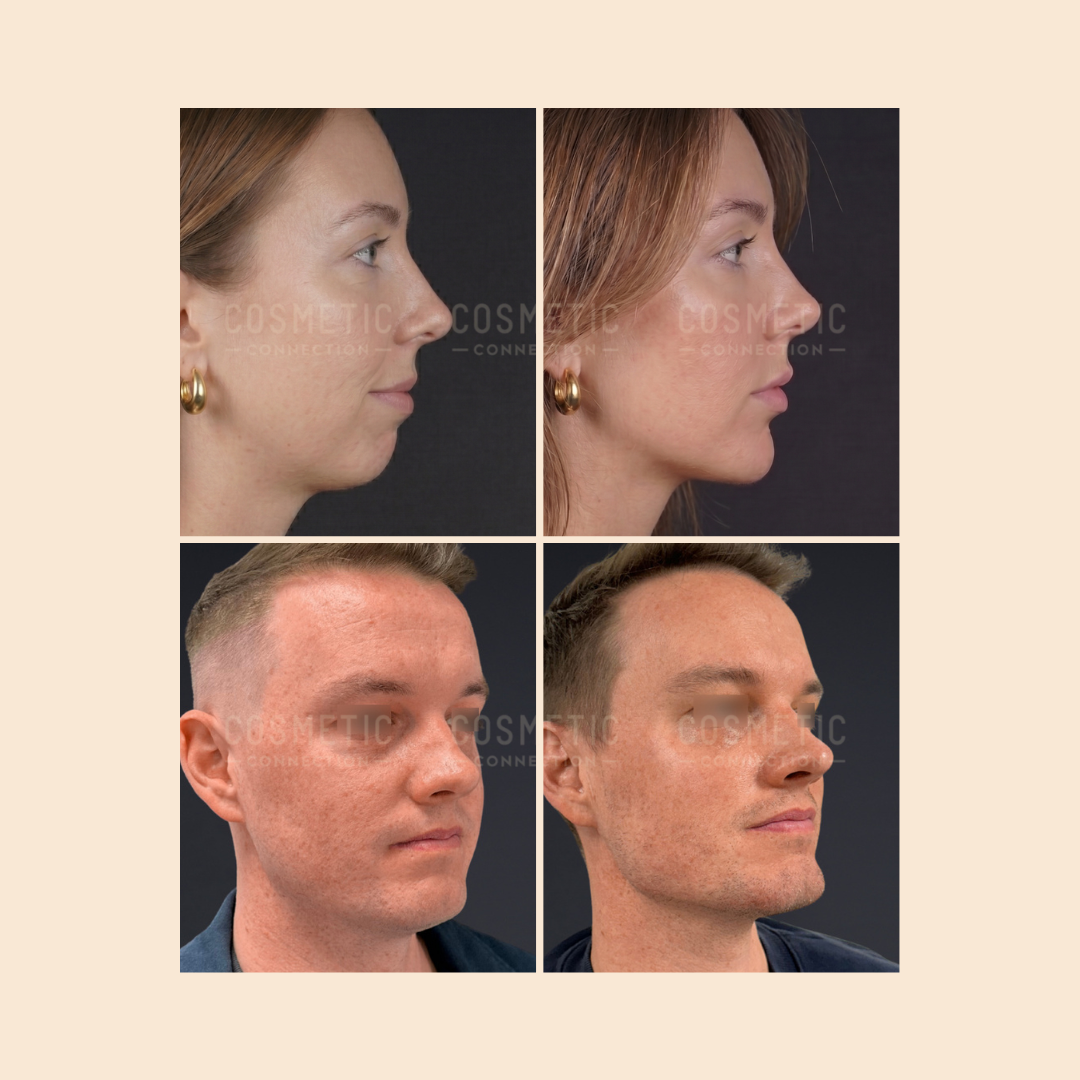
Jawline contouring results vary between individuals — and understanding what shapes that variation is more useful than looking at a single before and after photo. This guide covers what drives good outcomes, what different face types can expect, and how to read before and after images honestly.
Quick answer: Jawline contouring results are visible immediately and look best at two weeks once initial swelling has settled. The degree of change depends on the starting anatomy, the areas treated, and the volume placed. Most people see a sharper jaw border, improved lateral definition, and a better profile — without looking like they have had a procedure.
What changes and what stays the same
Non-surgical jawline contouring creates structural change — it adds volume at precise anatomical points to sharpen the jawline border, define the jaw angle, and improve the profile. What it does not do is change the underlying bone structure, remove fat, or tighten lax skin. Understanding this distinction helps set expectations correctly.
The most meaningful results tend to occur in people who have a generally defined face but lack specific structural sharpness along the jaw border — particularly at the angle and along the body of the jaw toward the chin. People with significant submental fat, heavy jowls, or very lax skin may see a more limited result from jawline contouring alone, and may benefit from additional or alternative approaches.
How the starting anatomy affects results
The single biggest predictor of how much change is visible from jawline contouring is the starting anatomy.
People with a naturally well-defined bone structure but soft tissue covering the definition — either from mild fat distribution or moderate skin laxity — tend to see the most dramatic improvement. Adding structure in the right places reveals a jawline that was always there.
People with a genuinely underdeveloped mandible can see meaningful improvement non-surgically, but the ceiling is lower than in people with good underlying structure. For significant structural deficits, surgery produces a more dramatic result.
People with excess submental fat are often better served starting with under-chin fat reduction before jawline volumising, because the fat can obscure the benefit of added structure. Our guide to double chin removal covers that approach.
Results by concern: what each group typically sees
| Primary concern | Typical result | Timeline |
|---|---|---|
| Undefined lateral jaw border | Sharper, more visible jaw outline from front and side | Visible day 1, best at 2 weeks |
| Soft jaw angle | More defined angle, stronger side profile | Visible day 1, best at 2 weeks |
| Recessed chin combined with jawline | Improved profile, more cohesive lower face | Visible day 1, best at 2 weeks |
| Age-related lower face softening | Restored structure, improved jowl appearance | Visible day 1, evolves over 4 weeks |
| Facial asymmetry — jaw | Reduced visible asymmetry, more balanced front view | Best assessed at 2–4 weeks |
Male vs female results: what looks right differs
A good jawline result looks different on a male face than a female face — and understanding this matters when you are looking at before and after images.
In women, the goal is typically a smooth lateral border that tapers gracefully toward the chin, with no harsh angles. A result that looks dramatic on a woman’s jawline may look unnatural. The ideal female outcome reads as refined rather than sharp.
In men, visible angularity at the jaw angle is aesthetically appropriate. A squarer, more defined lower face reads as masculine. The goal is structural clarity rather than softness. What would look too strong on a female face can look exactly right on a male one.
This is why before and after images from one gender do not always translate to the other. When evaluating results, look at images of the same gender and a similar starting anatomy to yours. Our dedicated guide to jawline contouring for men covers male-specific results in more detail.
Get started
How to read before and after images honestly
Before and after images are useful but need to be read carefully. A few things to look for:
Lighting and angle. Changes in lighting can make a jawline look more or less defined independently of any treatment. A good before and after is taken under standardised lighting at the same angle. If the after image has better lighting or a more flattering angle, that is doing some of the work the treatment should be doing.
Time from treatment. Results shown immediately after treatment include swelling, which temporarily exaggerates definition. The most accurate after images are taken at two to four weeks.
Zoom and crop. An after image zoomed into the jaw at a specific angle may look more impressive than a full-face view of the same result. Look for consistent framing between before and after.
Starting anatomy match. A result on someone with good underlying structure may look very different to what you would achieve with a different starting point. Look for cases that match your own anatomy as closely as possible.
At Cosmetic Connection, our before and after images are taken under consistent conditions and represent real patient outcomes across a range of starting anatomies. Our patient journey page explains how we plan and deliver treatment.
Before and after jawline contouring
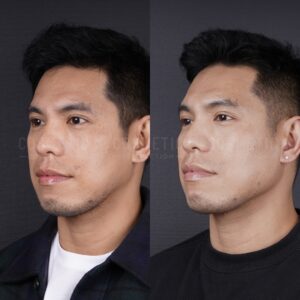
Before and after jawline contouring.
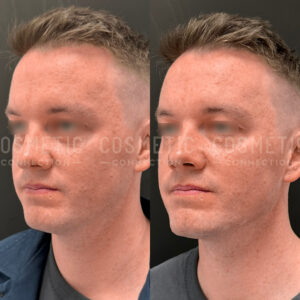
Before and after jawline contouring.
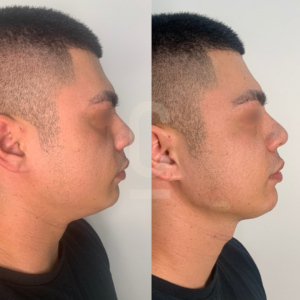
Before and after jawline contouring.
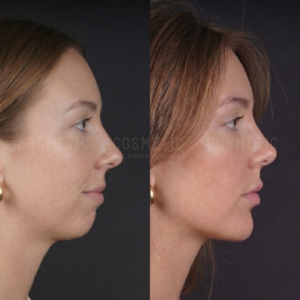
Before and after jawline contouring.
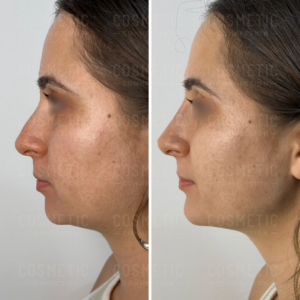
Before and after jawline contouring.
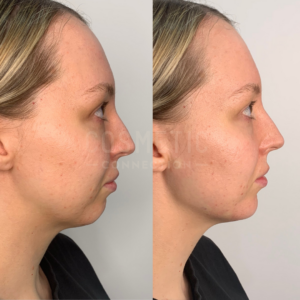
Before and after jawline contouring.
How long results last
Most people find their jawline contouring results are maintained for 12–18 months before a review or top-up is needed. The main factors that affect longevity are individual metabolism, the amount of volume placed, and the specific area treated.
In our clinical experience, patients who return at around 12 months for a review often need less treatment than their initial session — partly because the result has partially maintained, and partly because they now know exactly what they want and can be more targeted. Over time, many people extend the interval between treatments.
The jawline is also an area where treatment compounds. People who maintain consistent treatment over several years often achieve a cumulative structural improvement that looks and lasts better than any single session.
Get started
Frequently asked questions
How soon can I see my jawline contouring results?
Results are visible immediately. The initial appearance immediately after treatment often includes some mild swelling that temporarily exaggerates definition — the true result settles at around two weeks. Most people find the two-week result is what they will live with long-term.
What if I am not happy with my jawline contouring result?
The first step is always to wait until two weeks before assessing the result — early swelling and temporary asymmetry can be misleading. If after two weeks the result does not meet your expectations, a review appointment is the appropriate next step. Non-surgical jawline contouring is reversible if needed.
Can I get more definition than the first treatment achieved?
Yes. Many people start conservatively and build toward their desired result over two or three sessions. This is often a better approach than maximising volume in a single session — it allows the result to be refined as you see how your face responds.
Do results look natural?
When planned and placed correctly, yes. A well-executed jawline contouring result reads as a better version of your own face — not as an obvious cosmetic procedure. The goal is never to impose a look, but to enhance what is already there.