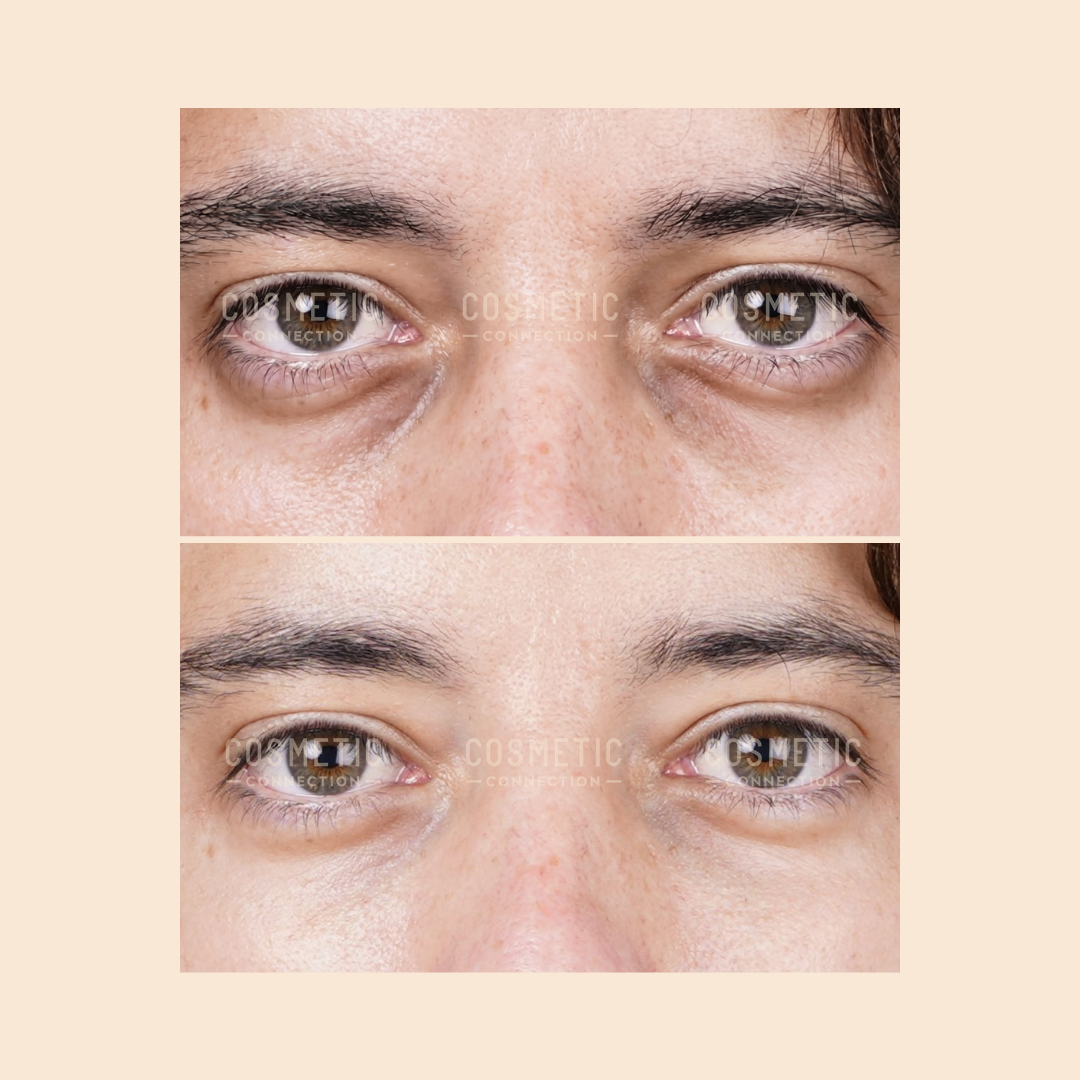
Under eye and tear trough treatment in Australia typically costs between $1,800 and $4,000 per appointment. That is a wide range — and understanding what drives it will help you evaluate quotes accurately and avoid the most common mistake people make when pricing this treatment.
This post breaks down the genuine cost variables, what is typically included in a quote, and why pricing transparency matters more for this treatment than almost any other non-surgical procedure.
Quick answer: Under eye treatment in Australia ranges from approximately $1,800 to $4,000 per appointment. The variation reflects the extent of treatment required, the clinician’s experience and qualifications, the product or combination of products used, and the geographic location of the clinic. A flat-fee pricing model gives you the clearest picture of what you will actually pay before you commit.
What drives the cost of under eye treatment?
Several legitimate factors account for the price variation you will see across providers in Australia. Understanding each one helps you compare quotes on equal terms.
Extent of treatment
The tear trough does not exist in isolation. In many cases, addressing under-eye hollowing effectively means treating adjacent areas — particularly the mid-face, which provides structural support beneath the eye. A result that looks natural and lasts well often requires a broader treatment plan than a single isolated area. More areas treated means a higher overall cost.
Clinician experience and qualification
The under-eye area carries a more complex risk profile than most non-surgical treatment zones. Experienced, medically qualified clinicians — particularly those with a focused scope in facial anatomy — typically charge at the higher end of the range. This reflects the years of training, the clinical infrastructure required to manage complications safely, and the lower revision rate that comes with experience.
Product selection
Different non-surgical volume products have different characteristics — viscosity, longevity, and behaviour in thin tissue vary significantly. Products specifically formulated for the delicate periorbital area are often priced differently from general-purpose alternatives. In some cases, a combination approach using more than one product type is clinically preferred.
Clinic location
Clinic overheads in Sydney and Melbourne CBD locations are higher than in outer suburbs or regional areas, and this is reflected in treatment pricing. Our clinic locations span both Sydney and Melbourne, with pricing consistent across our network.
What is typically included in a quote?
This is where the comparison gets complicated. Some clinics price per millilitre of product. Others quote a flat treatment fee. Others quote a consultation fee separately. The numbers may look similar on paper but deliver very different experiences.
| Pricing model | What it means | Risk to you |
|---|---|---|
| Per-mL pricing | You pay for each unit of product used | The final cost is unknown until after treatment — and it can escalate significantly if more product is used than initially discussed |
| Flat-fee pricing | One price covers the full treatment regardless of volume used | Low — you know the cost before you commit |
| Consultation fee separate | An initial consultation fee applies before treatment pricing is confirmed | Moderate — factor this into your total cost comparison |
| Package pricing | Treatment is bundled with skincare or other services | Can obscure the true cost of the treatment itself |
At Cosmetic Connection, we use a flat-fee pricing model. The price confirmed at your consultation is the price you pay. There are no per-mL charges applied retrospectively, and no hidden additions.
Why the cheapest quote is rarely the best decision for this area
Under eye treatment is one of the highest-risk non-surgical procedures offered in cosmetic medicine. The anatomy is complex, the tissue is thin, and complications — including blue-grey discolouration beneath the skin, lumps, and in rare cases vascular events — are more likely when treatment is performed by someone without adequate training or experience in this specific area.
The cost of correcting a result that has gone wrong — through revision treatment, reversal, or management of a complication — can easily exceed the cost difference between a budget provider and an experienced clinician. In our experience, the patients who present for correction are not typically those who spent the most on their original treatment.
A 2024 meta-analysis published in Aesthetic Plastic Surgery covering 2,556 participants found that contour irregularities occurred in approximately 5.3% of cases, and visible skin discolouration in 0.9%. These rates are not uniform across providers — they are meaningfully influenced by clinician skill and product selection.
Get started
Is the cost of under eye treatment covered by Medicare or private health insurance?
No. Non-surgical cosmetic treatments are not covered by Medicare or private health insurance in Australia. The full cost is an out-of-pocket expense. Some clinics offer payment plan options — it is worth asking about this at your consultation.
For information on payment options available at Cosmetic Connection, visit our payment options page.
What to ask at your consultation before committing
A consultation for under eye treatment should include a clear pricing conversation. The questions worth asking before you agree to proceed:
- Is the quoted price a flat fee, or is it per unit of product?
- What happens if more product is needed than initially planned — is there an additional cost?
- Is the consultation fee separate from, or credited toward, the treatment cost?
- Does the quoted price include any follow-up review?
- What is the clinic’s policy if you are not satisfied with the result?
Transparent answers to these questions are a reasonable baseline expectation from any reputable provider. For more guidance on choosing the right provider for this treatment, see our post on how to choose the right under eye treatment provider.
For a full picture of what is involved in under eye treatment — including how it works, who it suits, and what results look like — see our complete guide to under eye treatment.
Get started
Frequently asked questions
How much does under eye treatment cost in Sydney?
In Sydney, under eye treatment typically falls within the $1,800 to $4,000 range. Higher-end pricing in Sydney CBD reflects clinic overheads and, in many cases, the experience level of the treating clinician. Always confirm whether the quote is a flat fee or per-mL before proceeding.
How much does under eye treatment cost in Melbourne?
Melbourne pricing follows a similar range of $1,800 to $4,000. As with Sydney, the key variable is whether you are comparing flat-fee quotes or per-mL quotes — these are not equivalent numbers even when they look similar on paper.
Why is under eye treatment more expensive than other facial treatments?
The under-eye area requires more clinical precision than most other treatment zones, carries a higher risk profile, and typically demands more time and expertise to achieve a natural result. Clinicians who specialise in this area invest significantly in training and maintain clinical infrastructure — including reversal agents and complication management protocols — that adds to the cost of safe treatment delivery.
Does the cost change if I need retreatment?
Yes — retreatment is priced as a separate appointment. Most people find results last 12 to 18 months, after which a maintenance appointment is needed to sustain the improvement. Some clinics offer returning patient pricing — ask about this at your initial consultation.
Is a cheaper clinic a red flag?
Significantly below-market pricing for under eye treatment warrants scrutiny. It may reflect a less experienced clinician, a lower-quality product, or a per-mL model where the final cost will be higher than the initial number suggested. Ask specifically about clinician qualifications and what is included in the quoted price before deciding.
References
- Liu X, Gao Y, Ma J, Li J. (2024). The efficacy and safety of hyaluronic acid injection in tear trough deformity: a systematic review and meta-analysis. Aesthetic Plastic Surgery, 48(3), 478–490. https://link.springer.com/article/10.1007/s00266-023-03613-7
- Rao BK, Berger LE, Reilly C, Alamgir M, Galadari H. (2022). Tear trough filler techniques utilizing hyaluronic acid: a systematic review. Plastic and Reconstructive Surgery, 149(5), 1079–1087.
- Yip J et al. (2024). Anti-aging trends in Australia. Journal of the European Academy of Dermatology and Venereology. https://onlinelibrary.wiley.com/doi/abs/10.1111/jdv.19647