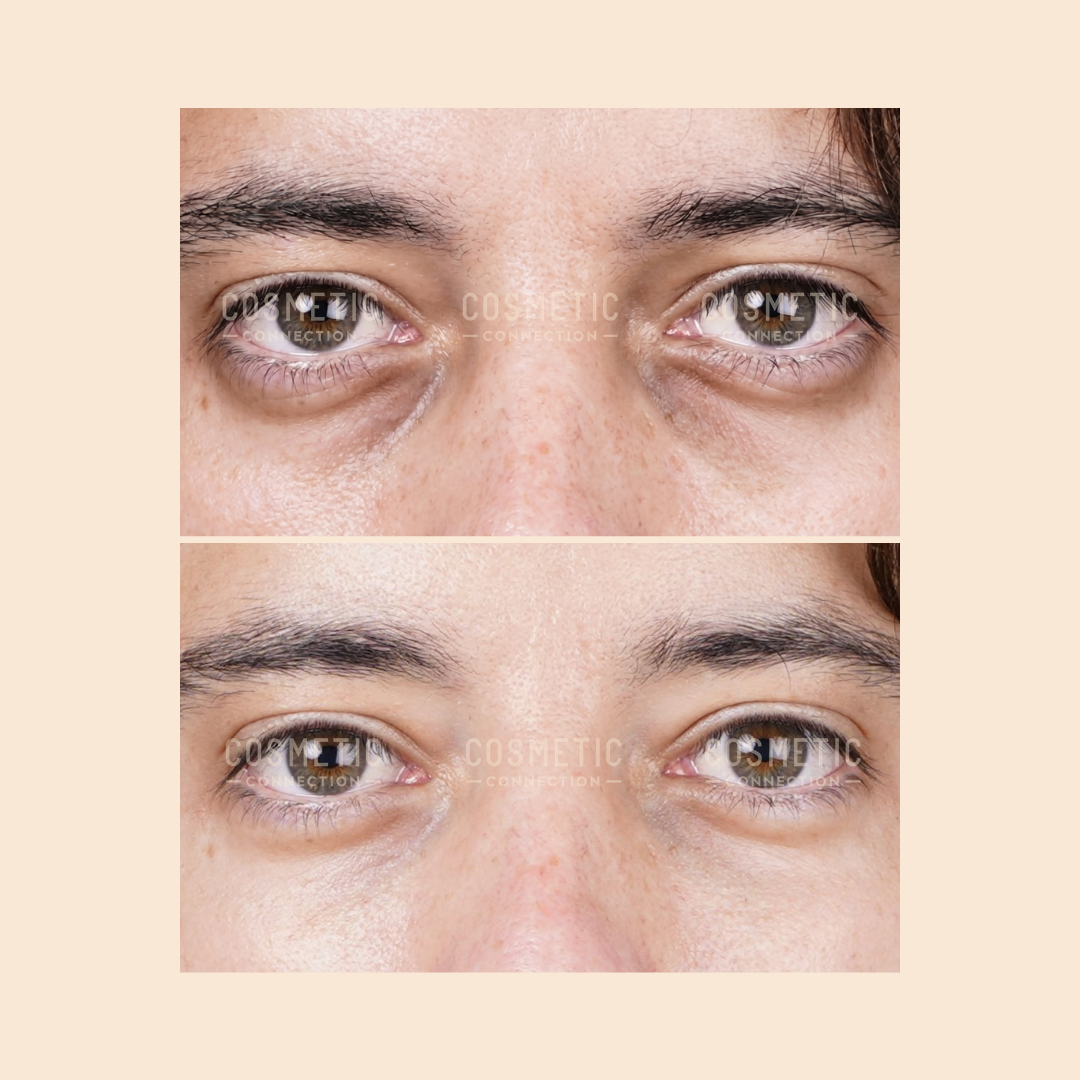
Provider selection matters for most non-surgical cosmetic treatments. For under eye treatment, it matters more than almost anywhere else. The anatomy is complex, the tissue is unforgiving, and the consequences of treatment placed incorrectly are visible, difficult to correct, and sometimes permanent. Choosing well is the single most important thing you can do to protect your outcome.
This post sets out exactly what to look for — and what to be cautious about — when choosing a provider for under eye treatment.
Quick answer
The most important factors when choosing a provider for under eye treatment are medical qualification, specific experience in periorbital anatomy, a suitability-first approach, transparent flat-fee pricing, and the presence of reversal agents on-site. The under-eye area is not an appropriate zone for treatment by less experienced clinicians, and cost should be a secondary consideration to clinical credentials.
Why provider selection matters more here than elsewhere
The tear trough sits at the convergence of several anatomical risks. The skin is the thinnest on the face. The blood vessels in the periorbital region include branches that connect to the ophthalmic circulation. The tissue holds product differently than other areas of the face, and the margin between a subtle, natural result and a visible complication is narrow.
A 2024 meta-analysis published in Aesthetic Plastic Surgery reported complication rates including contour irregularities in 5.3% of cases and visible skin discolouration in 0.9%. These are averages. They do not represent what happens in the hands of every provider equally — and the evidence consistently shows that complication rates are significantly influenced by clinician experience and product selection.
The risk profile of under eye treatment is manageable in skilled hands and disproportionately elevated in less experienced ones.
The most important selection criteria
1. Medical qualification and periorbital-specific experience
Not all medical practitioners are equally trained for this treatment zone. A general cosmetic nurse or injector with broad facial experience is not the same as a clinician who has developed specific competence in periorbital anatomy and under-eye treatment. Ask directly:
- What is your medical qualification?
- How many under eye treatments do you perform per month?
- What training have you done specifically in the periorbital area?
An experienced, medically qualified clinician should answer these questions without hesitation. A provider who deflects or gives vague answers to qualification questions is a meaningful warning sign.
2. A genuine suitability-first approach
One of the clearest markers of a responsible provider is a willingness to say no. Under eye treatment is not suitable for everyone, and a clinic that proceeds with everyone who presents — without conducting a real suitability assessment — is prioritising revenue over outcomes.
At consultation, a proper assessment should include evaluation of your lower eyelid skin quality, the depth and character of your tear trough, the presence or absence of orbital fat herniation, and the structural support of your mid-face. If a clinician proceeds to treat you without examining these things, that is a warning sign.
For a detailed breakdown of who is and is not well-suited to this treatment, see our post on under eye treatment suitability.
3. Reversal agents on-site
The most commonly used products for under eye treatment can be dissolved quickly if a complication arises. But this only matters if the clinic actually carries the dissolving agent on-site and the clinician knows how to use it. Ask this directly. The answer tells you something important about how the clinic approaches safety.
4. Transparent, flat-fee pricing
Per-mL pricing models are common in cosmetic treatment, but they are particularly problematic for under eye treatment — where the amount of product used can shift during a session and the final cost may be significantly higher than the opening number. A flat fee for the full treatment, confirmed before anything begins, is the clearest pricing model and the most transparent for the patient.
For a full breakdown of what drives cost variation and how to compare quotes accurately, see our post on under eye treatment costs in Australia.
5. A defined follow-up and outcomes policy
Ask what happens if you are not satisfied with the result. A provider who offers no follow-up, has no outcomes policy, and will not discuss correction is not one who will stand behind their work. A two-week review appointment is standard practice at a responsible clinic, and a clear policy on how complications and unsatisfactory results are managed should be something you can understand before you commit.
Red flags: what to be cautious about
| Red flag | Why it matters |
|---|---|
| Pricing significantly below market ($500–$900) | Under-eye treatment at this price point almost always reflects either an inexperienced clinician, an inappropriate product, or a per-mL model where the final cost will escalate |
| No consultation before treatment proceeds | A same-day consultation-and-treat model does not allow for proper suitability assessment |
| Treating everyone who presents | Responsible providers decline some patients. A 100% treatment rate signals that suitability is not being genuinely assessed |
| Unable to answer questions about qualifications | Experienced, qualified clinicians are transparent about their training and credentials |
| No reversal agents on-site | This is a basic safety standard for any provider working in the periorbital area |
| Before-and-after images with no visible variation in outcomes | Real clinical results vary. Curated galleries showing only perfect outcomes may not reflect the full picture |
Get started
How a doctor-led approach changes the risk profile
Under eye treatment in a doctor-led clinic differs from the same treatment in a nurse-led or beauty-focused setting in ways that materially affect your risk. Doctors bring a deeper understanding of anatomy, a broader capacity to manage complications, and a higher regulatory standard of accountability for clinical decision-making.
At Cosmetic Connection, our doctor-led approach means that clinical decisions — including the decision not to treat — are made by practitioners who understand the full anatomical picture and operate under the standards expected of medical professionals. Treatment is concern-based and suitability-first, not appointment-focused.
This matters beyond the under-eye area. If you are interested in other facial concerns — whether that is the nose, jawline, lips, or a non-surgical rhinoplasty — the same clinical standards apply across every treatment we offer.
Questions to ask at your consultation
Before committing to any provider for under eye treatment, ask these questions and note how they are answered:
- What is your medical qualification and how many under eye treatments do you perform per month?
- Do you carry reversal agents on-site?
- What is your pricing model — flat fee or per mL?
- What does your suitability assessment involve, and do you ever decline to treat?
- What is your policy if I am not satisfied with the result?
- Do you offer a follow-up review appointment, and is it included in the cost?
These are not difficult questions. A provider who answers them confidently and directly is one who has thought about these things. One who hedges, deflects, or becomes defensive is giving you useful information.
To understand more about the complete treatment — how it works, what results look like, and what the experience involves — see our complete guide to under eye treatment.
Get started
Frequently asked questions
Can a nurse perform under eye treatment safely?
Registered nurses with specific advanced training in periorbital anatomy can perform this treatment. The credential alone is less important than the specific training and experience in this treatment zone. Ask directly about periorbital-specific training and volume of experience, not just general qualifications.
Is a cosmetic clinic the same as a medical clinic for this treatment?
Not necessarily. The term “cosmetic clinic” covers a wide range of settings — from doctor-led medical practices to beauty salons offering cosmetic treatments. What matters is the qualification and specific experience of the person performing your treatment, and whether the clinical infrastructure — including reversal agents and complication management protocols — is in place.
How do I know if before-and-after photos are a reliable indicator of a clinic’s results?
Before-and-after galleries show selected outcomes. To get a more realistic picture, look for a range of results — not only the most dramatic improvements — and ask whether the photos were taken at one week or at full settlement (typically two to four weeks). Results at one week often look different from final outcomes.
Does it matter if a clinic is TGA compliant?
Yes. TGA compliance in advertising reflects a clinic’s broader relationship with regulatory standards. A clinic that makes inflated or misleading claims in its marketing is giving you information about how it operates generally.
Should I go to the cheapest provider I can find for this treatment?
We would strongly advise against making cost the primary selection criterion for under eye treatment. The cost of correcting a poorly performed result — including reversal, repeat treatment, and in some cases long-term management — can far exceed the difference between a budget provider and an experienced clinician. For this specific treatment area, the investment in the right provider is genuinely meaningful.
References
- Liu X, Gao Y, Ma J, Li J. (2024). The efficacy and safety of hyaluronic acid injection in tear trough deformity: a systematic review and meta-analysis. Aesthetic Plastic Surgery, 48(3), 478–490. https://link.springer.com/article/10.1007/s00266-023-03613-7
- Rao BK, Berger LE, Reilly C, Alamgir M, Galadari H. (2022). Tear trough filler techniques utilizing hyaluronic acid: a systematic review. Plastic and Reconstructive Surgery, 149(5), 1079–1087.
- Yip J et al. (2024). Anti-aging trends in Australia. Journal of the European Academy of Dermatology and Venereology. https://onlinelibrary.wiley.com/doi/abs/10.1111/jdv.19647