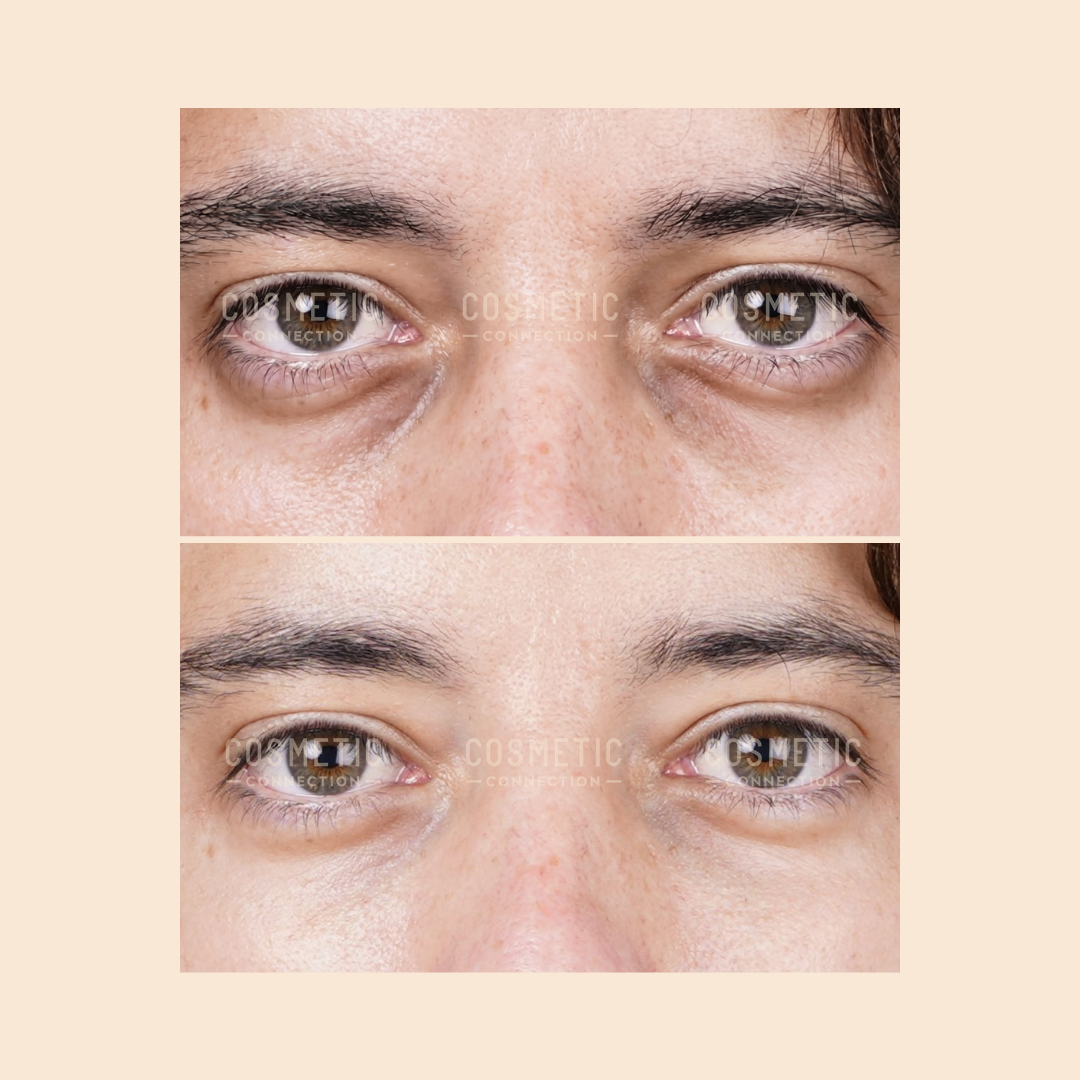
Under eye and tear trough treatment has one of the more complex risk profiles of any non-surgical cosmetic procedure. That is not said to alarm — it is said because understanding this is essential to making a good decision about whether to proceed, and with whom.
This post covers the full range of what can occur after under eye treatment: the common, temporary side effects that are expected in many cases, and the less common complications that require clinical management. It also covers what reduces risk most reliably — because that is information you can act on.
Quick answer: Common side effects of under eye treatment include swelling and bruising, which are temporary and typically resolve within one to two weeks. Less common complications include visible product under the skin, contour irregularities, and — rarely — vascular events. Risk is substantially influenced by clinician experience and product selection. All volume products used in this area can be dissolved if a complication arises.
Expected side effects: what is normal after under eye treatment
Some degree of swelling and bruising following under eye treatment is normal and not a sign that something has gone wrong. The periorbital area has a rich blood supply and thin, fragile tissue, which makes it more reactive than most other treatment sites.
Swelling
Swelling is the most common side effect and is expected in the majority of cases. It is usually most noticeable in the first 24 to 48 hours and tends to resolve within one to two weeks. In some people, mild swelling persists slightly longer. The final result is not visible until swelling has fully resolved.
Bruising
Bruising occurs in a meaningful proportion of patients — a 2024 meta-analysis published in Aesthetic Plastic Surgery, covering 31 studies and 2,556 participants, reported bruising in approximately 18% of cases. It is more likely in people who take blood-thinning medications, consume alcohol in the days before treatment, or have naturally fragile capillaries. Bruising in this area can take up to two weeks to resolve and, for many people, will be visible socially during that time.
Tenderness
The under-eye area may feel tender to the touch for several days after treatment. This is normal and resolves without intervention.
Less common complications and what causes them
The complications below are less frequent but clinically important. Understanding them helps you identify warning signs early and respond appropriately.
Tyndall effect (blue-grey skin discolouration)
The Tyndall effect occurs when product is placed too superficially beneath very thin skin, causing a visible blue-grey discolouration. It is one of the most commonly cited complications in periorbital treatment and is largely a function of technique and product selection. Placing product too close to the skin surface in an area with minimal tissue between the product and the outside world creates visible discolouration that does not resolve on its own. The same 2024 meta-analysis found a Tyndall effect rate of 0.9% across published studies — but this rate varies significantly with clinician experience. It is reversible with dissolving treatment.
Contour irregularities and lumps
Lumps or visible irregularities occur in approximately 5.3% of cases according to published meta-analysis data. They can result from uneven product placement, product migration, or the body’s response to the material. Mild irregularities often resolve as the product settles. Persistent or significant lumps may require dissolving treatment to correct.
Asymmetry
Minor asymmetry immediately after treatment is common, as swelling rarely distributes perfectly evenly between both sides. Persistent asymmetry after swelling has fully resolved may require a small correction at a follow-up appointment. This is not unusual and is straightforward to address.
Product migration
In some cases, product can move slightly from where it was originally placed, creating puffiness or a subtle fullness in an unintended area. Migration in the periorbital area is more likely when too much product is used, when it is placed at an incorrect depth, or in patients whose tissue does not hold volume well in this zone. It can be corrected with dissolving treatment.
Get started
Rare but serious risks
Vascular occlusion
Vascular occlusion occurs when product enters or compresses a blood vessel, restricting blood flow to the tissue it supplies. In the periorbital area, this is a serious complication that requires immediate recognition and management. Symptoms include sudden blanching or mottling of the skin, pain, or changes to vision. Any of these signs after treatment require immediate contact with your treating clinician or emergency services.
This complication is rare — but its likelihood is meaningfully reduced when treatment is performed by a clinician with specific training in periorbital anatomy, who uses appropriate technique, and who carries dissolving agents on-site for immediate use if needed.
Visual disturbance
Extremely rarely, product entering the ophthalmic vascular territory can affect vision. This is considered one of the most serious potential complications of any facial volume treatment and underscores why the under-eye area requires a higher standard of clinical expertise than most other treatment zones.
What reduces risk most reliably
The single most important risk-reduction factor is provider selection. The complication rates in published literature represent averages across a wide range of providers and clinical settings. In our clinical experience, the most common presentations we see for correction involve treatment performed by clinicians who lacked specific training in the periorbital area, used inappropriate product choices, or placed product at an incorrect depth.
The practical factors that meaningfully reduce risk:
- Clinician qualification and experience: specifically in periorbital anatomy and under-eye treatment, not just general facial treatment
- Suitability assessment: declining to treat patients whose anatomy makes a good outcome unlikely
- Reversal agents on-site: the ability to immediately dissolve product if a complication arises
- Conservative volume placement: using the minimum effective amount rather than over-treating
- Appropriate product selection: using formulations suited to the specific characteristics of periorbital tissue
For guidance on what to look for when choosing a provider for this treatment, see our post on how to choose the right under eye treatment provider.
What to do if something does not look right
If you have had under eye treatment and something does not seem right — whether that is unusual swelling, visible discolouration, pain, or anything involving your vision — contact your treating clinician promptly. Do not wait and hope it resolves. The earlier a complication is identified, the more straightforwardly it is managed.
If you experience any change to your vision, pain, or skin blanching immediately after treatment, treat it as a medical emergency and seek urgent care.
All volume products commonly used in under eye treatment are reversible. This is not a trivial point — it means that most complications, when identified in time, can be corrected with a dissolving treatment.
To understand who is and is not well-suited to this treatment before proceeding, see our post on suitability for under eye treatment.
For a complete overview of the treatment — how it works, what it costs, and what results look like — see our complete guide to under eye treatment.
Get started
Frequently asked questions
How long does bruising last after under eye treatment?
Bruising typically resolves within one to two weeks. It can occasionally take slightly longer in people who bruise easily. Applying ice immediately after treatment, avoiding alcohol, and staying upright for several hours after the procedure can all help minimise the extent of bruising.
What does the Tyndall effect look like and will it go away?
The Tyndall effect appears as a blue or grey tint beneath the skin in the treated area. It does not resolve on its own but can be corrected with a dissolving treatment. If you notice blue-grey discolouration after under eye treatment, contact your treating clinician.
Can under eye lumps resolve on their own?
Minor irregularities in the first two weeks after treatment can sometimes resolve as swelling subsides and product settles. Lumps that persist beyond two to three weeks are unlikely to resolve without intervention and should be assessed by your clinician. Dissolving treatment is straightforward and effective for persistent lumps.
Is it normal for under eye treatment to look worse before it looks better?
Yes — in the first few days, swelling can make the treated area appear fuller or puffy than expected. This is normal and does not reflect the final result. The true outcome becomes visible once swelling has resolved, typically within one to two weeks.
How do I know if I am having a vascular complication?
Warning signs of a vascular complication include sudden skin blanching (whitening), skin that becomes mottled or takes on a dusky purple colour, pain in the treated area, or any change to your vision. These signs require immediate medical attention. Contact your treating clinician or present to an emergency department without delay.
References
- Liu X, Gao Y, Ma J, Li J. (2024). The efficacy and safety of hyaluronic acid injection in tear trough deformity: a systematic review and meta-analysis. Aesthetic Plastic Surgery, 48(3), 478–490. https://link.springer.com/article/10.1007/s00266-023-03613-7
- Rao BK, Berger LE, Reilly C, Alamgir M, Galadari H. (2022). Tear trough filler techniques utilizing hyaluronic acid: a systematic review. Plastic and Reconstructive Surgery, 149(5), 1079–1087.
- Kang Y et al. (2024). Static and dynamic filler-associated tear trough deformities: manifestations and treatment algorithm. Aesthetic Plastic Surgery, 48(14), 2642–2650. https://link.springer.com/article/10.1007/s00266-024-04089-9