Chin contouring results can be genuinely transformative — improving the profile, balancing the face, and changing how the whole lower face reads. But what you should expect depends significantly on your starting anatomy. This guide explains what shapes outcomes, what different starting points can realistically achieve, and how to evaluate before and after images with clear eyes.
Quick answer: Chin contouring results are visible immediately and best evaluated at two weeks once any initial swelling has settled. The degree of change depends on the starting anatomy, the areas addressed, and the volume placed. Most people see improved profile projection, better lower face balance, and a sharper chin-to-neck transition.
What chin contouring actually changes
Non-surgical chin contouring changes the structural appearance of the chin by adding precise volume at anatomical reference points. The result is not a puffier chin — it is a structurally repositioned one. The chin projects further, the profile reads more balanced, and the relationship between the chin, jawline, and nose shifts.
What chin contouring does not do: it cannot remove bone, reposition the mandible, or reduce chin size. People seeking a smaller or shorter chin are better served by other approaches, and that assessment happens at consultation.
The profile result: where the change is most visible
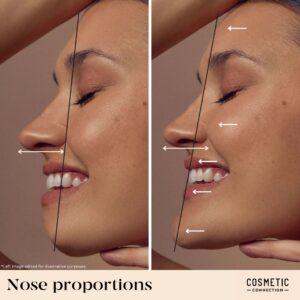
The profile view is where chin contouring results are typically most dramatic. A chin that sits behind the vertical plane of the lips and forehead in the side-on view creates a face that reads as soft or receding — even when the front view looks balanced. Adding forward projection in this context can fundamentally change how the face reads from the side.
The cervicomental angle — the angle between the chin and the neck — is also often improved. A more projected chin creates a cleaner separation between the jaw and the neck, which is one of the reasons chin treatment can make someone look like they have lost weight without any change in body composition.
The chin and jawline work together to create the profile. Most people who see the most satisfying chin results also address the jawline, because the two together create a lower face that reads as cohesive rather than piecemeal. Our complete jawline guide covers that relationship.
How starting anatomy shapes your result
| Starting anatomy | Typical result from non-surgical chin contouring |
|---|---|
| Mildly recessed chin, good skin quality | Significant profile improvement — often the most impactful application |
| Short chin, balanced projection | Improved lower face proportions, better facial thirds balance |
| Asymmetric chin | Reduced visible asymmetry — rarely perfectly symmetrical but meaningfully improved |
| Ageing chin with volume loss | Restored structure and support, improved jowl appearance in context |
| Significantly underdeveloped chin | Meaningful but limited improvement — surgery may be needed for dramatic change |
| Chin cleft or bum chin | Softened appearance — technically nuanced but achievable with precise placement |
Male vs female chin results: different goals, different outcomes
A good chin result looks different depending on the individual’s aesthetic goals and facial structure. In women, the goal is typically a more refined, tapered result — added projection without width, maintaining or enhancing a soft V-shape. In men, broader and flatter is usually the aim — forward projection with a maintained base width, creating a strong square-ish chin rather than a pointed one.
This means before and after images from female patients are not a reliable guide for what a male result will look like, and vice versa. When researching, look at examples that match your own gender and starting anatomy as closely as possible. Our dedicated guide to chin contouring for men covers male-specific outcomes.
Get started
The nose effect: why improving the chin can change how your nose reads
One of the most consistent findings in our clinical experience is that improving chin projection makes the nose look smaller — even though nothing about the nose has changed. This is a proportional effect: when the lower third of the face becomes more balanced relative to the upper and mid face, a nose that previously appeared dominant is contextualised differently.
This is one of the reasons we often recommend a thorough lower face assessment before pursuing any nose-related treatment. A significant proportion of people who come to us concerned about their nose find that addressing the chin produces the change they were looking for, without touching the nose at all.
How to evaluate before and after images
Before and after images are helpful when read carefully. The things that can mislead: lighting differences between images, changes in head position or angle, photos taken immediately after treatment when swelling exaggerates the result, and before photos that deliberately unflattering against an after taken under better conditions.
What to look for in a reliable set of images: standardised lighting, consistent head position and angle, after photos taken at two weeks rather than immediately post-treatment, and a realistic match to your own starting anatomy.
At Cosmetic Connection, our before and after images are taken under consistent standardised conditions and represent real patient outcomes across a range of face types and concerns. Our patient journey page explains how we approach treatment planning and documentation.
Before and after chin contouring results
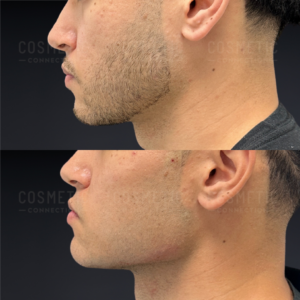
Before and after non-surgical lower face contouring, addressing the chin and jawline.

Before and after non-surgical lower face contouring, addressing the chin and jawline.
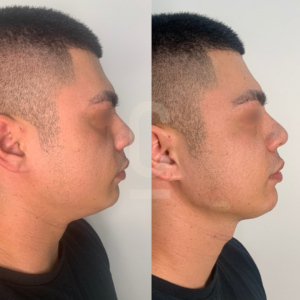
Before and after non-surgical lower face contouring, addressing the chin and jawline.
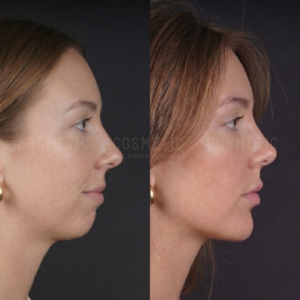
Before and after non-surgical lower face contouring, addressing the chin and jawline.
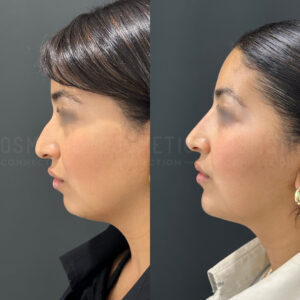
Before and after non-surgical lower face contouring, addressing the chin and jawline.
How long do chin contouring results last?
Most people find results are maintained for 12–18 months before a top-up or review is needed. Longevity varies between individuals based on metabolism, the volume placed, and the specific area treated. The chin tends to maintain results well because the area is not highly mobile compared to the lips or some other facial areas.
In our experience, patients returning at 12 months often need a modest top-up to maintain their result rather than a full repeat of their initial treatment. Over time, the interval between treatments often extends.
Get started
Frequently asked questions
When will I see the full result of chin contouring?
Results are visible immediately. The most accurate representation of your long-term result is visible at two weeks, once any swelling has resolved. The immediate post-treatment result sometimes looks more dramatic than the settled one, so two weeks is the right time to evaluate.
What if my result looks uneven in the first week?
Mild asymmetry in the first one to two weeks is normal and almost always due to uneven swelling rather than uneven placement. Wait until at least two weeks before assessing the final result. If asymmetry persists beyond that point, a review appointment is the appropriate next step.
Can I see my chin result before committing to treatment?
At consultation, we can discuss what is achievable based on your anatomy and use reference images and clinical assessment to set realistic expectations. We do not use digital simulation as a promise of results, but we do take time to ensure your expectations are aligned with what is clinically possible before any treatment begins.
Can chin contouring results be undone if I don’t like them?
Yes. Non-surgical chin contouring is reversible. If you are not happy with the result after the settling period, the treatment can be dissolved. This is one of the significant advantages over surgical chin implants.