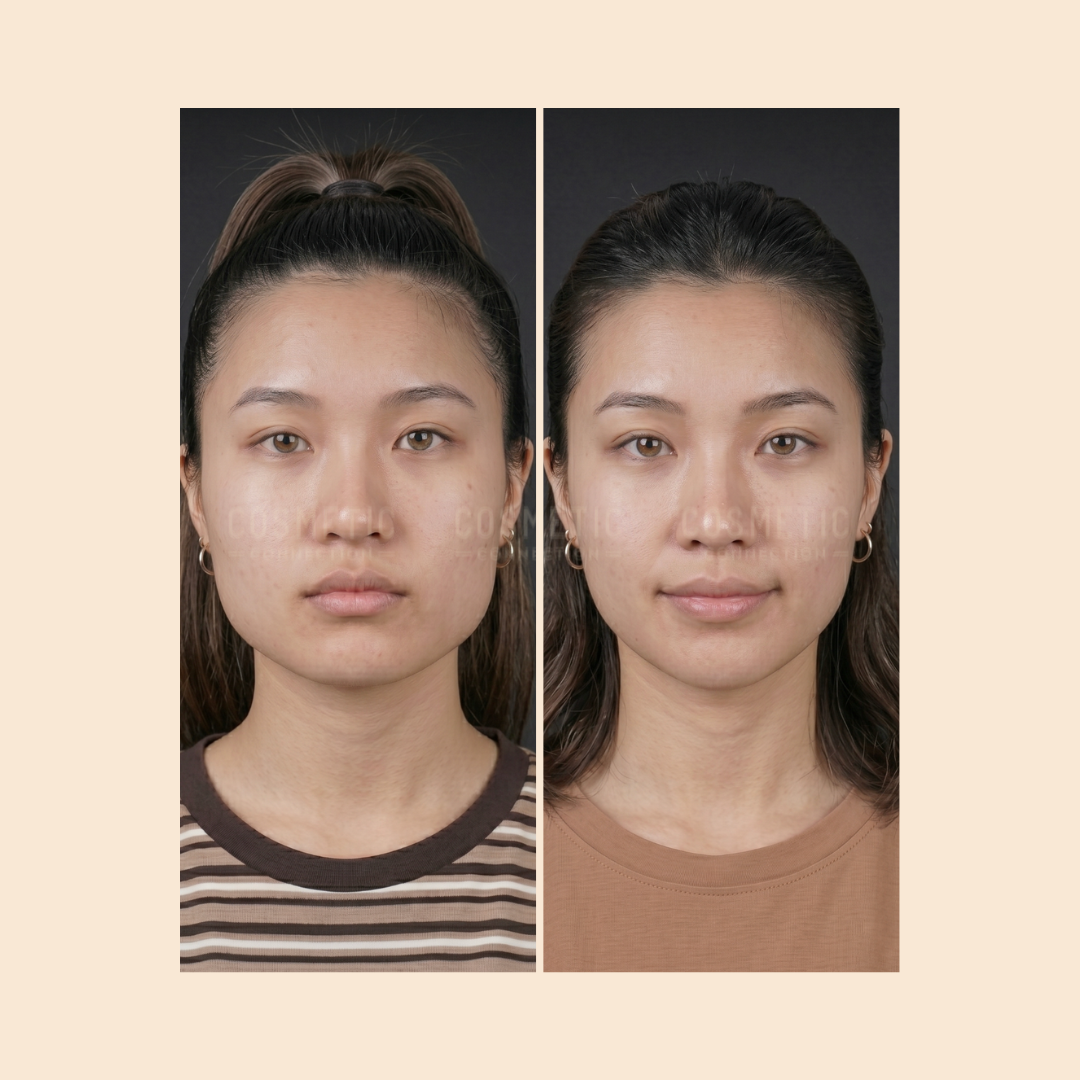
Non-surgical facial slimming treatment — used to reduce the size of the masseter muscles and slim a wide or square jawline — ranges from $600 to $1,500 per session in Australia. The cost varies based on the extent of treatment required, the clinic’s pricing model, and the experience of the treating practitioner. This guide breaks down what you will pay, what influences price, and what to watch for when comparing clinics.
Quick answer: Facial slimming treatment in Australia typically costs between $600 and $1,500 per session. Most patients fall in the mid-range. Factors that increase cost include larger muscle size, more extensive treatment goals, and premium doctor-led clinics. At Cosmetic Connection, we use flat-fee pricing — no variable unit costs, no surprises at checkout.
Typical cost ranges across Australia
The following ranges reflect what patients can expect to pay for non-surgical masseter slimming treatment across Australia in 2026.
| Scenario | Typical cost range |
|---|---|
| Mild masseter muscle with modest goals | $600 – $800 |
| Moderate masseter muscle — most patients | $800 – $1,100 |
| Large masseter muscle or more extensive goals | $1,100 – $1,500 |
These ranges reflect doctor-led cosmetic clinics in Sydney and Melbourne. Budget providers — including some beauty salons and nurse-only clinics — may quote lower prices, though this often reflects differences in dose, practitioner experience, and the clinical oversight involved.
What influences the cost of facial slimming treatment?
Several factors affect where your cost falls within this range.
Muscle size and treatment goals
The most significant variable is the size of your masseter muscles. Larger, more developed masseters require more extensive treatment to achieve a meaningful result. Patients who grind their teeth or clench habitually often have more developed muscles and typically sit at the higher end of the range.
Flat-fee vs per-unit pricing
Clinics price facial slimming treatment in one of two ways. Per-unit pricing means the total cost depends on how many units are used — which can vary significantly between patients and is not known until the treatment is complete. Flat-fee pricing means you know the full cost before your appointment. At Cosmetic Connection, we use a flat-fee model — one price covers the full treatment, with no add-ons or hidden extras. Our flat-fee pricing page explains how this works in practice.
Practitioner experience and clinic type
Doctor-led clinics with high-volume experience in masseter treatment typically charge more than general aesthetic clinics or nurse-injector-only practices. This premium reflects both clinical training and the lower risk of adverse outcomes when the treating practitioner has deep familiarity with the procedure. For a treatment that relies on precise placement and appropriate dosing, experience is not a minor variable.
Location
Sydney and Melbourne clinics tend to price higher than regional or suburban providers, reflecting higher operating costs. Within Sydney and Melbourne, there is also variation between inner-city and suburban clinic pricing.
Cost per session vs long-term cost
Facial slimming treatment is not a one-time investment for most people — the effects are temporary, and ongoing maintenance is required to sustain results. This makes the per-session cost only part of the picture.
Most patients start with an initial series of two to three sessions spaced four to six months apart. Once the muscle has responded cumulatively, many people find they can extend the interval — some maintaining results with one to two sessions per year rather than two to three.
Factoring in a realistic maintenance schedule, annual cost for most patients sits between $1,200 and $3,000 depending on individual response and session frequency.
This compares very favourably to surgical jaw reduction, which carries a one-time cost of $8,000 to $25,000 or more in Australia — plus the cost of recovery time, dietary restrictions, and follow-up care. For more detail on how these two options compare across multiple dimensions, not just cost, see our comparison guide for masseter treatment vs jaw reduction surgery.
Get started
Is facial slimming treatment covered by Medicare or private health?
No. Non-surgical facial slimming treatment for cosmetic purposes is not covered by Medicare or private health insurance in Australia. It is considered an elective cosmetic procedure.
There is one exception worth noting: where masseter treatment is used to address jaw clenching and teeth grinding (bruxism) on medical advice, some private health insurers may provide partial coverage under their dental or allied health benefits. This is not guaranteed and depends on your specific policy and provider. If this is relevant to your situation, confirm directly with your insurer before proceeding.
What does Cosmetic Connection charge for facial slimming treatment?
At Cosmetic Connection, facial slimming treatment is priced on a flat-fee basis. You will receive the full cost of your treatment at the time of consultation — before you commit to anything.
We are not able to publish exact pricing publicly due to regulatory requirements around cosmetic medical treatment advertising in Australia. What we can confirm is that our pricing falls within the ranges outlined in this guide, and that our flat-fee model means the price you are quoted is the price you pay — no variable units, no add-ons.
The first step is a suitability assessment, which allows us to evaluate your anatomy, confirm that treatment is appropriate, and provide a personalised cost. Visit our clinic locations or book an assessment to get started.
How to compare clinics on price without compromising on quality
Price comparison for facial slimming treatment requires asking the right questions, not just identifying the lowest quote.
| Question to ask | Why it matters |
|---|---|
| Is this flat-fee or per-unit pricing? | Per-unit pricing means your final bill may be higher than the quoted “starting from” price |
| Who will be performing the treatment? | Doctor vs nurse — different training, different risk profile |
| Is there a suitability assessment before treatment? | Clinics that skip assessment are more likely to treat unsuitable patients |
| What happens if results are asymmetric or unsatisfactory? | Understand the follow-up and correction policy before you commit |
| Does the quoted price include a follow-up review? | Some clinics charge separately for post-treatment review appointments |
Our complete facial slimming treatment guide includes a full section on how to evaluate providers, not just price.
Get started
Frequently asked questions — facial slimming treatment costs
Why do some clinics charge much less than $600 for facial slimming treatment?
Lower prices usually reflect lower doses, less experienced practitioners, or a per-unit model where additional units are charged if the initial dose is insufficient. In some cases, lower-priced providers are not operating under appropriate medical oversight. Price is not the only signal of quality, but a quote well below the market range warrants close scrutiny of who is performing the treatment and what the quoted price actually includes.
Is the cost the same in Sydney and Melbourne?
Broadly yes, at Cosmetic Connection — our flat-fee model applies at both our Sydney and Melbourne clinics. Across the broader market, some variation between cities exists.
How many sessions do I need to budget for?
Most people budget for two to three sessions in the first year, then reassess. With consistent treatment, many extend to one or two sessions per year. Your treating practitioner will give you a more personalised estimate after assessing your muscle size and response at your first session.
Can I pay in instalments?
Payment options vary by clinic. Visit our payment options page for details on how we handle this at Cosmetic Connection.
Does the cost increase over time?
Not necessarily. Some people find they need less treatment over time as the muscle responds cumulatively, which can reduce their ongoing cost per year. Others maintain a consistent schedule. Your individual response to treatment is the main variable.