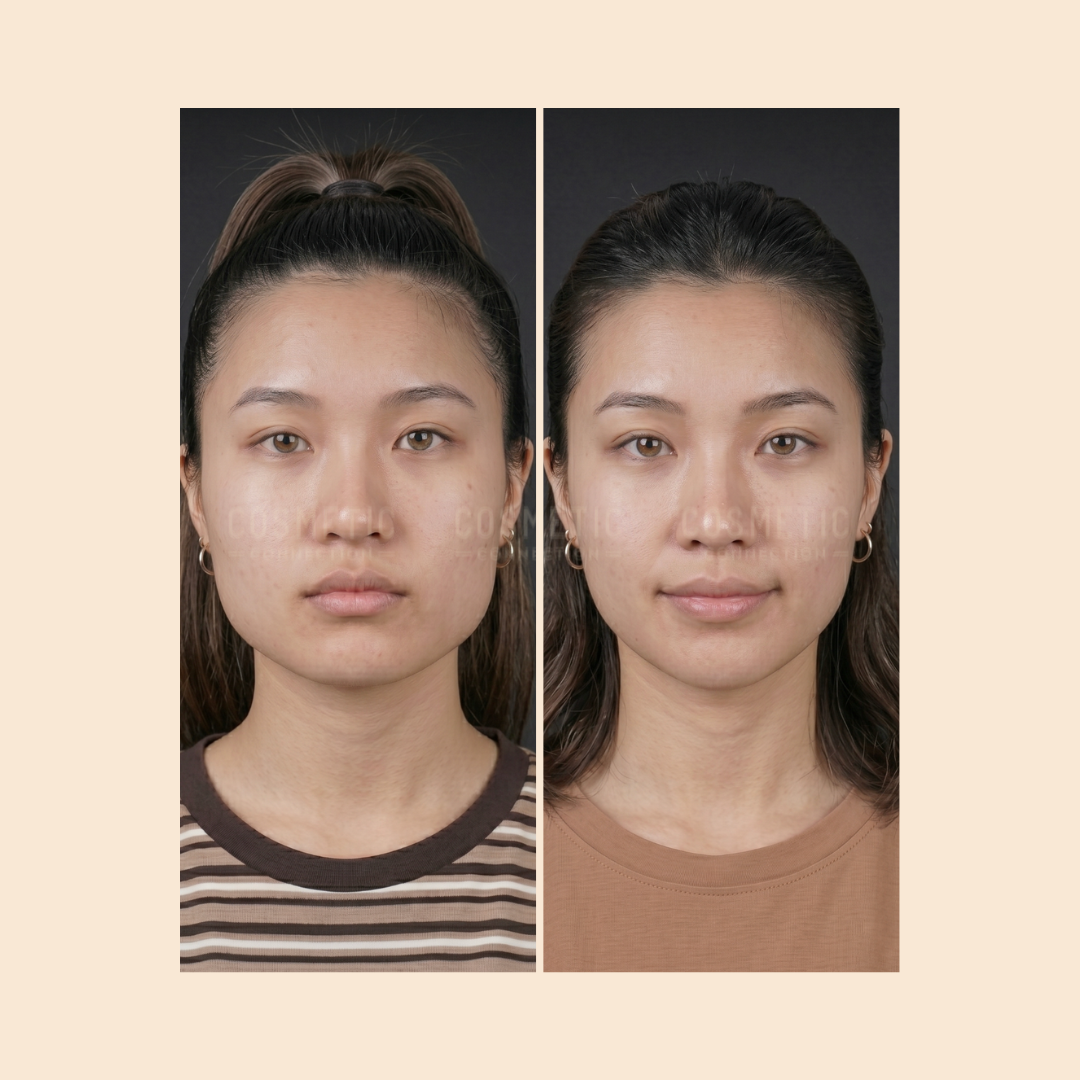
Non-surgical masseter treatment and surgical jaw reduction are the two main options for slimming a wide or square jawline — and they work in fundamentally different ways, suit different people, and carry very different risks. This guide explains both clearly so you can make a decision based on what actually fits your situation.
If you are weighing up these two options, you are probably past the “is this possible?” stage. The question now is which path makes sense for your anatomy, your goals, your timeline, and how much risk you are willing to accept. We will work through each of those factors in detail.
Quick answer: Non-surgical masseter treatment uses muscle-relaxing treatments to reduce the size and activity of the masseter muscles, softening the jawline over several weeks. Surgical jaw reduction (mandibular angle ostectomy) physically removes or reshapes the jaw bone. Non-surgical treatment is the first-choice option for most people — it is lower risk, requires no downtime, and produces results that are natural in appearance. Surgery is reserved for cases where bone structure, not muscle bulk, is the primary cause of jaw width.
What causes a wide or square jaw?
A wide jawline can come from two very different sources — and this distinction determines which treatment is right for you.
The first is muscle bulk. The masseter is a powerful chewing muscle that sits on either side of the jaw. In some people, this muscle is naturally large. In others, it has grown larger over time due to jaw clenching, teeth grinding, chewing hard foods, or stress. When the masseter is the main contributor to jaw width, non-surgical treatment is effective.
The second is bone structure. Some people have a naturally wide mandible — the jaw bone itself is wide or has prominent angles. No amount of muscle treatment will change bone. If bone structure is the primary driver of jaw width, surgical options may be worth considering, though the threshold for surgery is much higher given the risks involved.
In our clinical experience, the majority of people who come to us concerned about a square or wide jaw have muscle bulk as the primary or dominant cause — either alone, or sitting on top of a moderately wide bone structure. A small subset have bone-dominant anatomy. Identifying which category you fall into is the most important first step and should happen at consultation.
How does non-surgical masseter treatment work?
Non-surgical masseter treatment involves placing a muscle-relaxing treatment directly into the masseter muscles on both sides of the face. The treatment reduces the activity and, over time, the size of the muscle.
The results are not immediate. Most people notice early softening at around four to six weeks, with more visible slimming continuing over the following three to four months as the muscle gradually reduces in bulk. The effect is temporary — most people require maintenance every four to six months in the early stages, with some finding they can extend to longer intervals once the muscle has been consistently treated over time.
The procedure itself takes under fifteen minutes. There is no incision, no anaesthesia, and no required recovery time. Most people return to their usual activities immediately.
For a detailed explanation of how masseter treatment works at a muscle level, including what to expect during and after each session, that spoke covers the mechanism in full.
How does surgical jaw reduction work?
Surgical jaw reduction — technically a mandibular angle ostectomy or mandibular angle reduction — involves surgically reshaping the angle of the jaw bone. It is performed under general anaesthesia, typically through incisions made inside the mouth to avoid visible scarring.
The surgery physically removes or reshapes the bony prominence at the jaw angle. Results are permanent. Recovery involves significant swelling, dietary restrictions, and a return-to-normal timeline measured in weeks to months rather than days.
Surgical jaw reduction is most commonly performed in South Korea and parts of Southeast Asia, where the procedure has a longer history and higher procedural volume. In Australia, it is far less common — few surgeons perform it regularly, which affects both the availability of experienced providers and the benchmark for assessing outcomes.
The risks of surgical jaw reduction include nerve damage affecting sensation in the lower face, asymmetry, infection, prolonged swelling, and, in rare cases, more serious complications related to general anaesthesia. These are not theoretical risks — they are documented outcomes that require careful consideration before proceeding.
Side-by-side comparison
| Factor | Non-surgical masseter treatment | Surgical jaw reduction |
|---|---|---|
| What it targets | Masseter muscle bulk | Jaw bone structure |
| Anaesthesia | None (topical numbing optional) | General anaesthesia required |
| Procedure time | 10–15 minutes | 1–3 hours |
| Downtime | None | 2–6 weeks |
| Results onset | 4–8 weeks | 3–6 months (once swelling resolves) |
| Results duration | 4–6 months per treatment; cumulative over time | Permanent (bone change is irreversible) |
| Reversibility | Fully reversible — muscle returns to original size | Not reversible |
| Risk profile | Low — bruising, temporary asymmetry, rare | Higher — nerve damage, infection, asymmetry, anaesthesia risks |
| Cost (Australia) | $600–$1,500 per session | $8,000–$25,000+ depending on provider and location |
| Best suited to | Muscle-dominant jaw width; most patients | Bone-dominant jaw width; patients where surgery is clearly indicated |
| Available in Australia | Yes — widely available at qualified clinics | Limited — few providers |
Who is each option suited to?
Non-surgical masseter treatment is suited to people whose jaw width comes primarily from muscle bulk, or a combination of muscle and modest bone structure. It is also the appropriate starting point for anyone who has not yet determined the cause of their jaw width — a consultation can clarify this without any commitment to treatment.
Surgical jaw reduction is worth considering only when a thorough assessment has confirmed that bone structure is the dominant driver of jaw width, that the person has realistic expectations about a long surgical recovery, and that they have found a provider with demonstrable experience in this specific procedure. For most people presenting with jaw width concerns, surgery is not indicated.
A useful way to think about it: non-surgical treatment is both the lower-risk option and the diagnostic option. If you respond well to masseter treatment, it tells you the muscle was the primary cause. If results plateau and the underlying bone structure remains prominent, that information informs whether surgical assessment is warranted.
For a closer look at whether your anatomy, goals, and health history make you a good candidate for non-surgical jaw slimming, our guide to masseter treatment suitability for round and square face shapes covers the assessment criteria in detail.
Get started
What about people who want permanent results?
The temporary nature of non-surgical treatment is one of the most common reasons people ask about surgery. It is a fair question, and we take it seriously rather than dismissing it.
The honest answer is that “permanent” means different things depending on what you value. Surgical jaw reduction permanently reshapes the bone — but it cannot be undone if you are unhappy with the result. Non-surgical treatment, while temporary, gives you ongoing control. If you want more reduction, you adjust. If your goals change, you stop.
In our clinical experience, most people who start masseter treatment and maintain it consistently over one to two years notice that the muscle gradually reduces further with each session, and that the intervals between treatments can often extend. The cumulative effect can be significant. It is not the same as permanent surgical reduction — but for many people, it is a better fit for how they actually want to manage their appearance over time.
It is also worth noting that jaw width is not static across a lifetime. Bone remodelling, natural muscle changes with age, and lifestyle factors (jaw clenching, diet) all influence how the lower face looks over time. A rigid, permanent surgical change made at 28 may not align well with how the face looks at 45.
What about combining both?
Some people with genuinely bone-dominant jaw width find that a combination approach works well — surgical reduction addresses the structural component, and ongoing masseter treatment addresses any muscle bulk that sits on top of that. This is a niche scenario, not a standard treatment plan, and should be assessed individually with both a surgeon and a non-surgical provider who communicate directly about the plan.
Masseter treatment is also commonly combined with other non-surgical treatments for people who want more comprehensive facial reshaping. It pairs particularly well with facial balancing treatments — addressing jaw width alongside chin projection, cheek volume, or mid-face structure often produces a more balanced result than jaw slimming in isolation. The complete facial slimming treatment guide explains how combination approaches are planned.
How to make the decision
The clearest path forward is a consultation with an experienced non-surgical provider first — not because surgery is off the table, but because a thorough assessment of your anatomy will determine whether surgery is even necessary. In our experience, the majority of people who arrive convinced they need jaw surgery find that non-surgical treatment produces the result they were looking for.
If after non-surgical treatment you have maximised the improvement available from reducing muscle bulk and still feel the underlying bone structure is limiting your result, that is the point at which a surgical assessment with a qualified maxillofacial or plastic surgeon becomes appropriate.
What we would caution against is starting with surgery — not because it is never the right option, but because it is irreversible, carries significant risk, and for most people is not the primary cause of what they are trying to address.
Our approach at Cosmetic Connection is suitability first — we assess whether a treatment is appropriate before recommending it, and we tell you clearly if non-surgical treatment is unlikely to achieve what you are hoping for. If you are trying to work out where to start, the next step is an assessment, not a booking for a specific treatment.
Get started
Frequently asked questions
Can non-surgical masseter treatment give permanent results?
The treatment itself is temporary — effects from each session typically last four to six months. However, consistent treatment over time can produce cumulative muscle reduction that extends the interval between sessions and, for some people, leads to a maintained result with less frequent treatment. It is not permanent in the same way surgery is, but it can be long-lasting with an appropriate maintenance plan.
How do I know if my jaw width is caused by muscle or bone?
A clinical assessment can usually determine this through physical examination and, in some cases, imaging. Clues include whether the jaw feels more prominent when you clench your teeth (muscle) versus at rest (bone), your history of jaw clenching or grinding, and your facial structure more broadly. Our team assesses this at the suitability consultation — it is one of the first things we establish before making any treatment recommendation.
Is jaw reduction surgery available in Australia?
Yes, but it is not widely available. Few Australian surgeons perform it with the volume of experience that exists in South Korea or parts of Southeast Asia. If you are seriously considering surgical jaw reduction, finding a provider with specific, demonstrable experience in this procedure is critical — it is a technically demanding operation with significant consequences if performed by an inexperienced surgeon.
What does masseter treatment cost compared to surgery?
Non-surgical masseter treatment in Australia typically ranges from $600 to $1,500 per session, depending on the extent of treatment required and the clinic. Surgical jaw reduction in Australia can cost $8,000 to $25,000 or more, not including the cost of recovery, time off work, and any follow-up care. Our pricing guide for facial slimming treatments covers the non-surgical cost breakdown in more detail.
Can I have masseter treatment if I have bruxism or jaw clenching?
Yes — in fact, masseter treatment is commonly used to address both the cosmetic and functional aspects of an enlarged masseter caused by clenching and grinding. Many people find that treatment also reduces jaw tension and the associated headaches and discomfort. Our guide to jaw clenching and bruxism treatment covers this in more detail.
How long does recovery take after surgical jaw reduction?
Recovery from surgical jaw reduction typically involves two to six weeks before returning to normal activities, with dietary restrictions (soft foods) for a similar period. Full resolution of swelling can take three to six months, which also means final results are not visible until this point. This is a significant factor for most people when comparing their options.