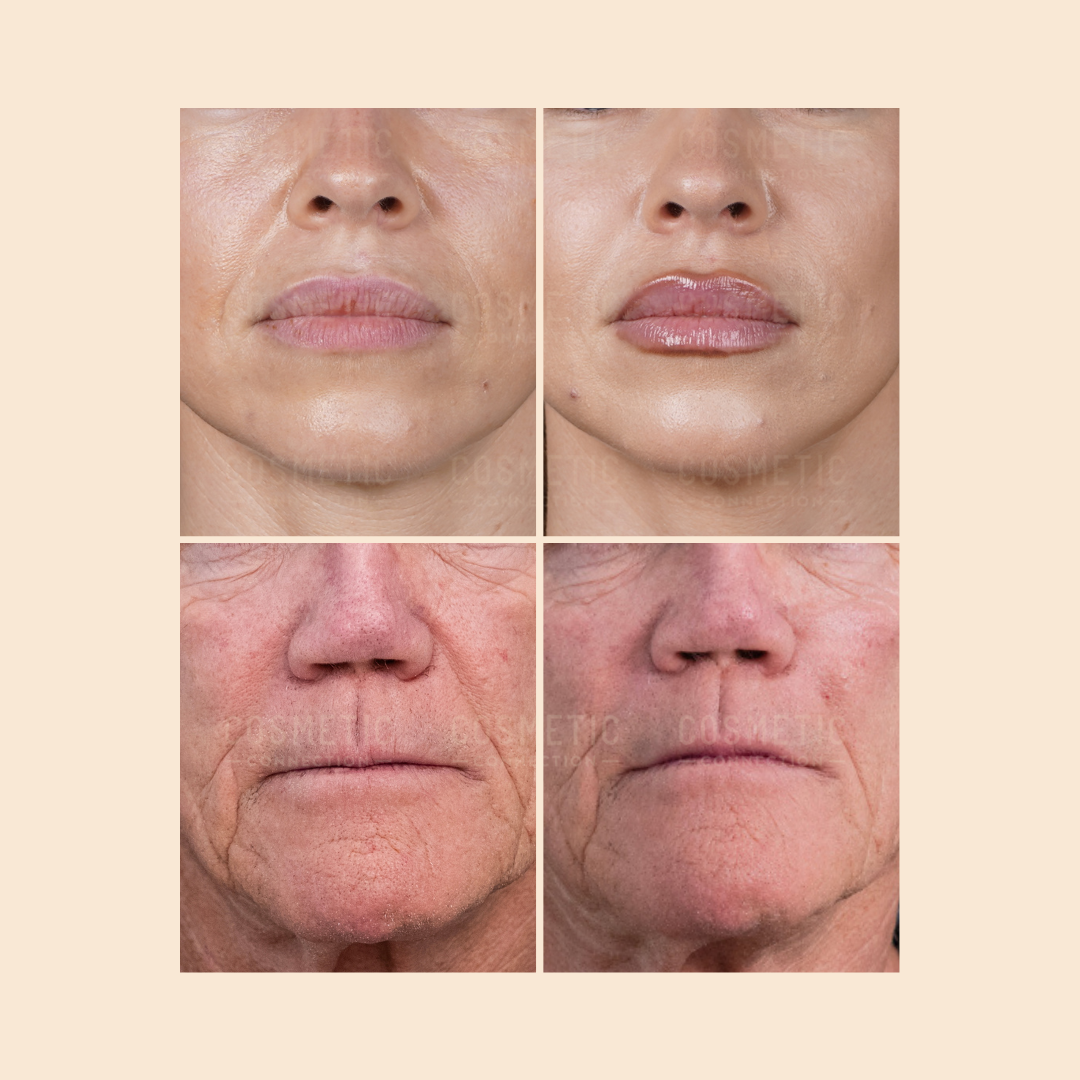
Not everyone with nasolabial folds is a good candidate for non-surgical treatment — and not everyone who is suitable will get the same type of plan. Suitability depends on what is causing your folds to deepen, the depth and character of the fold itself, your skin quality, and what you are hoping to achieve. This guide walks through the key factors that determine candidacy so you can approach your consultation with realistic expectations.
Quick answer: Good candidates for nasolabial fold treatment are typically people whose folds are visible at rest, whose concern is driven primarily by midface volume loss or fat pad descent, who have realistic expectations about softening rather than eliminating the fold, and who are in generally good health. People whose folds are driven mainly by significant skin laxity, or who expect complete elimination of the crease, are less likely to be well-suited to non-surgical treatment alone.
What makes someone a good candidate?
The most straightforward way to assess candidacy is to understand what non-surgical nasolabial fold treatment does well — and where its limitations lie. Candidates who fit the following profile tend to get the most satisfying results.
The fold is visible at rest
Dynamic lines — those that only appear during expression — tend to respond differently to volume support than folds that are present even when the face is completely relaxed. If your nasolabial fold is clearly visible at rest and bothers you in photos or in the mirror without any expression, that is a strong indicator that structural volume support may meaningfully improve its appearance.
Volume loss is the primary driver
Research published in Aesthetic Surgery Journal (Minelli et al., 2023) confirms that nasolabial folds deepen primarily through two mechanisms — fat pad deflation and bone resorption in the upper jaw. Both of these are structural changes that volume support can directly address. If your fold deepening is driven primarily by these mechanisms, you are likely to be a good candidate. If it is driven mainly by skin laxity, the picture is more nuanced.
Expectations are realistic
Non-surgical treatment softens nasolabial folds — it does not eliminate them. The fold is a normal anatomical feature. The goal of treatment is a more rested, refreshed appearance in the midface, with the fold reduced to a depth that no longer concerns you at rest. Patients who understand and accept this distinction — and are not expecting their face to look the way it did at 20 — tend to be the most satisfied with their outcomes.
General health is stable
Certain medical conditions, autoimmune conditions, active infections, and medications can affect candidacy or timing. These are assessed at consultation. Pregnancy and breastfeeding are contraindications to treatment. A history of cold sores or herpes simplex in the perioral area is worth disclosing, as treatment in or near this region may trigger an outbreak without appropriate prophylaxis.
Who may not be a good candidate?
Equally important is understanding where non-surgical nasolabial fold treatment is unlikely to achieve the desired result — so patients are not recommended a treatment that is not going to help them.
Significant skin laxity
When the skin itself has substantially thinned, loosened, and lost its structural attachment to the underlying tissue, adding volume alone can sometimes make the area look heavier rather than more lifted. In these cases, the skin laxity needs to be addressed — either with a skin-quality approach, a surgical consultation, or a very carefully planned combination strategy. A non-surgical treatment that places volume in the presence of significant laxity can, in some cases, worsen the appearance rather than improve it.
Very deep structural folds present since youth
Some people have deep nasolabial folds from an early age — not because of volume loss, but because of their underlying facial structure. These folds are present during expression from childhood and simply become more visible with age because the surrounding tissue provides less support. Non-surgical volume treatment can soften these folds to some degree, but the result may be less dramatic than in patients whose fold depth is primarily age-related. Expectations need to be calibrated accordingly at consultation.
Body dysmorphia or disproportionate distress
When the level of distress about a concern is significantly out of proportion to the clinical appearance of the fold, non-surgical treatment is unlikely to provide lasting satisfaction regardless of the outcome. Our suitability-first approach means we discuss this honestly at consultation, and may recommend other forms of support before or instead of treatment. This is not a reason to feel dismissed — it is a reflection of clinical responsibility.
Get started
How age affects candidacy
Nasolabial fold treatment is not age-restricted, but the drivers of fold deepening — and therefore the most appropriate approach — change across different life stages.
| Age group | Typical drivers of fold depth | Candidacy notes |
|---|---|---|
| 20s–early 30s | Facial structure; limited volume loss | Assessment is important — structural folds may be less responsive. Suitability assessed individually. |
| Mid 30s–40s | Early midface volume loss; beginning of fat pad descent | Often good candidates, particularly for midcheek volume support. Results tend to be natural and well-maintained. |
| 50s–60s | Moderate to significant volume loss; some skin laxity | Good candidates where laxity is not the dominant factor. Combination approaches often most appropriate. |
| 70s+ | Significant structural change; skin laxity more prevalent | Suitability assessed individually. Volume alone may be insufficient where laxity is advanced. Surgical consultation may be appropriate. |
Questions to ask yourself before your consultation
Going into a consultation having already reflected on these questions will help you get more out of the assessment conversation.
- Is the fold that bothers me visible at rest, or mainly when I smile or make expressions?
- When I look in the mirror or at photos, is the fold the main thing I notice — or is it part of a broader concern about the midface, cheeks, or lower face?
- What does “improvement” look like to me? Am I expecting the fold to disappear entirely, or am I hoping for it to be less noticeable?
- Has this concern been present since I was young, or has it developed or deepened noticeably in the last few years?
- Am I currently pregnant, breastfeeding, or taking any medications that affect the immune system or blood clotting?
Being honest about your answers to these questions — both with yourself and with your treating practitioner — is the foundation of a good outcome. Suitability assessment is not a formality. It is the most important step in the process.
What the suitability assessment at Cosmetic Connection involves
At our clinics, the assessment for nasolabial fold treatment involves a structured face-to-face evaluation of your fold depth and character, the state of your midface and cheek volume, skin quality and laxity, and the balance of your face as a whole. We discuss your goals, your history with any previous cosmetic treatments, and any relevant medical background.
If treatment is appropriate, we confirm the plan and the cost — using our flat-fee pricing structure — before anything proceeds. If treatment is not the right fit at this point, we explain why and, where relevant, discuss what alternatives or timing adjustments might better serve your situation. Our full approach to this process is explained on our patient journey page.
For a broader overview of the treatment itself, our complete guide to smile lines treatment covers what the treatment involves, how long results last, and how it compares to other approaches.
Get started
Frequently asked questions
Can I have nasolabial fold treatment if I have had it before elsewhere?
Yes, in most cases. If you have had previous treatment in the area, we will assess the current state of your anatomy before recommending anything. In some cases, previous treatment that has not fully resolved may need to be considered in the planning. Disclosing your treatment history at consultation is important so the assessment is accurate.
Am I too young for smile lines treatment?
There is no minimum age restriction, but treatment in younger patients needs to be assessed carefully. If a fold is present primarily because of facial structure rather than age-related volume loss, the result from non-surgical treatment may be more limited. A thorough assessment will clarify whether treatment is likely to achieve the result you are hoping for.
Am I too old for smile lines treatment?
Age alone does not determine suitability. The key factor is the nature and driver of the fold — not the patient’s age. In patients where significant skin laxity is the dominant factor, a different approach may be needed. But many patients in their 60s and beyond are excellent candidates for non-surgical treatment when the anatomy is appropriate.
What if I am not suitable for non-surgical treatment?
If the assessment finds that non-surgical treatment is unlikely to achieve your goals — because of skin laxity, anatomy, or the nature of your concern — we will discuss alternatives. This might include a referral for surgical assessment, a different non-surgical approach, or a recommendation to defer treatment. Being told you are not a good candidate is not a rejection — it is honest clinical guidance that protects you from investing in a treatment that will not deliver what you are hoping for.
How do I know if my folds are caused by volume loss or skin laxity?
A face-to-face assessment is the only reliable way to determine this. A rough self-test: gently lift the skin of your cheek upward with your fingers. If the fold softens significantly when you do this, volume loss and midface descent are likely contributors. If the fold remains deep regardless, skin laxity may be a more dominant factor. This is a guide only — it does not replace clinical assessment.
References
- Minelli L, Brown CP, Warren RJ, van der Lei B, Mendelson BC, Little JW. (2023). Lifting the Anterior Midcheek and Nasolabial Fold: Introduction to the Melo Fat Pad Anatomy and Its Role in Longevity and Recurrence. Aesthetic Surgery Journal, 43(9), 941–954. https://doi.org/10.1093/asj/sjad126
- Stefura T, Kacprzyk A, Droś J, Krzysztofik M, Skomarovska O, Fijałkowska M, Koziej M. (2021). Tissue Fillers for the Nasolabial Fold Area: A Systematic Review and Meta-Analysis of Randomized Clinical Trials. Aesthetic Plastic Surgery, 45(5), 2300–2316. https://doi.org/10.1007/s00266-021-02439-5
- Aesthetic Surgery Journal Open Forum. (2025). Quantitative Assessment of Nasolabial Fold Characteristics Across Age Groups. Oxford Academic. https://academic.oup.com/asjopenforum/article/doi/10.1093/asjof/ojaf075/8180122