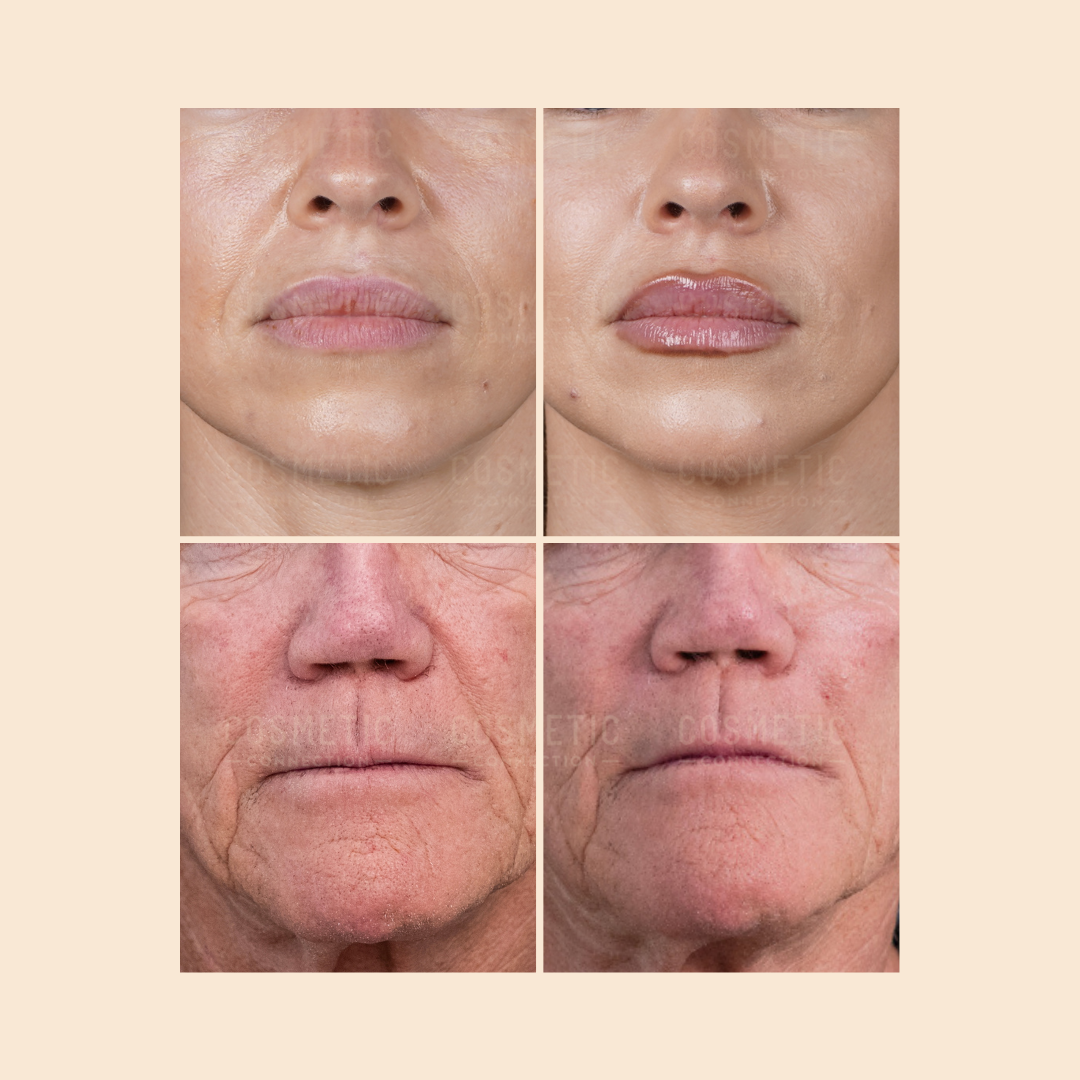
Smile lines — the creases that run from the sides of your nose to the corners of your mouth — are one of the most common concerns we assess at Cosmetic Connection. Non-surgical cosmetic treatments can soften their appearance by addressing the structural changes that cause them to deepen over time. This guide explains what drives that deepening, what treatment involves, who is a good candidate, and what realistic outcomes look like.
Quick answer: Smile lines (nasolabial folds) deepen primarily due to midface volume loss, fat pad descent, and reduced skin support — not simply repeated facial movement. Non-surgical cosmetic treatments work by restoring structural volume to the midface, which lifts the overlying tissue and softens the fold. In the right candidate, results are visible immediately and can last 12 months or longer depending on the approach used.
What are smile lines and why do they deepen?
Smile lines — clinically called nasolabial folds — are the creases that run from the base of the nose to the corners of the mouth. Every face has them to some degree. They are a normal part of facial anatomy, formed where the muscles of the cheek attach to the skin. The question is not whether they exist, but how prominent they become at rest.
In younger faces, the surrounding tissue — fat, collagen, and structural support — keeps the fold shallow. As we age, that support erodes from multiple directions at once. Research published in Aesthetic Surgery Journal (Minelli et al., 2023) identifies two primary mechanisms: bone resorption of the upper jaw causing the overlying soft tissue to lose its structural foundation, and fat deflation and muscle changes in the perioral region reducing soft tissue thickness by up to 40%. The fold does not move downward — the tissue around it loses the volume that once kept it looking shallow.
This distinction matters clinically. A smile line that looks deep is usually not a skin problem — it is a structural one. Which is why skincare products rarely produce meaningful change, and why treatment plans that address the underlying volume loss tend to produce the most natural-looking results.
What causes smile lines to deepen faster in some people?
The rate at which nasolabial folds deepen varies significantly between individuals, and volume loss is only part of the picture. Several factors compound the underlying ageing process.
- Genetics and facial structure: People with flatter cheekbones or less midface projection tend to develop more prominent folds earlier, because there is less natural scaffolding to support the overlying tissue as it changes with age.
- Sun exposure: UV radiation accelerates collagen breakdown — a process called photoaging — which reduces the skin’s structural support and causes folds to appear more pronounced. Australia’s UV environment makes this a significant factor for many patients.
- Weight fluctuation: Repeated cycles of weight gain and loss affect the fat pads of the face in a similar way to the rest of the body — stretching and then deflating the tissue that supports the midface.
- Smoking: Reduces collagen synthesis and impairs the skin’s ability to repair itself, accelerating the visible effects of volume loss.
- Body weight: Lower body weight is associated with less facial fat, which can make structural changes more visible at an earlier age.
In our clinical experience, patients who develop noticeable smile lines in their 30s often have a combination of two or more of these factors at play — not simply the natural pace of ageing.
Is treating the fold directly the right approach?
This is one of the most important questions in assessment, and the answer is not always straightforward. Treating the fold itself — placing volume directly into the crease — can soften its appearance. But for many patients, a better result comes from addressing the upstream cause: the volume loss in the cheek and midface that is allowing the fold to deepen in the first place.
Think of it this way. If a tent sags in the middle, you can push the fabric up from below — or you can re-tension the poles that support it from above. Both approaches change the appearance. But the structural approach tends to look more natural, because it restores the three-dimensional shape of the face rather than filling a line.
Research published in Aesthetic Surgery Journal Open Forum (2025) confirms that the lower nasolabial zone deepens progressively from the forties onward, driven largely by the descent of the buccal fat pad and cumulative changes in midface tissue. This is why a thorough assessment considers the whole midface — not just the fold in isolation. Our approach at Cosmetic Connection is to evaluate the cheeks, midface volume, and lower face together before recommending any treatment plan.
For patients whose folds are driven primarily by cheek volume loss, cheek volume treatment often produces a more complete and natural-looking result than treating the fold alone. For those with deeper, more established folds where the crease itself needs direct attention, a combination approach is often most appropriate. The right answer depends on the individual assessment — not a blanket protocol.
Get started
What does smile lines treatment involve?
Non-surgical treatment for smile lines uses carefully placed volume support to restore the structural depth the midface has lost. The treatment is performed in-clinic and does not require general anaesthetic or surgical recovery.
At our clinics, the process begins with a detailed assessment of your facial anatomy — the depth and character of the fold, the degree of cheek volume loss, skin quality, and how your face moves. This shapes the treatment plan before anything else happens.
The treatment itself typically takes 30 to 45 minutes. A topical numbing preparation is applied beforehand to maximise comfort. Volume is then placed using precise technique in the areas identified during assessment — which may include the midcheek, the fold itself, or both, depending on what the anatomy requires. Most patients experience mild swelling and some tenderness for a few days afterward, which settles as the treated area integrates. The improvement in the appearance of the fold is typically visible immediately, with final results apparent once any initial swelling has resolved.
For a detailed breakdown of what to expect during and after treatment, see our guide to nasolabial fold treatment: what to expect and how it works.
How long do results last?
Longevity varies between individuals and depends on the treatment approach, the area treated, your metabolism, and lifestyle factors. As a general guide, results in the nasolabial area can last anywhere from 12 to 18 months, with some patients maintaining their result for longer.
A systematic review and meta-analysis published in Aesthetic Plastic Surgery (Stefura et al., 2021) provides useful context. Across randomised clinical trials, the average fold severity score one month after treatment had improved significantly from baseline. At six months, results remained substantially better than pre-treatment. By 12 months, there was gradual return toward baseline — though still measurably improved — indicating that results fade gradually rather than disappearing suddenly.
In practice, we find that patients who maintain their results with a scheduled review appointment at around the 12-month mark tend to sustain their improvement more consistently than those who wait until the fold has returned to its pre-treatment depth. This is consistent with the clinical evidence showing that maintenance treatments at earlier intervals preserve results more efficiently than reactive treatment after full return.
Who is a good candidate for smile lines treatment?
Most adults who are bothered by the depth of their nasolabial folds at rest — not just when smiling — are worth assessing. The best candidates share a few common characteristics.
- The fold is visible at rest: Dynamic lines that only appear during expression tend to respond differently to volume-based treatment than folds that are present even when the face is relaxed.
- The cause is structural volume loss: Patients whose fold depth is driven primarily by midface and cheek volume loss tend to respond best to non-surgical treatment. Those with folds driven predominantly by skin laxity may benefit from a different approach or a combination plan.
- Expectations are realistic: Treatment softens the fold — it does not eliminate it entirely. The goal is a more refreshed, rested appearance with natural facial movement preserved.
- General health is stable: Certain medical conditions, medications, and circumstances affect suitability. These are assessed at consultation.
Suitability is always assessed individually. For a more detailed look at candidacy criteria, see our guide to nasolabial fold treatment suitability.
Smile lines treatment vs other approaches: how do they compare?
Non-surgical volume support is one of several approaches available for nasolabial folds. Understanding how they differ helps set accurate expectations.
| Approach | Mechanism | Downtime | Longevity | Best suited for |
|---|---|---|---|---|
| Non-surgical volume support | Restores structural volume to midface and/or fold | Minimal (2–5 days swelling) | 12–18 months typically | Volume-driven fold deepening; moderate to deep folds at rest |
| Collagen stimulating treatment | Stimulates the body’s own collagen production over time | Minimal | Longer-lasting; builds gradually over months | Patients who prefer a gradual approach; skin quality concerns alongside fold depth |
| Skincare (topical retinoids, peptides) | Supports surface skin quality; slows collagen degradation | None | Ongoing maintenance only | Prevention and maintenance; mild surface lines only |
| Surgical facelift | Repositions underlying tissue; removes excess skin | Weeks to months | Years | Significant skin laxity; advanced structural changes not addressable non-surgically |
For a full comparison of non-surgical treatment options and how to choose between them, see our post on nasolabial fold treatment options.
What does smile lines treatment cost in Australia?
The cost of non-surgical smile lines treatment in Australia typically ranges from $1,500 to $2,500 per appointment, depending on the treatment approach, the areas addressed, and the extent of volume correction required. Treating the fold in isolation generally sits at the lower end of this range. A plan that addresses midface volume alongside the fold sits at the higher end.
At Cosmetic Connection, we use flat-fee pricing — meaning the cost of your treatment is confirmed before you commit, with no variable charges based on product quantities used during the procedure. You can view our full service and pricing guide for more detail, or explore our complete guide to smile lines treatment costs in Australia for a breakdown of what influences pricing.
What do results look like?
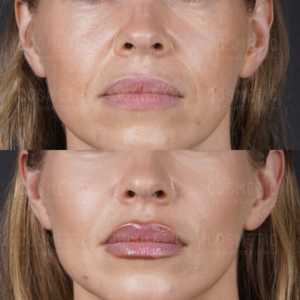
Before and after treatment for nasolabial folds (smile lines).
Before and after treatment for nasolabial folds (smile lines).
Before and after treatment for nasolabial folds (smile lines).
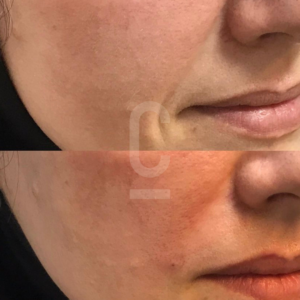
Before and after treatment for nasolabial folds (smile lines).
Why the assessment matters as much as the treatment
In our experience, the outcomes that patients are most satisfied with are not always the result of the most aggressive treatment — they are the result of the most accurate assessment. Identifying whether a fold is driven by cheek volume loss, direct fold volume deficit, skin laxity, or a combination of these factors determines the entire treatment approach.
This is why our consultations at Cosmetic Connection are structured around suitability first. We assess your anatomy, discuss realistic outcomes, and recommend a plan that fits your face — not a standard protocol. If treatment is not the right fit, we say so.
Our approach to cosmetic treatment is built around this principle: a treatment that is right for someone else’s face is not automatically right for yours.
Get started
Frequently asked questions
Are smile lines the same as nasolabial folds?
Yes. Smile lines, laugh lines, and nasolabial folds all refer to the same creases — the lines that run from the sides of the nose to the corners of the mouth. “Nasolabial fold” is the clinical term; “smile lines” and “laugh lines” are the more commonly used everyday descriptions of the same feature.
What is the difference between smile lines and marionette lines?
Smile lines run from the nose to the corners of the mouth. Marionette lines run downward from the corners of the mouth toward the chin, and often create a downturned expression. They appear in the same region of the face and are frequently assessed together, but they involve different anatomical structures and may benefit from different treatment approaches. Both can be discussed in a single smile lines consultation. Read more about the differences between marionette lines and nasolabial folds.
Is non-surgical smile lines treatment painful?
Most patients find the treatment well-tolerated. A topical numbing preparation is applied beforehand, and the procedure itself is typically described as a mild pressure sensation rather than significant pain. Some tenderness in the treated area is normal for a few days afterward and settles on its own.
Can smile lines come back after treatment?
Results from non-surgical treatment gradually fade over time as the volume placed is naturally processed by the body. The fold does not return suddenly — it gradually deepens over 12 to 18 months back toward its pre-treatment appearance. Maintenance appointments at around the 12-month mark typically preserve results more efficiently than waiting for full return.
Does treating smile lines look natural?
When treatment is planned correctly based on accurate assessment, the result should look like a more rested version of you — not a different face. The goal is to restore the structural support the midface has lost, which allows natural facial movement and expression to be fully preserved. Overfilled or misplaced volume is the most common reason treatment looks unnatural, which is why assessment and technique matter as much as the treatment itself.
How do I know if I’m a good candidate for smile lines treatment?
The best way to determine candidacy is a face-to-face assessment. As a general guide, people who notice their folds are visible at rest, are bothered by a tired or aged appearance in the midface, and have realistic expectations about softening rather than erasing the fold tend to be suitable. A full suitability breakdown is available in our nasolabial fold treatment suitability guide.
References
- Minelli L, Brown CP, Warren RJ, van der Lei B, Mendelson BC, Little JW. (2023). Lifting the Anterior Midcheek and Nasolabial Fold: Introduction to the Melo Fat Pad Anatomy and Its Role in Longevity and Recurrence. Aesthetic Surgery Journal, 43(9), 941–954. https://doi.org/10.1093/asj/sjad126
- Stefura T, Kacprzyk A, Droś J, Krzysztofik M, Skomarovska O, Fijałkowska M, Koziej M. (2021). Tissue Fillers for the Nasolabial Fold Area: A Systematic Review and Meta-Analysis of Randomized Clinical Trials. Aesthetic Plastic Surgery, 45(5), 2300–2316. https://doi.org/10.1007/s00266-021-02439-5
- Aesthetic Surgery Journal Open Forum. (2025). Quantitative Assessment of Nasolabial Fold Characteristics Across Age Groups. Oxford Academic. https://academic.oup.com/asjopenforum/article/doi/10.1093/asjof/ojaf075/8180122