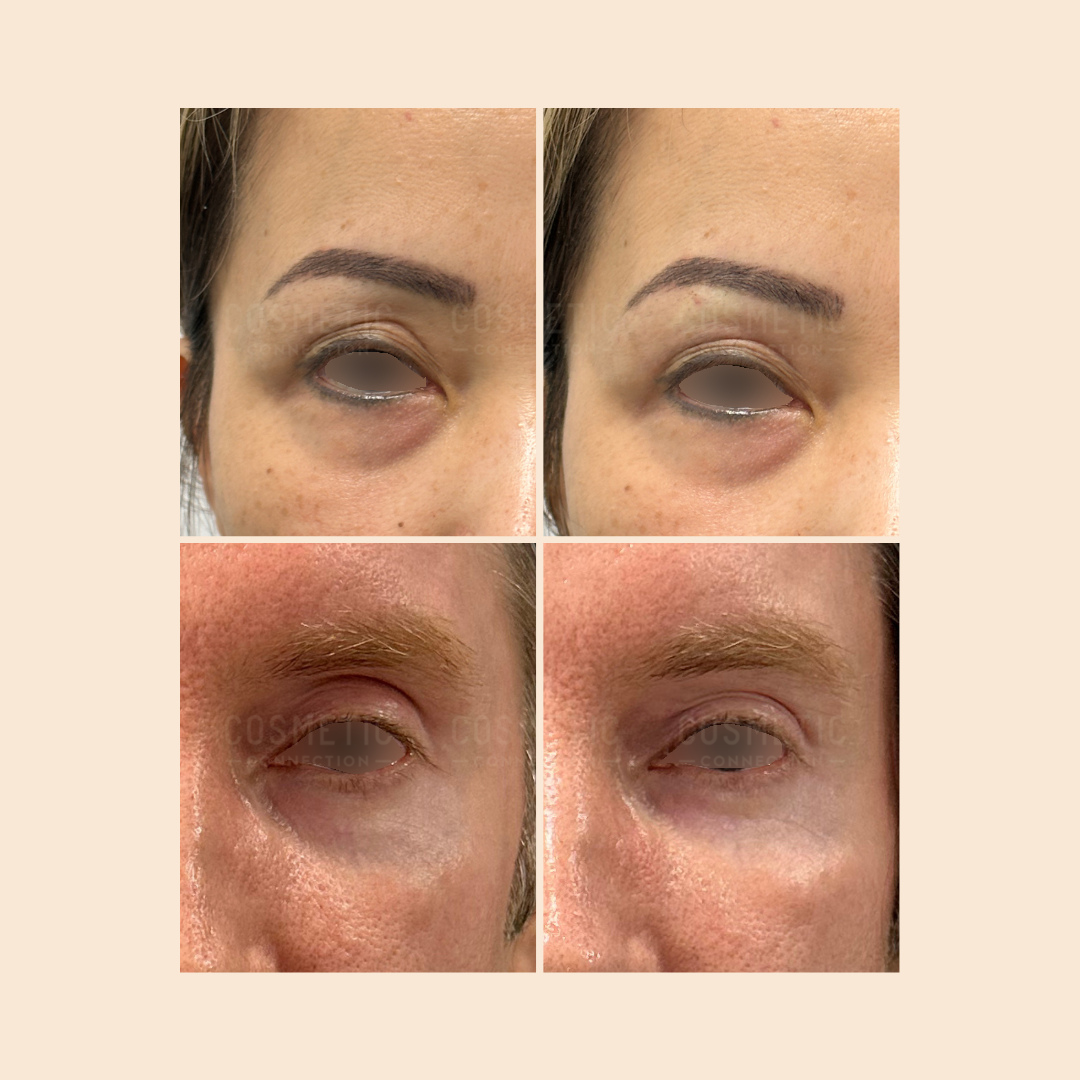
If you have upper eyelid hollowing, excess eyelid skin, or a combination of both, two main paths exist: non-surgical upper eyelid volume restoration, or surgical blepharoplasty. Both are legitimate. Neither is universally better. The right choice depends entirely on what is causing your concern — and getting that diagnosis right before committing to either path is the most important step you can take.
Quick answer: Non-surgical upper eyelid volume restoration addresses hollowing and deflation beneath the brow. Surgical blepharoplasty addresses excess skin, tissue redundancy, or functional eyelid problems. They solve different problems. For people whose primary concern is volume loss, non-surgical treatment is often the most direct and lowest-risk first step. For excess skin or functional concerns, surgery is the appropriate path. Some people need both — but rarely at the same time, and almost never before an honest assessment of which concern is primary.
What each option actually treats
The most important distinction between non-surgical volume restoration and blepharoplasty is not the method — it is what problem each one solves.
Non-surgical upper eyelid volume restoration addresses hollowing. A 2025 study in the Journal of Cosmetic Medicine confirms that sunken eyelids result from the loss of orbital fat, atrophy of retro-orbicularis oculi fat, and deficits in superficial dermal layers — and that volume restoration addresses these deficits directly, with high clinical applicability and excellent patient satisfaction at over one year of follow-up. It does not remove skin, change eyelid crease position, or alter brow position in any structural way.
Blepharoplasty removes excess skin — and in some cases fat — from the upper eyelid. It is the appropriate solution when skin redundancy creates a hooded or heavy appearance, when brow drooping contributes to excess lid tissue, or when excess upper lid tissue genuinely impairs vision. Aggressive fat removal during blepharoplasty can lead to an A-frame deformity or hollowed upper lid — the precise problem non-surgical volume restoration is designed to correct.
Getting this distinction right is critical because the treatments work in opposite directions. Volume restoration adds tissue. Blepharoplasty removes it. Applying the wrong approach to the wrong problem does not produce a neutral result — it makes things worse.
Side-by-side comparison
| Feature | Non-surgical volume restoration | Blepharoplasty (surgical) |
|---|---|---|
| Primary concern treated | Volume loss, hollowing, A-frame deformity | Excess skin, tissue redundancy, functional obstruction |
| Procedure type | Non-surgical, in-clinic treatment | Surgical procedure under local or general anaesthetic |
| Downtime | 1–5 days bruising and swelling typical | 2–4 weeks with sutures and healing |
| Results duration | 12–18 months typically | Permanent — skin removal does not reverse |
| Reversible | Yes | No |
| Risk profile | Low to moderate — periorbital vascular risk is real but rare | Surgical risks: anaesthesia, scarring, asymmetry, over-correction |
| Cost in Australia | $1,500–$3,000 | $5,000–$12,000+ depending on surgeon and complexity |
| Maintenance required | Yes — repeat treatment every 12–18 months | No — though ageing continues |
| Suitable for post-surgical correction | Yes — established use for correcting over-resected blepharoplasty | Revision surgery possible but carries additional risk |
When non-surgical volume restoration is the better first step
Non-surgical upper eyelid volume restoration is the more appropriate first choice when:
- The primary concern is hollowing, deflation, or a sunken quality beneath the brow — not excess skin
- You want to understand what volume restoration can achieve before committing to an irreversible procedure
- You have had previous blepharoplasty and the result has left you with a hollow or over-corrected upper eyelid — one of the clearest indications for volume restoration
- You are not yet certain whether your concern is volume loss, skin excess, or both — starting with a reversible, non-surgical option gives you information without permanent consequences
- Extended surgical downtime is not currently feasible
The reversibility of non-surgical methods is a meaningful advantage in any situation where the diagnosis is uncertain. If volume restoration is performed and the result is not what you expected, the treatment can be undone and a different path considered. The same is not true of surgery.
When surgery is the appropriate path
Blepharoplasty is the appropriate option — and often the only effective one — when:
- Excess, overhanging upper eyelid skin is the primary concern — skin redundancy cannot be addressed with volume restoration and attempting to do so makes the problem worse
- Brow drooping is contributing significantly to upper eyelid heaviness — this may require a brow lift, eyelid surgery, or both
- Upper lid tissue is genuinely impairing vision — this is a functional concern requiring surgical assessment
- Thorough non-surgical assessment has confirmed that volume restoration is not the right fit
It is worth saying plainly: blepharoplasty is a well-established and effective procedure when it is the right treatment for the right concern. The goal of this comparison is not to discourage surgery — it is to help you identify which concern you actually have before you commit to either path.
When both may be relevant
Some people have both volume loss and skin excess — a hollow upper eyelid and excess skin above it. In these cases, both approaches may be appropriate, but rarely simultaneously and rarely without first establishing which concern is the more dominant driver.
In our experience, volume restoration first is often the better sequencing choice where there is genuine diagnostic uncertainty. Starting with a reversible treatment that can be assessed and adjusted gives you and your treating doctor a clearer picture of what skin removal alone would achieve — and sometimes removes the apparent need for surgery altogether.
How to know which applies to you
The most reliable way to distinguish between a volume concern and a skin concern is a clinical assessment with someone who treats both and has no commercial incentive to push you toward one or the other.
A simple self-assessment that can provide a starting point: place your fingertip gently beneath your brow bone and apply light upward pressure, supporting the brow. If the upper eyelid still looks hollow or deflated with the brow supported, volume loss is likely a significant factor. If the area looks smooth and full when the brow is supported but the skin falls when the support is removed, skin excess or brow position may be the more dominant concern. This is a rough guide, not a diagnosis — but it can help clarify the conversation before a clinical assessment.
You can also read more about what upper eyelid hollowing involves and how non-surgical treatment works in our complete guide to upper eyelid volume loss, and our guide to upper eyelid exposure .
Get started
Frequently asked questions
Is upper eyelid volume restoration a replacement for blepharoplasty?
No. They treat different things. Volume restoration addresses hollowing and deflation. Blepharoplasty addresses excess skin and tissue redundancy. For some people, one is clearly the right choice. For others, both may be relevant at different points. They are not interchangeable, and treating a skin problem with volume — or a volume problem with skin removal — produces poor results.
Can I try non-surgical treatment first to see if I need surgery?
Yes, and in many cases this is a sensible approach where there is genuine uncertainty about the primary concern. Because non-surgical treatment is reversible, starting non-surgically gives you information without permanent consequences. If volume restoration improves the appearance significantly, surgery may not be necessary. If the result is not satisfactory, the surgical option remains available.
What if I have had blepharoplasty and now have a hollow upper eyelid?
This is a well-recognised presentation and a clear indication for non-surgical upper eyelid volume restoration. As noted by Dr Adam Scheiner, over-resection of fat during blepharoplasty can lead to an A-frame deformity or hollowed upper lid appearance. Volume restoration addresses this directly by restoring what the surgery removed.
How much does blepharoplasty cost compared to non-surgical treatment?
Blepharoplasty in Australia typically costs $5,000–$12,000 or more depending on the surgeon, the complexity of the procedure, and whether it is performed under local or general anaesthetic. Non-surgical upper eyelid volume restoration at Cosmetic Connection is priced between $1,500 and $3,000. The cost difference is significant, though the treatments address different concerns and the comparison is only relevant where both are genuinely viable options for a given individual.
Is there an age limit for upper eyelid volume restoration?
There is no strict age limit in either direction. The relevant factor is the nature of the concern, not age. Younger people with genetic upper eyelid hollowing may be appropriate candidates. Older people with significant skin excess may be better served by surgical options regardless of age. A thorough clinical assessment is the determining factor.