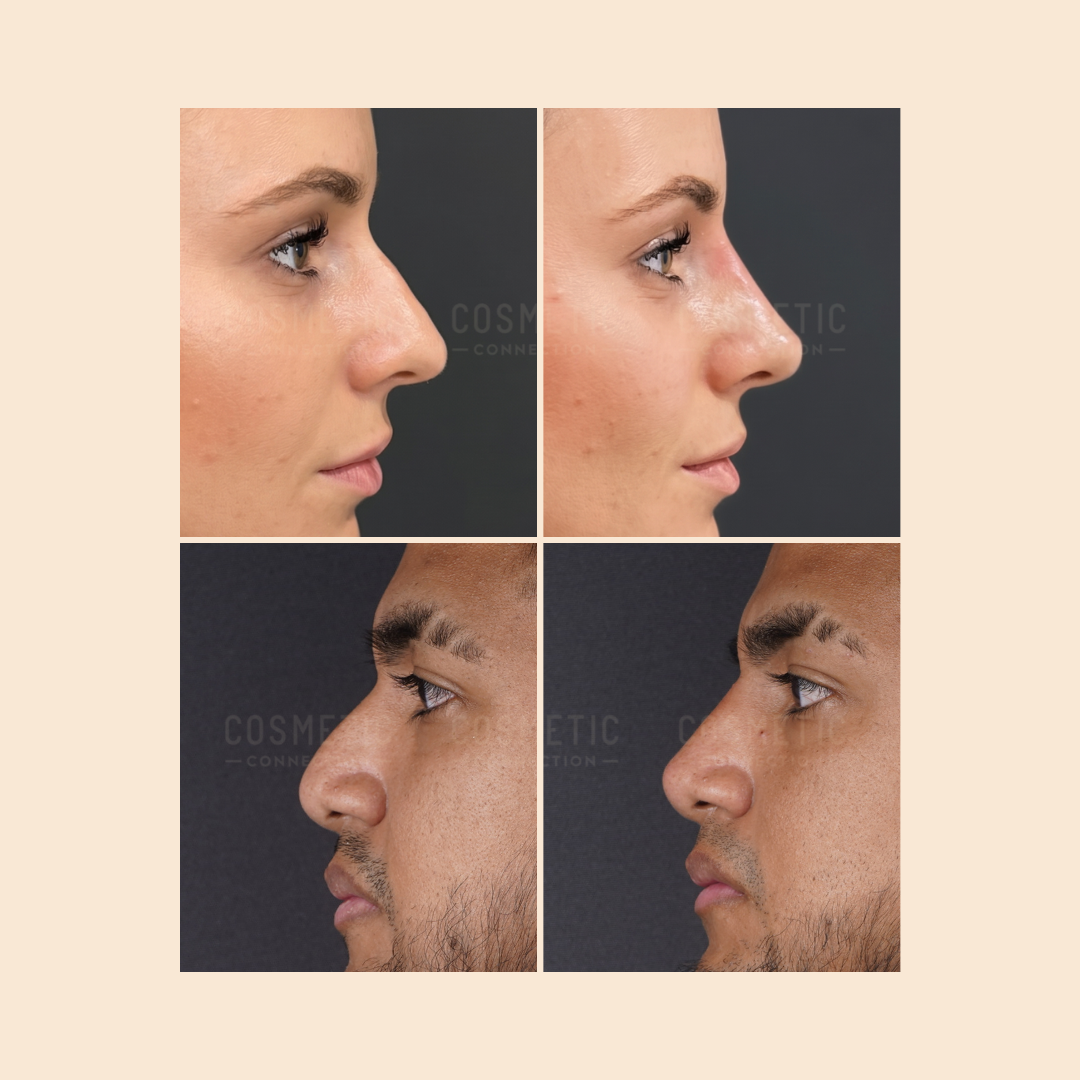
A dorsal hump, the bump on the bridge of the nose, is one of the most common concerns people bring to a non-surgical rhinoplasty consultation. Cosmetic treatment can be used to camouflage a dorsal hump non-surgically by creating a straighter profile line above and below it. The result is not a physical removal of the bump, but a visual correction that can be remarkably effective for the right candidate. This guide explains exactly what is possible, what is not, and how to know if this approach suits your specific anatomy.
Quick answer: Non-surgical rhinoplasty cannot physically reduce a dorsal hump, it adds volume, it does not remove it. However, strategic treatment above and below the hump disguises the bump for a straighter, smoother profile. This works best for small to moderate humps. Large or prominent humps where full correction is desired are generally better addressed with surgical rhinoplasty.
How does non-surgical rhinoplasty camouflage a dorsal hump?
The technique works through optical illusion rather than physical reduction. A dorsal hump appears as a raised bump because of the contrast between the hump and the areas above and below it. By adding volume to the radix (the point between the eyes, at the top of the nose) and to the supratip area (just above the tip), a skilled clinician creates a straighter silhouette.
Think of it like contouring with makeup. The bump itself has not changed, but the surrounding areas have been brought up to reduce the contrast.
The critical variable is the size of the hump. This technique works well for small humps that create a slight deviation in the profile, moderate humps where the overall nose structure is proportionate, and people who want to preview what a straighter profile would look like before committing to surgery.
When is a dorsal hump too large for non-surgical rhinoplasty?
A larger hump creates a more significant contrast, and correcting that contrast requires adding meaningful volume above and below. At some point, the volume required to create a straight profile makes the nose itself look too large or wide. This is the practical ceiling of the non-surgical approach.
There is no universal measurement that defines “too large”, it depends on the individual’s overall facial proportions and what they find acceptable. In our experience, people with a very prominent dorsal hump who are genuinely seeking a smaller, refined nose will not be satisfied with treatment alone. For them, the honest recommendation is a surgical rhinoplasty consultation.
This is exactly the type of assessment we conduct before any treatment, because proceeding with treatment on a hump that is too large for the technique benefits no one.
What does the procedure involve?
For dorsal hump correction specifically:
- The radix and supratip zones are assessed and marked
- The treatment is administered with fine-gauge needles at the planned points
- The result is reviewed from multiple angles: front, side, three-quarter
- Adjustments are made before the procedure concludes
The entire session takes 10–30 minutes. Results are immediately visible, though minor swelling can subtly affect the profile for 24–72 hours.
| Profile type | Suitability | Expected outcome |
|---|---|---|
| Small, subtle hump | High | Near-complete visual correction of profile |
| Moderate hump | Moderate | Significant improvement, profile reads straighter |
| Large, prominent hump | Low | Insufficient correction; may make nose appear larger |
| Hump with wide nose | Requires careful assessment | Risk of adding apparent width — discuss in consultation |
Get started
How long do results last for dorsal hump correction?
Non-surgical rhinoplasty for dorsal hump correction typically lasts 12–18 months, consistent with the general longevity of nasal treatment. Because the radix and bridge are relatively low-movement areas, longevity tends to be at the longer end of this range for most clients.
Maintenance treatment is recommended before the result fully reduces as re-treating with residual product in place is more efficient than starting from scratch.
Non-surgical vs surgical rhinoplasty for a dorsal hump
| Factor | Non-surgical | Surgical |
|---|---|---|
| What it does to the hump | Camouflages it visually | Physically removes it |
| Downtime | None to minimal | 2–4 weeks minimum |
| Result duration | 12–18 months longevity | 10+ years, nose changes with age |
| Best for | Small to moderate humps | Large humps |
| Reversible | Yes, can be dissolved | No |
Read more on how to choose between surgical and non-surgical rhinoplasty.
What does non surgical rhinoplasty for a dorsal hump look like?
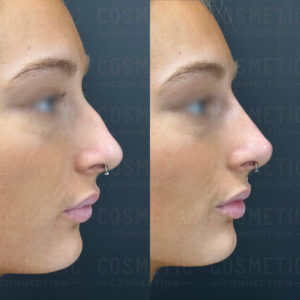
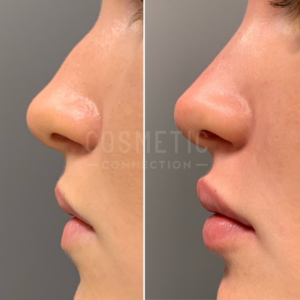
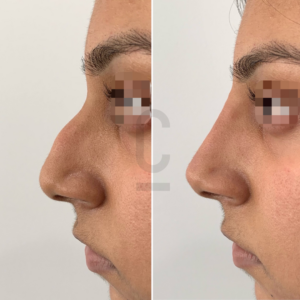
See more non-surgical rhinoplasty results.
Frequently asked questions
Will non-surgical rhinoplasty make a dorsal hump look worse?
In the right hands, no. However, if too much product is placed or the technique is incorrect, the nose can look larger or the bridge can appear wider. This is why practitioner experience with nasal anatomy specifically, not just general experience, matters.
Can I use non-surgical rhinoplasty to preview a surgical result?
Yes, many people use this approach as a way to preview a change before committing to surgery. It is not a perfect simulation of a surgical result, but it can give you a meaningful sense of what a straighter profile looks and feels like.
Is non-surgical rhinoplasty for a dorsal hump painful?
Not at all. Most people describe the sensation as mild pressure, with far less discomfort than they were expecting. The bridge of the nose is generally less sensitive than the tip.
Want to know more about non surgical rhinoplasty?
Read our complete guide to non surgical rhinoplasty in Australia.