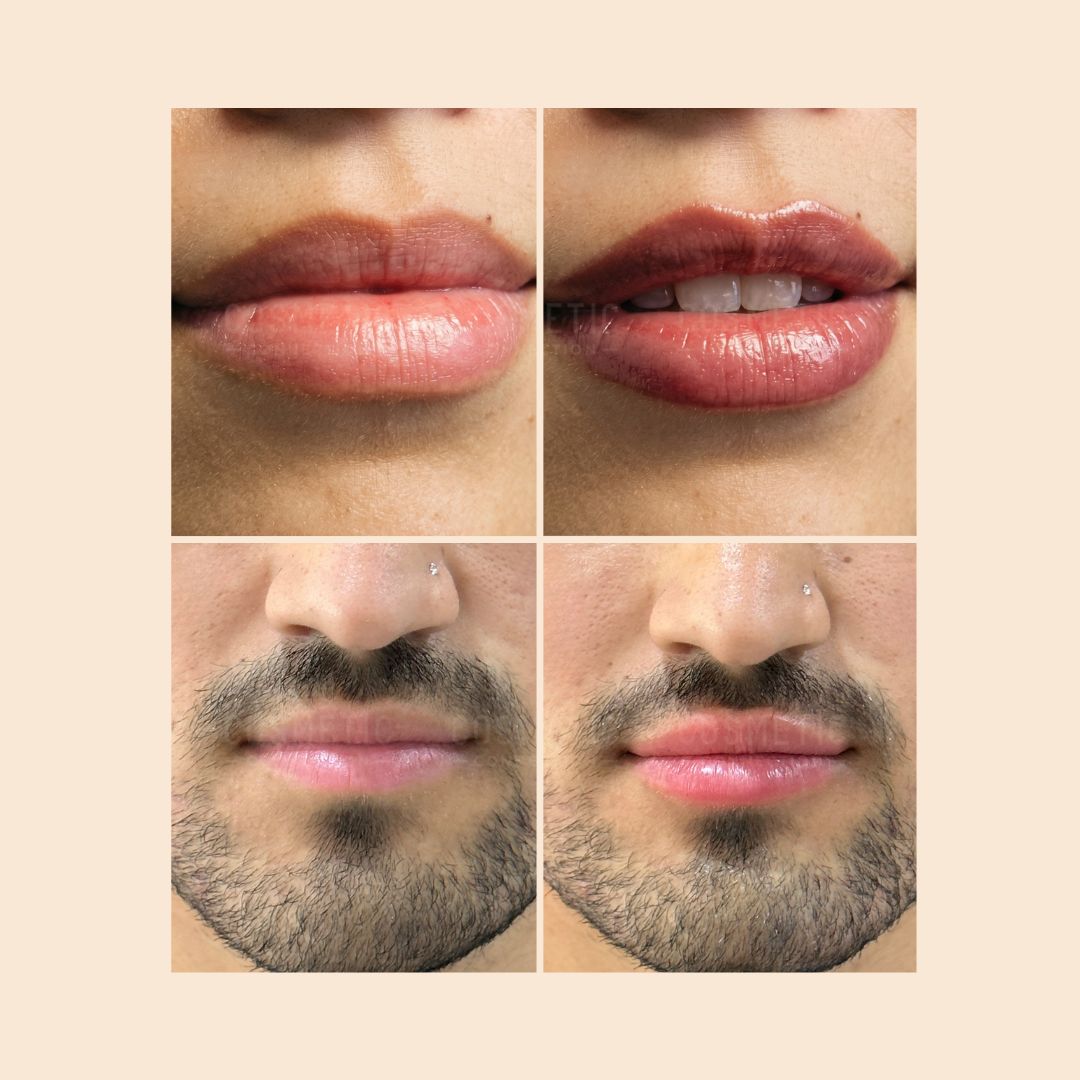
Swelling after non-surgical lip enhancement is expected, predictable, and temporary. Understanding what happens day by day prevents unnecessary alarm in the first 48 hours, when lips look their most swollen and least representative of the final result, and helps patients set realistic expectations for when the outcome will be visible.
Quick answer: Swelling after cosmetic lip enhancement peaks at 24 to 48 hours and resolves progressively over 5 to 10 days. The final result is visible at 2 weeks once all swelling has fully resolved. Do not assess or judge the result in the first 48 hours — what you see immediately after treatment is not the final outcome.
Why swelling occurs after lip enhancement treatments
Swelling is the body’s normal inflammatory response to tissue trauma. Any treatment creates a micro-injury at the insertion site, triggering localised inflammation, such as increased blood flow, fluid accumulation, and tissue swelling. In the lips, this response is amplified by two factors: the lips have a rich blood supply and thin, pliable tissue that swells visibly even with mild inflammation.
The result is that lips look larger, and often uneven in the first 24 to 48 hours, not because the treatment has gone wrong, but because the inflammatory response is doing exactly what it should.
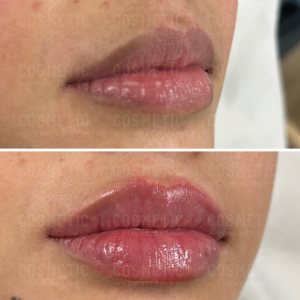
Before and immediately after treatment (swelling present)
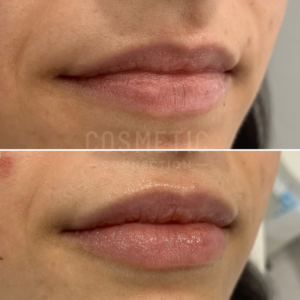
Before and after (fully healed, no swelling)
Day-by-day swelling timeline
| Timeframe | What to expect | Is this normal? |
|---|---|---|
| Immediately after | Redness and tenderness at treatment sites; mild swelling beginning; lips appear larger than the final result will be | Yes — do not assess the result yet |
| Hours 2–6 | Swelling increases progressively; lips may feel firm or tight; mild bruising may begin to appear | Yes |
| Day 1 (24 hours) | Swelling peaks; lips may appear significantly fuller, uneven, or disproportionate; this is the most alarming stage for first-time patients | Yes — this is normal and temporary |
| Day 2–3 | Swelling begins to subside; shape becomes more defined; bruising (if present) may peak then begin fading | Yes |
| Day 4–5 | Most acute swelling resolved; the shape of the result is now visible for the first time | Yes — result is emerging but not final |
| Day 7–10 | Residual swelling largely resolved; result is mostly visible; bruising faded in most patients | Yes |
| 2 weeks | Final result visible; all swelling resolved; appropriate time for review appointment | This is when to assess and review |
Bruising after lip enhancement treatments
Bruising is common after lip enhancement treatments, more so than in lower-vascularisation areas of the face. The lips have a dense blood supply and thin overlying skin, making bruising both more likely and more visible.
Bruising typically appears in the first 24 hours after treatment, peaks at days 2 to 3, then gradually resolves over 5 to 10 days. Hirudoid cream applied to the bruised area may help accelerate resolution. Avoiding alcohol and strenuous exercise in the 24 to 48 hours before treatment reduces the likelihood of bruising.
If bruising or swelling is severe, asymmetric, worsening beyond day 3, or accompanied by significant pain or skin colour change, contact your treating clinic promptly.
What helps reduce swelling after lip enhancement
- Apply a wrapped ice pack intermittently for the first 72 hours where possible: 20 minutes on, 40 minutes off; do not apply ice directly to the skin
- Sleep on your back using 1-2 pillows for the first two nights: this allows fluid to drain away from the lips
- Avoid alcohol for 24 hours after treatment: alcohol increases vasodilation and worsens swelling
- Avoid strenuous exercise for 24 to 48 hours: elevated heart rate increases blood flow to the treated area
- Avoid heat sources: saunas, steam rooms, and very hot showers increase blood vessel dilation and swelling
Read our detailed aftercare guide for more information on how to care for your lips after treatment.
If you want to explore your options and suitability for lip enhancement, request a consultation with our clinical team. We’ll assess your lips using our 3 pillar framework, and provide fair, honest guidance.
Get the decide guide
When swelling is not normal — warning signs
Most post-treatment swelling is benign and follows the timeline above. The following warrant prompt contact with your treating clinic:
- Swelling that is progressively worsening rather than improving
- Asymmetric swelling where one side is markedly more swollen than the other
- Skin that appears white, mottled, or discoloured during or shortly after treatment
- Significant pain that is worsening rather than improving
- Blistering or skin breakdown at any point
- Fever or systemic symptoms: rare, but may indicate infection
For a complete overview of risks and complications, see our guide to risks of lip enhancement treatments.
Frequently asked questions
How long does swelling last after lip enhancement?
For volume-restoring cosmetic treatments, swelling peaks at 24 to 48 hours and largely resolves by 5 to 10 days. The final result is visible at 2 weeks. PDO thread treatment swelling resolves within 5 to 7 days. Rejuran papules resolve within 12 to 24 hours.
Why do my lips look uneven after treatment?
Uneven appearance immediately after treatment is almost always caused by asymmetric swelling — the upper and lower lip, and the left and right sides, do not swell uniformly. This is normal and almost always resolves as swelling subsides. If the unevenness persists beyond the 2-week review, raise it with your practitioner at that appointment.
Can I wear makeup to cover bruising after lip enhancement?
Avoid applying makeup directly to treatment sites for the first 24 hours. After that, concealer can be carefully applied to bruised areas — but avoid rubbing or pressing the lip area. Colour-correcting concealer (peach or orange-toned) can neutralise purple bruising before covering with foundation.
How soon after lip enhancement can I have an event?
Bruising and acute swelling typically resolve within 5 to 10 days. For most social events, 2 weeks is the safe planning window — this allows full swelling resolution and a review appointment if any minor adjustments are needed. Do not schedule a first-time treatment within 2 weeks of an important event.