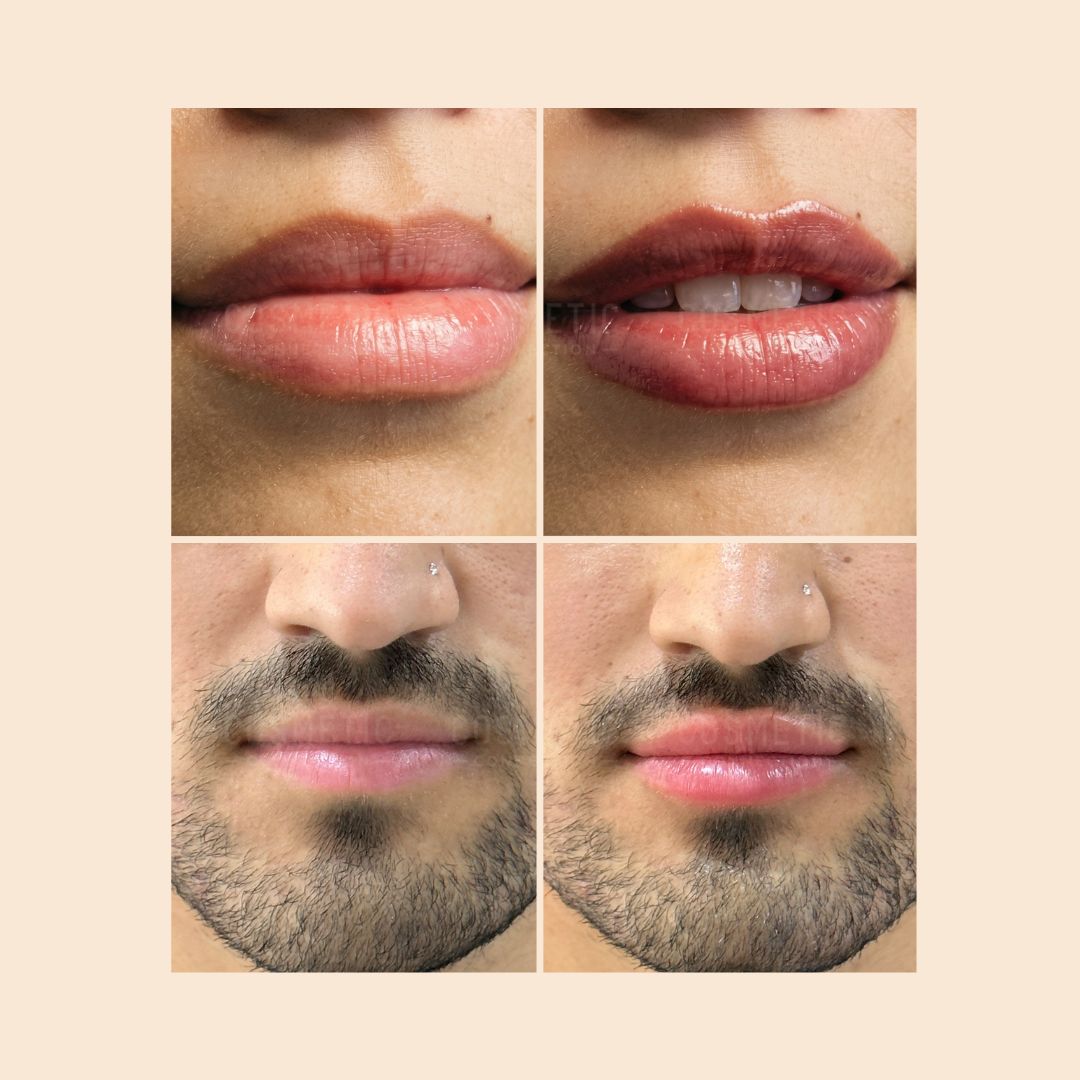
Non-surgical lip enhancement is a medical procedure. Transparent, honest discussion of risks is a clinical obligation, not a disclaimer to be minimised. This guide covers the complete risk profile for all types of lip enhancement treatment, including what is common, what is uncommon, what is serious, and how risks are managed in a properly governed clinical setting.
Quick answer: The most common risks after cosmetic lip enhancement are swelling and bruising, which are expected and temporary. The most serious risk is vascular occlusion, interruption of blood supply to surrounding tissue, which is rare when treatment is performed by an experienced practitioner with appropriate safety protocols in place. Some treatments are fully reversible, which provides a meaningful safety advantage over irreversible alternatives.
Risk profile by treatment category
Volume-restoring cosmetic treatments
The lips have cosmetic treatment-related risks due to the density of the labial vasculature. The superior and inferior labial arteries run close to the surface of the lip and have complex anastomotic connections. Because of this, clinicians require particular anatomical knowledge and vascular risk awareness when performing cosmetic treatments in this area.
| Complication | Incidence | Severity | Management |
|---|---|---|---|
| Swelling | Universal — expected | Minor | Resolves 5–10 days; ice and elevation |
| Bruising | Common — 10–20% of patients | Minor | Resolves 5–10 days; hirudoid |
| Asymmetry (temporary) | Common initially; resolves with swelling | Minor | Review at 2 weeks |
| Asymmetry (persistent) | Uncommon | Moderate | Additional treatment or reversal at review |
| Lumps or surface irregularities | Uncommon with correct technique | Moderate | Review after healing; dissolution if persistent |
| Migration | Uncommon with conservative volumes | Moderate | Dissolution and re-treatment with corrected approach |
| Infection | Rare | Moderate to serious | Antibiotic treatment; prompt medical review |
| Delayed inflammatory nodule (granuloma) | Rare | Moderate | Medical assessment; steroid injection or dissolution |
| Vascular occlusion | Rare — but most serious complication | Serious | Immediate reversal agent; emergency management |
| Skin necrosis | Very rare; associated with vascular occlusion | Serious | Emergency management; wound care |
Vascular occlusion — the critical risk to understand
Vascular occlusion occurs when the substance enters or compresses a blood vessel, interrupting blood supply to the surrounding tissue. In the lips, the primary concern is the labial arteries.
Signs of vascular occlusion that require immediate response:
- Blanching (immediate white discolouration) of the skin during or after treatment
- Disproportionate or unusual pain during treatment
- Progressive skin discolouration or mottling after the procedure
- Blistering or pustule formation in the hours following treatment
Management requires immediate administration of the reversal agent, which must be physically present at every clinic performing cosmetic treatments. Time is critical: delayed treatment significantly increases the risk of permanent tissue damage. This is why confirming that the reversal agent is on-site at every appointment is a non-negotiable criterion when selecting a provider.
PDO thread lip treatment risks
| Complication | Incidence | Management |
|---|---|---|
| Bruising and swelling | Common — expected | Resolves within 5–7 days |
| Thread extrusion (thread works to the surface) | Uncommon | Thread trimmed or removed at clinic; no long-term consequence in most cases |
| Infection at insertion site | Rare | Antibiotic treatment; medical review |
| Asymmetric tension or result | Uncommon | Review appointment; minor adjustment or waiting for threads to settle |
Rejuran lip treatment risks
| Complication | Incidence | Management |
|---|---|---|
| Papules (small bumps at treatment sites) | Universal — expected; resolves 12–24 hours | Normal response; no intervention needed |
| Redness and swelling | Common — expected; resolves 24–72 hours | Normal response; ice if needed |
| Bruising | Uncommon — lower risk than volume-restoring treatments due to superficial placement | Resolves 5–7 days |
| Infection | Rare | Antibiotic treatment; medical review |
How to minimise risk when choosing a provider
Provider selection is the most significant modifiable risk factor for all categories of lip enhancement treatment. Clinical skill, product knowledge, safety protocols, and the availability of emergency management all depend on the provider.
- Confirm a registered doctor is involved in your clinical assessment
- Confirm the reversal agent is physically present at every appointment
- Ensure a genuine consultation occurs before treatment
- Avoid significantly below-market pricing, it almost always reflects a compromise in safety infrastructure
- Confirm there is a clear complication management pathway: what happens if something goes wrong?
You can view the Cosmetic Connection treatment risks disclosure for a complete overview of how we communicate and manage risk across all cosmetic procedures.
If you’re interested in lip enhancement, and want to ensure a safe and professional treatment, request a consultation with our clinical team. We’ll assess your lips using our 3 pillar framework, and provide fair, honest guidance.
Get the decide guide
Frequently asked questions
How common are serious complications from lip enhancement treatments?
Serious complications such as vascular occlusion are rare in absolute terms. The risk is substantially reduced — though not eliminated — when treatment is performed by an experienced doctor with appropriate safety protocols, using correct technique and conservative volumes. Choosing a well-governed clinic is the most effective risk reduction strategy available to patients.
What should I do if something goes wrong after my treatment?
Contact your treating clinic immediately. For any sign of vascular compromise — skin blanching, unusual pain, discolouration — treat this as an emergency and return to the clinic or an emergency department without delay. For non-urgent concerns such as persistent asymmetry or lumps, wait until swelling has fully resolved at 2 weeks before attending your review appointment.
Are there long-term risks from repeated lip enhancement treatment?
The most significant long-term risk is product accumulation leading to migration, which occurs with repeated high-volume treatments over many years. This is preventable through conservative, staged treatment and periodic assessment. There is no credible clinical evidence that well-administered, appropriately dosed treatment causes permanent adverse structural change to the lips over the long term.