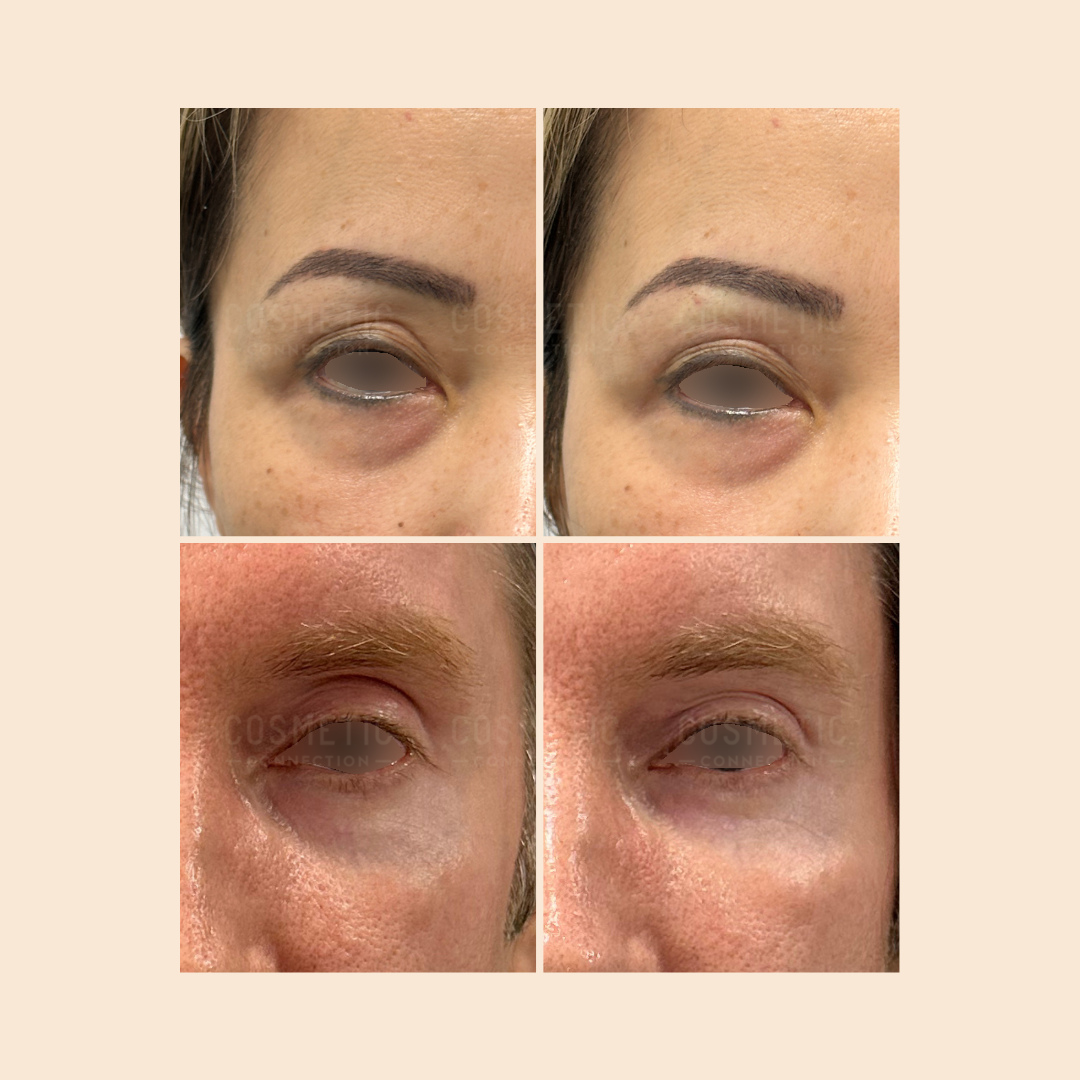
Upper eyelid volume loss creates a hollow, sunken appearance beneath the brow bone that reads as fatigue, premature ageing, or a drawn, skeletal quality around the eyes. Non-surgical treatments restore that lost volume, rebuilding the smooth curve that defined the upper eyelid before volume was lost, or that is naturally deficient.
This guide covers everything you need to understand about upper eyelid volume restoration: what causes hollowing, how treatment works, who it suits, what the risks are, what results look like, how long they last, and what it costs in Australia.
Quick answer: Upper eyelid hollowing — also called the A-frame deformity or sunken superior sulcus — occurs when volume beneath the brow bone is lost through ageing, genetics, or previous surgery. Non-surgical volume restoration rebuilds the natural curve of the upper eyelid. Results typically last 12–18 months. The periorbital area carries higher anatomical risk than most injection sites, making doctor-led treatment essential.
What is upper eyelid volume loss?
The upper eyelid occupies a space defined by the brow bone above and the eyelid itself below. In a full, youthful upper eyelid, there is a smooth, gently curved transition between the brow and the lid. When volume in this space reduces — through fat pad thinning, bone resorption, or soft tissue descent — the area becomes concave. The result is a shadow or sunken appearance that can make eyes look smaller, more aged, or persistently fatigued.
This condition is known clinically by several interchangeable terms. According to a 2022 paper published in the Journal of Drugs in Dermatology, it may be referred to as an A-frame deformity, superior sulcus syndrome, upper eyelid hollowing, sunken superior sulcus, or sunken upper eyelid. The A-frame name describes what you see from the front: the brow forms the top of the triangle, and the concave hollow beneath forms the space inside it.
Upper eyelid volume loss is not only an ageing concern. Some people carry a genetic predisposition to a more hollowed upper lid from early adulthood. Others develop it following upper eyelid surgery where fat was removed too aggressively. Understanding the cause matters because it determines whether non-surgical treatment is appropriate and what result is realistic.
What causes upper eyelid hollowing?
There are three primary causes, and they sometimes overlap.
Ageing. A review published in PMC (National Library of Medicine) confirms that changes in the upper eyelid region with age include brow descent, unmasking of the medial fat pad, and progressive exposure of the superior orbital rim — all driven by the gradual thinning and descent of fat pads, reduced soft tissue support, and bone resorption that occurs across the face from the mid-twenties onward. The periocular area typically shows these changes earlier than other facial regions.
Genetics. A review published in PMC covering periorbital filler anatomy and technique notes that supraorbital hollowness can result from genetic factors, and is particularly prevalent in East Asian patients due to anatomical differences including weaker levator muscles and unique fat distribution patterns. For people in this group, hollowing may be present from a young age and is not a sign of premature ageing.
Post-surgical. Patients who have undergone upper blepharoplasty with aggressive fat removal can be left with an over-corrected, hollowed appearance. Caution is necessary during blepharoplasty to avoid over-resection of skin or fat, which can lead to an A-frame deformity or hollowed upper lid appearance. For people in this situation, non-surgical volume restoration methods are often the most direct correction available.
How non-surgical upper eyelid volume restoration works
Non-surgical upper eyelid volume restoration uses various methods to rebuild the curve that was lost.
The treatment takes 10–20 minutes in clinic. A injectable anaesthetic is applied beforehand and the product itself contains a local anaesthetic that reduces discomfort as treatment proceeds. Most people return to normal activities the same day, and bruising and mild swelling is uncommon. Final results are best assessed at 2–4 weeks once the area fully heals.
Is upper eyelid volume restoration safe?
This is the question we hear most often, and it deserves a direct answer.
According to a report published by Ophthalmology Times, citing Oxford Academic data, the incidence of vascular complications when administering hyaluronic acid treatments is between 0.01% and 0.05% per treatment. The periorbital area is anatomically complex with numerous vital structures and thin, delicate skin, making it more susceptible to bruising, swelling, and in rare cases vision impairment.
What reduces this risk substantially: deep anatomical knowledge, use of an appropriate product selected specifically for periorbital placement, small volumes, careful technique, and immediate access to the dissolving agent that can reverse treatment in the event of a vascular emergency. As noted by EyeWiki (American Academy of Ophthalmology), hyaluronic acid treatment in the periorbital region is considered off-label — its use in this area has not been formally approved by regulatory bodies, though clinical practice and published evidence support its use by appropriately trained practitioners.
At Cosmetic Connection, upper eyelid treatment is performed exclusively by doctors with specific training in periorbital anatomy. We carry reversal agents in clinic at all times and apply the same emergency protocol standards to all periorbital work. If you are comparing providers, asking about clinical background, emergency protocols, and periorbital experience specifically (how many treatments they have done) is entirely reasonable — any provider worth consulting will welcome those questions.
If your concern is genuine upper eyelid hollowing and you want to understand whether non-surgical volume restoration is appropriate for your situation, our team will give you an honest assessment before any treatment is planned. Book a consultation at any of our clinic locations.
Who is suitable for upper eyelid volume restoration?
Non-surgical upper eyelid volume restoration works well for a specific presentation. Getting this right at assessment is what separates a natural, satisfying result from a poor outcome — or an inappropriate treatment entirely.
You may be a suitable candidate if:
- You have genuine volume loss in the upper eyelid area — the hollow is caused by deflation, not excess skin or brow drooping
- The skin of your upper eyelid is in reasonable condition — very thin or crepey skin can increase the visibility of product at the surface
- You have realistic expectations — this treatment restores what was lost rather than creating a dramatically different appearance
- You have had previous blepharoplasty with an over-resected result — a well-established indication for non-surgical volume correction
Non-surgical upper eyelid volume restoration is not appropriate if:
- Your primary concern is excess or overhanging upper eyelid skin — volume restoration will not address this and may worsen the appearance
- Your brow sits low and creates the appearance of heaviness — the concern here is brow position, not volume
- You have a functional vision issue from heavy upper lids — this requires surgical assessment
In our experience, a proportion of people who enquire about upper eyelid volume restoration are better served by a different approach — brow repositioning, temple volume restoration, or a broader upper face assessment that considers all contributing factors together. An honest suitability assessment before any treatment is planned is the most valuable thing we offer. You can explore how we approach treatment planning in our guide to upper eyelid exposure and what causes it and our detailed comparison of non-surgical treatment and blepharoplasty .
Get started
How long do results last?
Most patients see results lasting 12–18 months, though this varies depending on individual metabolism, and the treatment details.
With repeat treatment over time, many patients find their results become more stable, consistent with what is observed across treatments generally as tissue quality gradually improves with repeated treatment. Your treating doctor will advise on maintenance timing based on how your result settles and what your goals are.
What does upper eyelid volume restoration cost in Australia?
Upper eyelid volume restoration in Australia is priced between $1,500 and $3,000, depending on the extent and complexity of treatment, and the skill and experience of the clinician.
We operate on flat-fee pricing — the fee quoted includes all product used in your treatment, with no per-unit add-ons once treatment has been planned. You can read more about how our pricing structure works and what flat-fee treatment means in practice.
If you are comparing costs across providers, the most important variable is not price — it is the clinical background of the person performing the treatment. Given the anatomical complexity and risk profile of periorbital treatment, this is not a decision to make on cost alone.
Frequently asked questions
Is upper eyelid volume restoration painful?
Most people find it very manageable. An injectable anaesthetic is applied beforehand and the product contains a local anaesthetic that reduces discomfort during treatment. The periorbital area can be more sensitive than other sites.
What is the A-frame deformity?
The A-frame deformity is a clinical term for upper eyelid hollowing where the brow bone and lid create a concave, triangular shadow between them when viewed from the front. It can develop through natural ageing, genetics, or as a result of over-aggressive fat removal during blepharoplasty surgery.
Can non-surgical upper eyelid treatment go wrong?
Yes — as with any periorbital treatment, there are real risks. Common issues include bruising, swelling, surface irregularities, and the Tyndall effect if product sits too superficially. More serious but rare complications include vascular compromise. Choosing a doctor with specific periorbital experience who carries reversal agent in clinic reduces this risk substantially.
How do I know if I need volume restoration or surgery?
The key question is whether your concern is primarily volume loss or excess skin. Genuine hollowing or deflation beneath the brow points toward non-surgical volume restoration. Excess overhanging skin, heavy lids, or brow drooping that affects vision points toward surgical assessment. You can read a detailed breakdown in our guide to upper eyelid treatment vs surgery .
Does non-surgical upper eyelid treatment look natural?
In appropriate candidates, yes. The goal is restoration — returning volume that was previously there, not augmentation. Very small volumes are used, typically under 1 mL per side, and deep placement means product is not visible at the surface.
Where can I get upper eyelid volume restoration in Australia?
Cosmetic Connection offers upper eyelid volume restoration at our clinics in Australia. All periorbital treatment is performed by doctors with specific training in periorbital anatomy and access to emergency reversal protocols.