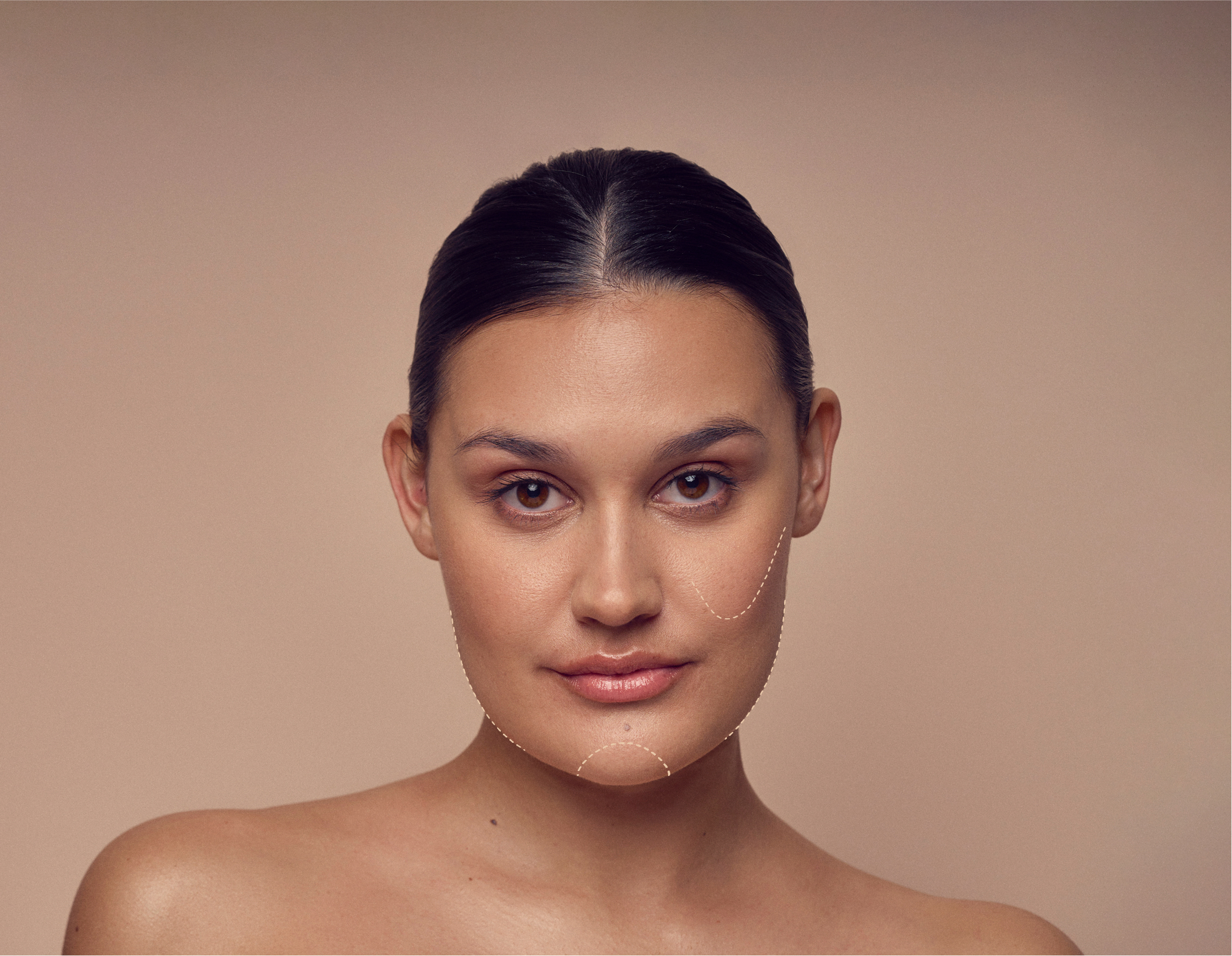
Non-surgical cheek volume treatment and surgical cheek augmentation both improve mid-face structure and definition — but they work differently, last differently, and suit different people. This guide sets out the key differences so you can make an informed decision about which approach fits your situation.
The short version: non-surgical treatment is the more flexible, lower-commitment option with no downtime and reversible results. Surgical augmentation offers permanent change for those who want a long-term structural result. Neither is universally better — the right choice depends on what you’re trying to achieve and how much commitment you’re prepared to make.
Quick answer: Non-surgical cheek volume treatment delivers adjustable, reversible results with no downtime and a recovery measured in days. Surgical cheek augmentation is permanent and requires weeks of recovery, but does not need maintenance. For most people considering this decision for the first time, non-surgical treatment is the lower-risk starting point — particularly because it allows you to experience the result before committing to anything permanent.
What each option actually involves
Before comparing outcomes, it helps to understand what each procedure involves at a practical level — because the differences in experience are significant.
Non-surgical cheek volume treatment
Non-surgical treatment involves prescription medicines placed into the mid-face using a fine needle or blunt-tipped cannula. The procedure takes 30–45 minutes and is performed in a clinic setting. Topical numbing is applied beforehand. You leave the clinic with results visible immediately, and return to your normal day the same day or the next. The most common after-effects are mild swelling and occasional bruising that settles within a few days to two weeks.
Volumising treatment is fully reversible — it can be dissolved using a specific enzyme if the result is not what you wanted or a complication occurs. Collagen stimulating treatment produces gradual results over several months and is not reversible in the same way, though its effects are not permanent. Both approaches are discussed and matched to your anatomy at consultation.
For a complete overview of what non-surgical treatment involves, see our cheek volume treatment guide.
Surgical cheek augmentation
Surgical cheek augmentation typically involves placing a solid silicone implant through an incision made inside the mouth or along the lower eyelid. The procedure is performed under general anaesthetic and takes 1–2 hours. Recovery involves significant swelling for 2–4 weeks, dietary restrictions while the mouth heals, and a return-to-normal-activity timeline of 4–6 weeks. The result is permanent — implants are designed to remain in place indefinitely.
Revision or removal of implants is possible but requires another surgical procedure. Implants can shift position over time in a small number of cases, which may also require surgical correction.
Fat transfer is a second surgical option — fat is harvested from another area of the body through liposuction and transferred to the cheeks. Results are long-lasting but variable, as a proportion of transferred fat is reabsorbed by the body in the months following the procedure. This also requires general anaesthetic and a longer recovery than implants for some patients.
Side by side: the key differences
| Factor | Non-surgical treatment | Surgical augmentation |
|---|---|---|
| Procedure time | 30–45 minutes | 1–2 hours (general anaesthetic) |
| Downtime | None to minimal — days | 4–6 weeks |
| When results appear | Immediately (volumising) or 6–8 weeks (collagen stimulation) | Visible once swelling resolves — 4–8 weeks |
| Longevity | 12–24 months depending on approach | Permanent (implant); variable (fat transfer) |
| Reversibility | Yes (volumising); no (collagen stimulating) | Removal requires surgery |
| Adjustability | Yes — amount can be refined over time | No — result is fixed at placement |
| Anaesthetic | Topical numbing only | General anaesthetic |
| Risk profile | Mild — bruising, swelling; rare serious events | Surgical risks — infection, implant shift, anaesthetic |
| Cost (Australia) | $1,500–$3,000 per treatment | $8,000–$18,000+ (surgeon fees, anaesthesia, hospital) |
| Maintenance required | Yes — every 12–24 months | No (unless revision needed) |
When non-surgical treatment is the stronger choice
Non-surgical cheek volume treatment suits a broader range of situations than surgical augmentation does. In our clinical experience, it is the appropriate starting point for the majority of people considering mid-face improvement for the first time.
It is particularly well-suited when:
- The concern is volume loss from ageing, weight change, or natural leanness — restoration is almost always better addressed non-surgically first
- You want to see a result before committing to something permanent — non-surgical treatment lets you experience the change, refine it if needed, and make a more informed long-term decision
- Your concern is subtle or nuanced — the adjustability of non-surgical treatment means results can be dialled in precisely over one or two sessions
- Downtime is a practical constraint — most patients return to work the same day or the next
- You want the option to reverse the result — either because you’re uncertain, or because your preferences may change over time
A 2025 systematic review and meta-analysis published in Medicina, which analysed 14 studies involving 748 participants, found that volumising treatment for the mid-face produced significantly higher improvement rates than control groups, with rare moderate-to-severe adverse events. The evidence base for non-surgical mid-face treatment is well-established.
Get started
When surgical augmentation may be the stronger choice
Surgical cheek augmentation is a reasonable consideration in a narrower set of circumstances. It is not the default — the commitment it requires means it is better suited to patients who have a clear, stable preference for permanent change and have ideally experienced non-surgical treatment first.
Surgical augmentation may be the stronger option when:
- You have experienced non-surgical cheek treatment and consistently want more volume or projection than can be achieved non-surgically
- You prefer a permanent result and are confident in the outcome — and do not want to maintain treatment every 12–24 months
- Your concern is significant structural underdevelopment rather than volume loss — patients with very flat mid-face anatomy from birth sometimes achieve better structural results with implants
- You are already planning other surgical procedures and are open to addressing the cheeks at the same time
What surgical augmentation does not do well: it cannot address the nuanced, layered nature of age-related volume change. Implants add projection, but they do not restore the multi-compartment volume distribution that was present in youth. For patients whose primary concern is looking “rested and refreshed” rather than more projected, non-surgical treatment tends to produce more natural-looking outcomes.
A note on the jowl question
Patients often ask whether cheek treatment will improve the appearance of their jowls. This deserves a direct answer.
Cheek volume treatment does not lift the jowls. The tissue in the lower face is not mechanically elevated by adding volume to the mid-face — that is not how the anatomy works. What mid-face treatment can do is improve the overall balance of facial proportions. A fuller, better-defined mid-face can make the lower face look more harmonious by comparison, which sometimes gives the impression of a lifted or tighter lower face. This is a visual effect created through better proportion — not a structural change to the lower face.
If jowls are the primary concern, the more appropriate treatment is one that specifically addresses the lower face — such as jowl contouring and lifting. Many patients benefit from addressing both the mid-face and lower face as part of a broader plan. This is something we assess and discuss at consultation. Our facial balancing guide provides a useful framework for thinking about the face as a whole rather than feature by feature.
The case for starting non-surgically
One of the most compelling arguments for non-surgical treatment — even for patients who are ultimately open to surgery — is that it provides information before commitment.
Cheek volume is a structural feature of the face. Adding it changes the way you look, and not everyone anticipates correctly how that change will feel. Non-surgical treatment lets you experience the result in real life — at work, in photographs, in different lighting — before making any permanent decision. If you love it, you maintain it. If you decide you want more, that informs a more confident conversation about surgery. If it doesn’t feel right, it resolves over time.
This is a different kind of value to longevity, and it’s one that surgical augmentation can’t offer. The permanence of implants is a feature for people who are certain — and a liability for people who aren’t.
At Cosmetic Connection, our approach is suitability-first. We don’t recommend treatment for the sake of it, and we don’t push patients toward surgical options we don’t perform. Our job is to give you an accurate picture of what each path involves so you can make the choice that fits your situation. You can learn more about how we approach this on our our difference page.
Get started
Frequently asked questions
Is non-surgical cheek treatment as effective as surgical augmentation?
It depends on the goal. For restoring lost volume, improving proportion, and achieving a natural-looking refreshed result, non-surgical treatment is highly effective and often produces better outcomes than implants. For permanent structural projection — particularly in patients who want significantly higher cheekbones — surgical augmentation may achieve a result that non-surgical treatment cannot sustain long-term. These are different tools for different goals, not a better-or-worse hierarchy.
What does cheek treatment cost compared to surgery in Australia?
Non-surgical cheek volume treatment at Cosmetic Connection costs between $1,500 and $3,000 per appointment, depending on what is required. Surgical cheek augmentation in Australia typically costs $8,000–$18,000 or more when surgeon fees, anaesthesia, and hospital costs are included. Non-surgical treatment requires maintenance every 12–24 months; surgical augmentation does not. Over a 10-year period, the total cost of non-surgical maintenance may approach or exceed the surgical cost depending on how frequently treatment is required. For a full breakdown, see our cheek treatment cost guide.
Can I try non-surgical treatment before deciding on surgery?
Yes — and in most cases we recommend it. Non-surgical cheek treatment gives you a lived experience of the result before any permanent commitment. Many patients who originally planned to have surgery find that non-surgical treatment achieves what they were looking for, and some patients who try non-surgical treatment use it to confirm their preference for a more lasting structural change.
Are cheek implants safe?
Cheek implants have a well-established surgical track record. As with any surgical procedure, risks include infection, implant displacement, asymmetry, and anaesthetic complications. The risk of serious complications is low in the hands of a qualified plastic or cosmetic surgeon, but surgical risk is categorically different from the risk profile of non-surgical treatment. These risks should be discussed in detail with any surgeon you consult.
Will cheek treatment affect how I look in the long term?
Non-surgical volumising treatment resolves naturally over 12–24 months if not maintained. It does not alter the underlying structure of your face permanently. Collagen stimulating treatment encourages your own collagen production — the structural changes this creates are longer-lasting but also resolve gradually over time. Surgical augmentation is permanent unless revised. Neither non-surgical approach creates dependency or makes future ageing worse.