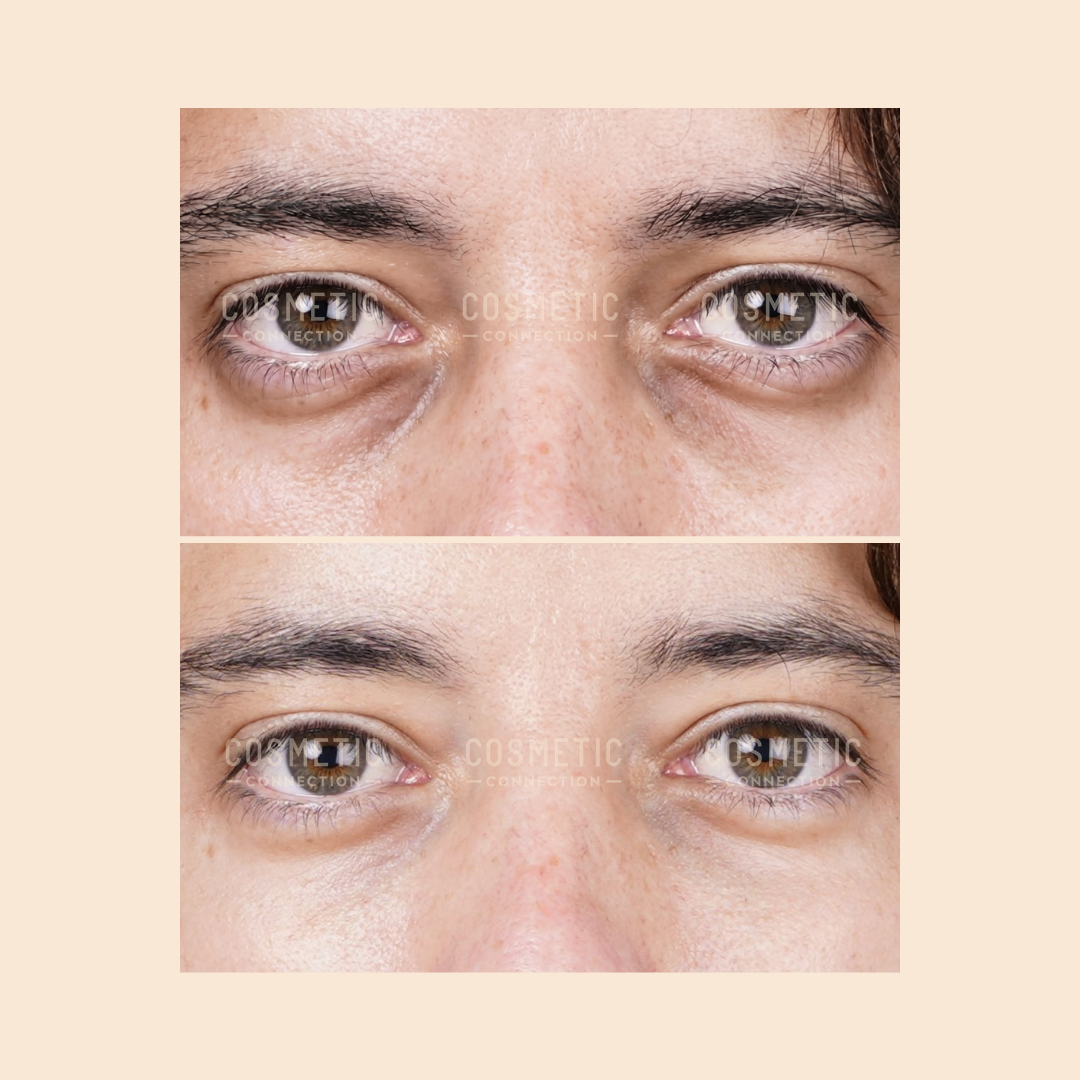
Under eye and tear trough treatment produces some of the most striking facial improvements we see — but it is also one of the treatments we decline to perform most often. Not because the treatment is inherently problematic, but because the anatomy of the periorbital area is unforgiving, and proceeding when the assessment does not support it tends to produce outcomes that are difficult to correct.
This post covers who tends to respond well to under eye treatment, who is better served by a different approach, and what we look for in a proper under eye suitability assessment.
Quick answer: Good candidates for under eye treatment typically have a well-defined tear trough hollow, reasonable skin quality in the periorbital area, and adequate structural support in the mid-face. People with significant lower eyelid laxity, very thin translucent skin beneath the eye, or orbital fat herniation creating puffiness are often not well-suited to this treatment and may achieve better outcomes through other means.
What makes someone a good candidate?
Suitability for under eye treatment is not simply a question of whether someone dislikes their under-eye appearance. It requires a careful structural assessment of the whole periorbital area and the face more broadly.
People who tend to achieve the best outcomes from under eye treatment share the following characteristics:
A clearly defined hollow beneath the eye
The treatment is designed for volume deficiency — a sunken groove that creates shadow beneath the lower eyelid. When this hollow is the primary concern, restoring volume to that area directly addresses the problem. If the concern is primarily puffiness or excess skin rather than a hollow, volume treatment is unlikely to help and could worsen the appearance.
Good skin quality in the periorbital area
The skin beneath the eye is the thinnest on the face. When that skin is reasonably smooth and has adequate elasticity, it accommodates the placed volume and the result settles naturally. When the skin is very thin, crepey, or has visible surface texture, product placed beneath it can become visible or irregular at the surface — a phenomenon known as the Tyndall effect, where the product shows through as a blue-grey discolouration.
Adequate mid-face structure
The tear trough does not sit in isolation. Its appearance is heavily influenced by the volume and position of the cheek below it. When the mid-face is reasonably full and structurally sound, under eye treatment addresses the remaining deficit effectively. When the mid-face has significant volume loss, treating only the tear trough can look incomplete or can accentuate the contrast between the treated area and the deflated cheek beneath it.
In our clinical experience, the best under-eye results often come from addressing both the tear trough and the midface volume in a coordinated plan — rather than treating the tear trough alone.
Realistic expectations
Under eye treatment can significantly reduce the appearance of a tear trough hollow. It cannot eliminate all shadow beneath the eye, correct skin pigmentation, or address structural changes that are better suited to a surgical approach. People who understand what the treatment can and cannot do — and approach it as an improvement rather than a correction — consistently report higher satisfaction.
A 2024 systematic review published in Aesthetic Plastic Surgery involving 2,556 participants reported an overall satisfaction rate of 91% — a figure that reflects both the efficacy of the treatment and the importance of appropriate patient selection.
Who may not be well-suited to under eye treatment?
Several presentations make under eye treatment inadvisable or require a modified approach. We assess for all of these at consultation.
Significant lower eyelid laxity
If the lower eyelid skin is loose or has poor tone, adding volume beneath it can sometimes exacerbate the appearance of sagging rather than improve it. In these cases, treatment requires caution, and in some situations a surgical opinion may serve the patient better.
Orbital fat herniation
When puffiness beneath the eye is caused by orbital fat pushing forward through a weakened orbital septum, adding volume does not address the cause. In some cases, it can accentuate the contrast between the puffy area and the surrounding tissue. This is a surgical concern, not a non-surgical one. We are direct about this at assessment.
Very thin or translucent lower eyelid skin
Exceptionally thin skin in the periorbital area significantly increases the risk of visible irregularity and the Tyndall effect. This does not always rule out treatment, but it changes the product selected, the depth of placement, and the volume used. When the risk is high enough, we recommend deferring until a skin quality treatment — such as Rejuran — has improved the tissue before any volume work is considered.
Certain medical conditions and medications
People taking blood-thinning medications, those with a history of cold sores around the eye area, or those with active skin conditions in the periorbital region require individual assessment before treatment proceeds. This is not necessarily a contraindication, but it requires disclosure at consultation so the treating clinician can factor it into the plan.
Get started
What does a suitability assessment involve?
At Cosmetic Connection, every under eye treatment appointment begins with a suitability assessment — not an assumption that treatment will proceed. This assessment evaluates:
- The type and depth of the tear trough hollow
- Lower eyelid skin quality and tone
- Presence or absence of orbital fat herniation
- Mid-face volume and structural support
- The overall balance of the periorbital and facial structure
- Medical history and current medications
If treatment is appropriate, the plan is explained clearly before anything proceeds. If it is not appropriate, we will tell you why — and in many cases, we can recommend an alternative approach that better fits the clinical picture.
You can learn more about our approach to assessment and treatment planning on our patient journey page.
The periorbital area as a whole
One thing we emphasise consistently is that the under-eye area is part of a connected structure. Changes to the upper eyelid, brow, and mid-face all affect how the under-eye area reads. A suitability assessment for under eye treatment should include an honest appraisal of whether the under-eye concern exists in isolation — or whether it is part of a broader pattern of periorbital change that is better addressed with a more complete treatment plan.
For a full explanation of how under eye treatment works, what it involves, and what realistic outcomes look like, see our complete guide to under eye treatment.
Get started
Frequently asked questions
Can I get under eye treatment if I have very dark circles?
It depends on the cause. When darkness is due to the shadow cast by a hollow tear trough, volume treatment can significantly reduce it. When darkness is caused by skin pigmentation, volume treatment has limited effect on the colour itself. At assessment, we identify the primary driver of your concern before recommending a treatment path.
Can under eye treatment be done alongside other facial treatments?
Yes, in many cases. Under eye treatment is frequently combined with mid-face treatment to achieve a more cohesive result. It is also commonly included as part of a broader facial balancing plan. Your clinician will advise on sequencing and timing at your consultation.
Am I too young for under eye treatment?
Age is less relevant than anatomy. We see people in their mid-20s with a naturally pronounced tear trough who benefit from treatment, and people in their 50s for whom the anatomy makes it inadvisable. Suitability is determined by what we find at assessment, not by your age.
Am I too old for under eye treatment?
Not necessarily. In older patients, the main considerations are skin quality in the periorbital area and the degree of lower eyelid laxity. When the tissue quality supports treatment, age alone is not a contraindication. We assess this carefully at consultation.
What if I am not suitable — what are my options?
If under eye treatment is not appropriate, there are usually alternative approaches worth considering. These might include skin quality treatments to improve tissue before volume work is attempted, a referral for a surgical opinion if structural changes are significant, or a broader facial treatment plan that addresses the mid-face and improves the under-eye appearance indirectly.
References
- Liu X, Gao Y, Ma J, Li J. (2024). The efficacy and safety of hyaluronic acid injection in tear trough deformity: a systematic review and meta-analysis. Aesthetic Plastic Surgery, 48(3), 478–490. https://link.springer.com/article/10.1007/s00266-023-03613-7
- Rao BK, Berger LE, Reilly C, Alamgir M, Galadari H. (2022). Tear trough filler techniques utilizing hyaluronic acid: a systematic review. Plastic and Reconstructive Surgery, 149(5), 1079–1087.
- Journal of Aesthetic Nursing. (2021). Periorbital rejuvenation and tear trough filler. Journal of Aesthetic Nursing. https://www.aestheticnursing.co.uk/content/clinical/periorbital-rejuvenation-and-tear-trough-filler/