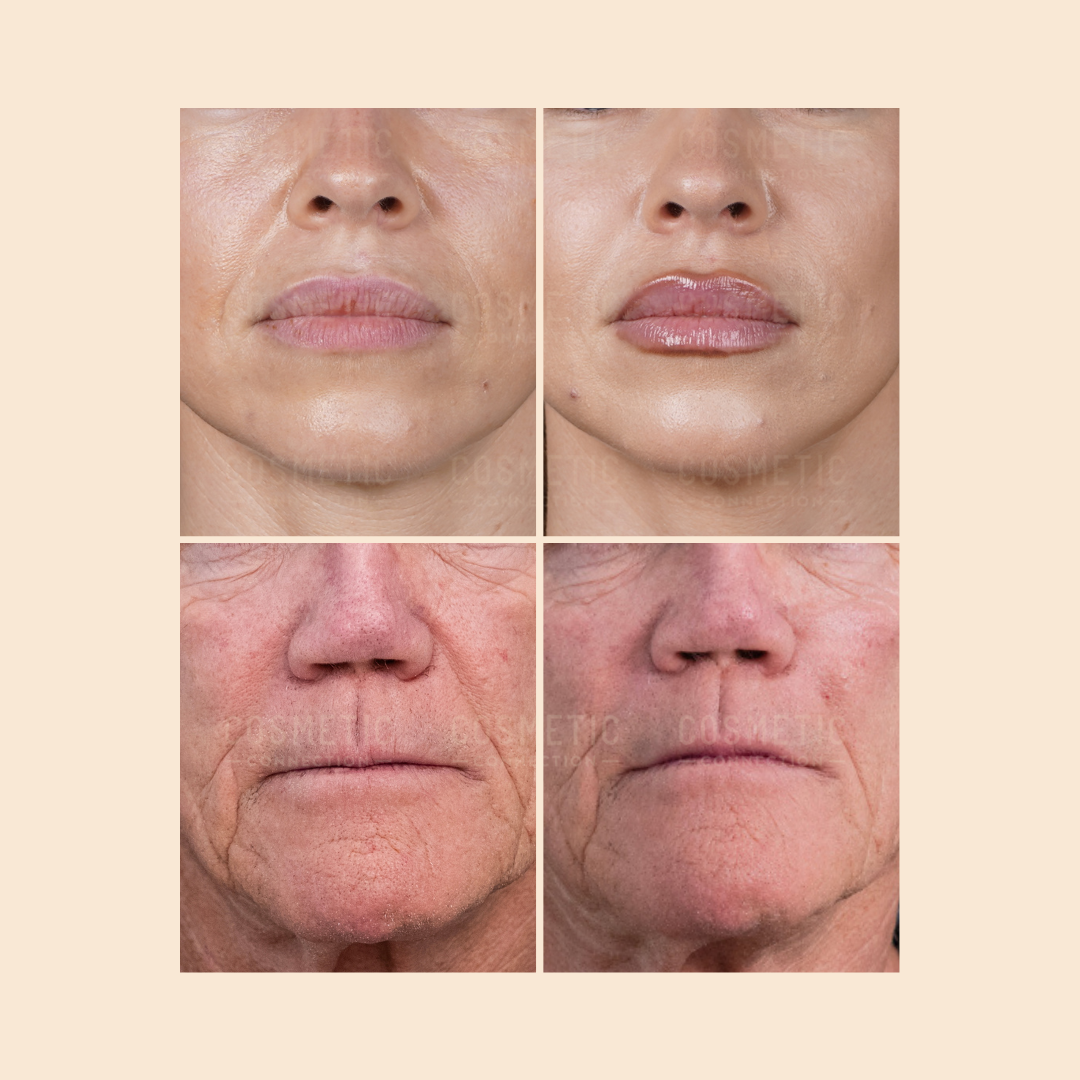
Several non-surgical treatment options exist for nasolabial folds, and they work in meaningfully different ways. The right choice depends on what is causing your folds to deepen, how quickly you want to see results, how long you want them to last, and what your anatomy actually needs. This guide compares the main options side by side so you can go into your assessment with a clear picture of what each approach involves.
Quick answer: The two main non-surgical options for nasolabial folds are immediate volume support treatments and collagen stimulating treatments. Volume support produces visible results on the day and typically lasts 12 to 18 months. Collagen stimulating treatment builds gradually over several months and tends to last longer. For most patients presenting with moderate fold depth driven by midface volume loss, volume support — placed in the cheek, the fold, or both — is the most commonly recommended starting point.
Why the treatment choice depends on the cause
Before comparing treatment options, it helps to understand that nasolabial folds deepen for more than one reason — and not every approach addresses every cause equally well.
The three main drivers are: midface fat pad descent and volume loss (the most common cause); reduced bone support in the upper jaw, which causes overlying tissue to lose its foundation; and skin laxity, where the skin itself has thinned and lost the elasticity to remain supported. Most patients have a combination of all three in varying proportions.
This is why the same treatment approach does not produce the same outcome in every patient. A plan that works well for someone whose fold is primarily driven by midface volume loss may produce a modest result in someone whose fold is driven mainly by skin laxity. Accurate assessment — not a standard protocol — is what determines which option is most appropriate. You can read more about the structural causes of fold deepening in our complete guide to smile lines treatment.
Option 1: volume support treatment
Volume support treatment is the most commonly used non-surgical approach for nasolabial folds. It works by placing biocompatible material at a precise anatomical depth — either in the midcheek to restore structural lift, directly in the fold to address the crease, or both — to replace the volume the face has lost with age.
Results are visible immediately after treatment, with the final outcome apparent once any swelling has resolved — usually within one to two weeks. The effect typically lasts 12 to 18 months depending on the individual, the areas treated, and lifestyle factors.
A systematic review and meta-analysis published in Aesthetic Plastic Surgery (Stefura et al., 2021), which analysed randomised clinical trials of tissue volume treatments for the nasolabial fold area, found that average fold severity scores improved substantially from baseline at one month and remained meaningfully improved at six months, with gradual return toward baseline by 12 months. The evidence base for this approach is well-established across multiple high-quality trials.
Best suited for: Moderate to deep folds at rest; volume loss as the primary driver; patients who want visible results on the day.
Typical longevity: 12–18 months.
Downtime: 2–5 days of mild swelling and tenderness.
Option 2: collagen stimulating treatment
Collagen stimulating treatment works differently. Rather than placing volume directly, it triggers the body’s own collagen-building response over time. The result builds gradually over several months and tends to last significantly longer than immediate volume support approaches — in some cases 24 months or beyond.
The trade-off is timing. Patients who choose this approach should expect to wait two to four months before seeing meaningful change, and in some cases a series of treatment sessions is recommended to achieve the full result. It is not suitable for patients who want an immediate improvement.
A 2024 randomised controlled trial involving 260 participants reported a 67.6% improvement in wrinkle severity at 52 weeks using a poly-L-lactic acid collagen stimulating approach, with patient satisfaction exceeding 90%. A separate 2025 multicentre trial found this approach achieved strong midfacial volume correction at 12 months. The evidence base for collagen stimulating treatment is supported by Level 1 evidence across multiple randomised trials. Our collagen stimulating treatment page covers this approach in more detail.
Best suited for: Patients who prefer a gradual, longer-lasting approach; those with skin quality concerns alongside fold depth; patients happy to wait for results to build.
Typical longevity: 18–24+ months.
Downtime: Minimal. Some swelling in the first few days after each session.
Get started
Option 3: treating the cheek rather than the fold
This is not a separate treatment type — it is a strategic choice about where volume support is placed. Many patients assume treatment for nasolabial folds involves placing volume directly into the crease. In practice, treating the cheek and midface is often the more effective approach, because it addresses the upstream cause of fold deepening rather than the fold itself.
When volume is restored to the midcheek, it lifts the overlying tissue that has descended and effectively reduces the apparent depth of the fold without placing anything directly in the crease. The result tends to look more natural because it restores three-dimensional facial shape rather than simply filling a line.
Research published in Archives of Dermatological Research directly compared cheek volume restoration with alternative approaches for nasolabial fold improvement, finding statistically significant improvements in fold depth scores when cheek volume was addressed alongside nasolabial folds — supporting the clinical case for this upstream approach. Our guide to cheek volume treatment explains this in more detail.
Best suited for: Patients whose fold deepening is primarily driven by cheek descent and midface volume loss; those who want a more natural-looking result; patients already considering cheek treatment.
Option 4: combination approaches
In many cases, the most complete result comes from combining approaches rather than choosing one in isolation. A treatment plan might include midcheek volume support to restore structural lift alongside direct fold treatment to address any remaining crease depth — or a volume support approach in the short term with collagen stimulating treatment planned as the longer-term maintenance strategy.
Combination planning is assessed on an individual basis and depends on the patient’s anatomy, goals, and what the assessment finds. The holistic approach we use at Cosmetic Connection is built around treating the face as a whole system rather than addressing concerns in isolation. This tends to produce the most proportionate, natural-looking outcomes — particularly in the midface, where the nasolabial fold, cheeks, under-eyes, and lower face all interact with each other visually.
Side by side comparison
| Treatment option | How it works | Results visible | Longevity | Best for | Downtime |
|---|---|---|---|---|---|
| Volume support (fold direct) | Replaces volume in the crease | Immediately | 12–18 months | Deep resting folds; fold as primary concern | 2–5 days |
| Volume support (midcheek) | Lifts overlying tissue via upstream volume | Immediately | 12–18 months | Volume loss as primary driver; natural result priority | 2–5 days |
| Collagen stimulating treatment | Triggers body’s own collagen production | Gradually over 2–4 months | 18–24+ months | Longer-lasting result; skin quality concerns | Minimal |
| Combination approach | Multiple methods addressing different drivers | Partially immediate; builds over time | Varies | Complex presentations; comprehensive result | 2–5 days initially |
| Skincare only | Surface-level support; slows collagen loss | No | Ongoing maintenance required | Prevention | None |
What is not the right approach for nasolabial folds
It is worth being clear about what non-surgical treatment cannot address well, so expectations are accurate from the start.
Significant skin laxity — where the skin has substantially thinned and lost its attachment to underlying structures — is not well addressed by volume support alone. Adding volume in the presence of lax skin can sometimes make the area appear heavier rather than more lifted. In these cases, a surgical consultation may be a more appropriate referral. Similarly, very deep nasolabial folds present from a young age and driven primarily by facial structure rather than age-related volume loss may have limited response to volume support.
The assessment at Cosmetic Connection is specifically designed to identify these situations early — so you are not recommended a treatment that is unlikely to achieve what you are hoping for.
Get started
Frequently asked questions
Which nasolabial fold treatment option is best?
There is no single best option — the right approach depends on the cause of your fold deepening, your anatomy, and your goals. For most patients with moderate fold depth driven by midface volume loss, immediate volume support — placed in the cheek, the fold, or both — is the most effective starting point. For those who want longer-lasting results and are prepared to wait for them to build, collagen stimulating treatment is a strong alternative or complement.
Can I have nasolabial fold treatment and cheek treatment at the same time?
Yes, and in many cases this is the recommended approach. Treating the cheek and fold simultaneously addresses both the upstream cause of fold deepening and the crease itself, which tends to produce a more complete and natural-looking result than treating either area in isolation.
How do I know if I need volume in my cheeks or in the fold itself?
This is determined at assessment. If the fold looks deep primarily because the cheek above it has descended and lost volume, treating the cheek tends to produce a more natural result. If the fold itself is the primary concern and the cheek volume is relatively preserved, treating the fold directly may be more appropriate. In practice, many patients benefit from some volume in both areas.
Is collagen stimulating treatment painful?
Most patients find collagen stimulating treatment well-tolerated. A topical numbing preparation is used beforehand, and the procedure involves a series of small placements rather than a single site treatment. Some patients notice a mild tenderness in the treated area for a few days after each session.
What happens if I do not like the result of nasolabial fold treatment?
Volume support treatments using certain materials can be partially or fully dissolved if you are unhappy with the result or if a complication occurs. This is one of the key clinical safety advantages of this treatment approach. Collagen stimulating treatments cannot be reversed in the same way, though results fade naturally over time. Reversal options are discussed as part of every consultation.
References
- Stefura T, Kacprzyk A, Droś J, Krzysztofik M, Skomarovska O, Fijałkowska M, Koziej M. (2021). Tissue Fillers for the Nasolabial Fold Area: A Systematic Review and Meta-Analysis of Randomized Clinical Trials. Aesthetic Plastic Surgery, 45(5), 2300–2316. https://doi.org/10.1007/s00266-021-02439-5
- El-Mesidy MS, Alaklouk WT, Azzam OA. Nasolabial fold correction through cheek volume loss restoration versus thread lifting: a comparative study. Archives of Dermatological Research. 2020. https://doi.org/10.1007/s00403-019-02031-7
- Advances in Poly-l-lactic Acid Injections for Facial and Neck Rejuvenation. (2025). PMC / Journal of Cosmetic Dermatology. https://pmc.ncbi.nlm.nih.gov/articles/PMC12323926/