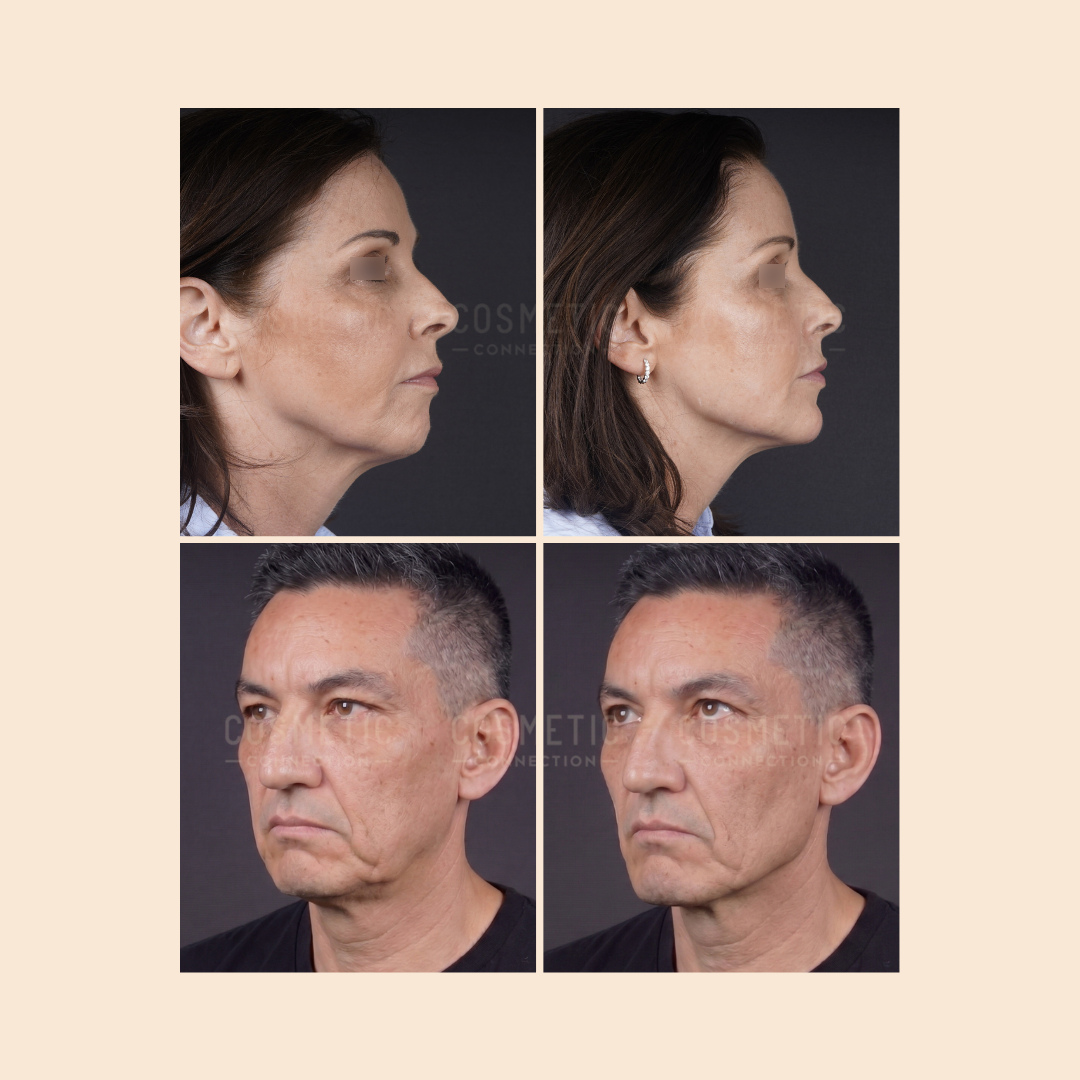
Nasolabial folds and marionette lines are two of the most common lower face concerns we assess at Cosmetic Connection — and they are frequently confused with each other. They sit in the same region of the face, share some underlying causes, and often appear together. But they are anatomically distinct, they create different visual effects, and they are not always treated the same way. This guide explains the differences clearly and covers what treatment for each actually involves.
Quick answer: Nasolabial folds run from the sides of the nose to the corners of the mouth. Marionette lines run downward from the corners of the mouth toward the chin. Both deepen with age due to volume loss and structural changes in the lower face — but marionette lines tend to appear later and are more strongly associated with jowl formation and a downturned resting expression. Both can be addressed with non-surgical cosmetic treatment, and both are frequently treated in the same appointment as part of a lower face plan.
Where each line sits on the face
The simplest way to distinguish these two concerns is by location.
Nasolabial folds — also called smile lines or laugh lines — are the creases that extend from the outer base of the nose diagonally downward to the corners of the mouth. They are present to some degree in every face and become a concern when they are visible and prominent at rest, creating a tired or aged appearance in the midface.
Marionette lines — clinically called melomental folds — are the vertical creases that extend downward from the corners of the mouth toward the chin. The name comes from the pronounced lower facial lines of a marionette puppet. When deep, they create the impression of a downturned or unhappy expression at rest, even when the face is completely relaxed.
The two sets of lines meet at the corners of the mouth. Nasolabial folds end where marionette lines begin — which is part of why they are so often seen together and why a lower face assessment considers both simultaneously.
What causes each one — and how the causes differ
Both lines deepen through similar broad mechanisms — volume loss, reduced structural support, and skin changes over time — but the specific anatomical drivers are somewhat different for each.
Nasolabial folds
Nasolabial folds deepen primarily because of changes in the midface. As the fat pads of the cheek thin and descend with age, and as bone in the upper jaw recedes, the overlying tissue loses its structural support and the fold appears deeper. Research published in Aesthetic Surgery Journal (Minelli et al., 2023) identifies fat deflation and muscle atrophy in the perioral region — causing up to a 40% reduction in soft tissue thickness — alongside upper jaw bone resorption as the two primary mechanisms. Nasolabial folds tend to become noticeable earlier, often from the late twenties or early thirties onward in people with predisposing facial structure.
Marionette lines
Marionette lines involve a more complex anatomical picture. Research published in Skin Research and Technology (Hong et al., 2024) identifies their formation as a result of bone resorption of the lower jaw, gravitational forces on descending fat compartments, ligament tethering at the corners of the mouth, muscle compression from the depressor anguli oris, and progressive skin ageing — all acting simultaneously. Facial volume loss during ageing significantly impacts the definition of the jawline, contributing to skin sagging, jowl formation, and the development of prominent marionette lines. They tend to appear later than nasolabial folds — typically becoming noticeable from the mid-forties onward — and are more strongly associated with lower face heaviness and jowling.
In our clinical experience, patients who present with significant marionette lines almost always have some degree of nasolabial fold deepening as well — because the upstream causes, particularly midface volume loss and lower face descent, drive both simultaneously.
How the visual effect differs
Understanding the different visual effect of each concern helps explain why people find them bothersome in different ways.
Deep nasolabial folds at rest tend to create an aged or tired appearance in the midface. They frame the mouth in a way that can make the face look heavy or drawn. Because they become more pronounced during expression, patients sometimes notice them particularly in photos taken while smiling.
Deep marionette lines create a different impression — one that is often described as sad, stern, or unhappy at rest. The downward direction of the line pulls the visual weight of the lower face toward the chin and jaw, and when prominent, they contribute to jowling and a loss of the clean lower face contour that is associated with a more youthful appearance.
Both affect how others perceive your mood and energy level from your resting face — which is why they are consistently among the concerns that patients find most affecting day to day.
Get started
How treatment for each differs
Because the anatomical drivers and locations of nasolabial folds and marionette lines are different, the treatment approach for each has some important distinctions — even though both involve non-surgical volume support.
Treating nasolabial folds
As covered in our complete guide to smile lines treatment, the most effective approach for nasolabial folds often involves addressing the midcheek and upstream volume loss rather than simply filling the crease directly. Restoring volume to the cheek lifts the overlying tissue that has descended and reduces the apparent depth of the fold from above, producing a more natural-looking result than treating the fold in isolation. In many cases, a combination of midcheek volume and direct fold treatment produces the best outcome.
Treating marionette lines
Marionette lines respond differently. Because their formation involves ligament tethering at the corners of the mouth, jowl fat accumulation, and lower jaw bone resorption, treatment typically needs to address the lower face as a structural unit — not just the line itself. Volume placed in the pre-jowl area and along the jawline can help lift the tissue that has descended and reduce both the marionette line and the associated jowling. In some cases, chin support is also part of the treatment plan. Our marionette lines treatment page covers this approach in more detail.
When both are treated together
Treating nasolabial folds and marionette lines in the same appointment is common and clinically appropriate. The lower face functions as a system — changes in one area affect the appearance of adjacent areas. A plan that addresses both simultaneously, as part of a broader lower face assessment, typically produces a more balanced and natural-looking result than treating each in isolation at separate times. This is the approach we take through facial balancing at Cosmetic Connection.
Side by side: nasolabial folds vs marionette lines
| Nasolabial folds | Marionette lines | |
|---|---|---|
| Location | Nose to corners of mouth | Corners of mouth to chin |
| Clinical name | Nasolabial folds | Melomental folds |
| When they typically appear | Late 20s–30s onward | Mid-40s onward typically |
| Primary cause | Midface volume loss; cheek fat pad descent; upper jaw bone resorption | Lower jaw bone resorption; ligament tethering; jowl fat descent; lower face volume loss |
| Visual effect | Tired or aged midface; more pronounced during expression | Downturned or unhappy resting expression; contributes to jowling |
| Associated concerns | Cheek volume loss; under-eye hollowing | Jowls; lower face heaviness; jawline loss |
| Treatment focus | Midcheek and fold volume support | Pre-jowl, jawline, and lower face structural support |
| Can they be treated together? | Yes — often recommended in the same appointment | |
What to expect if you are assessed for both
If you present to assessment at our clinics with both nasolabial folds and marionette lines as concerns, the consultation will evaluate the whole lower face — not just each line in isolation. This includes the state of your midcheek volume, the degree of lower face descent, the depth and character of each set of lines, your skin quality and laxity, and how the two concerns interact visually.
From that assessment, we will recommend a plan that addresses the actual drivers of your concern — which may involve treating both in the same appointment, prioritising one over the other based on what is most affecting your appearance, or recommending a staged approach if the level of correction needed is more significant.
Costs for treating both concerns in a single appointment will vary depending on the areas addressed and the approach used. Our flat-fee pricing structure means the total cost is confirmed at consultation with no variable charges applied during the procedure. For a breakdown of typical costs for smile lines treatment specifically, see our smile lines treatment cost guide.
Can both concerns be treated non-surgically?
In most cases, yes — with the understanding that results are a softening of the lines rather than their complete elimination. The best candidates for non-surgical treatment of both nasolabial folds and marionette lines are those whose concerns are primarily driven by volume loss and structural descent rather than significant skin laxity.
Where skin laxity is the dominant factor — particularly with advanced marionette lines and jowling — non-surgical volume support alone may produce a limited result. In these cases, a surgical consultation may be the more appropriate recommendation, or a carefully considered combination approach. The assessment will clarify which category applies to your anatomy.
For a detailed breakdown of who is and is not a good candidate for non-surgical treatment of nasolabial folds, see our nasolabial fold treatment suitability guide.
Get started
Frequently asked questions
Are nasolabial folds and marionette lines the same thing?
No. They are two distinct sets of lines in adjacent areas of the lower face. Nasolabial folds run from the nose to the corners of the mouth. Marionette lines run from the corners of the mouth downward toward the chin. They share some underlying causes and frequently appear together, but they involve different anatomical structures and are not always treated the same way.
Which appears first — nasolabial folds or marionette lines?
Nasolabial folds typically become noticeable earlier, often from the late twenties or early thirties onward in people with predisposing facial structure. Marionette lines tend to appear later — most commonly from the mid-forties onward — because their formation is more dependent on lower face descent and jaw bone changes that develop over a longer period.
Do I need to treat both at the same time?
Not necessarily. If one concern is significantly more prominent than the other, it may make clinical sense to prioritise that area first and reassess. However, because both sets of lines are driven by related structural changes in the lower face, treating them together in the same appointment often produces a more balanced result — and may be more cost-effective than two separate appointments.
Will treating my nasolabial folds also improve my marionette lines?
Partially, in some cases. Restoring midcheek volume can lift the lower face tissue and reduce the appearance of marionette lines to some degree — because it addresses upstream descent that contributes to both concerns. But a treatment plan specifically targeting marionette lines directly, including the pre-jowl area and lower face, will produce a more complete result for that specific concern.
Are marionette lines harder to treat than nasolabial folds?
They are generally more complex to treat well. The ligament tethering at the corners of the mouth and the associated jowl formation mean that treatment needs to address the lower face as a structural unit rather than simply filling the line. In our clinical experience, the most common reason marionette line treatment elsewhere produces a limited or unnatural result is that the lower face was not treated as a whole — volume was placed in the line without addressing the structural context around it.
References
- Minelli L, Brown CP, Warren RJ, van der Lei B, Mendelson BC, Little JW. (2023). Lifting the Anterior Midcheek and Nasolabial Fold: Introduction to the Melo Fat Pad Anatomy and Its Role in Longevity and Recurrence. Aesthetic Surgery Journal, 43(9), 941–954. https://doi.org/10.1093/asj/sjad126
- Hong J, et al. (2024). Why do marionette lines appear? Exploring the anatomical perspectives and role of thread-based interventions. Skin Research and Technology. https://doi.org/10.1111/srt.13676
- Yi KH, Park SY. (2024). Marionette lines correction with volumizing threads. Journal of Cosmetic Dermatology. https://pmc.ncbi.nlm.nih.gov/articles/PMC11626340/