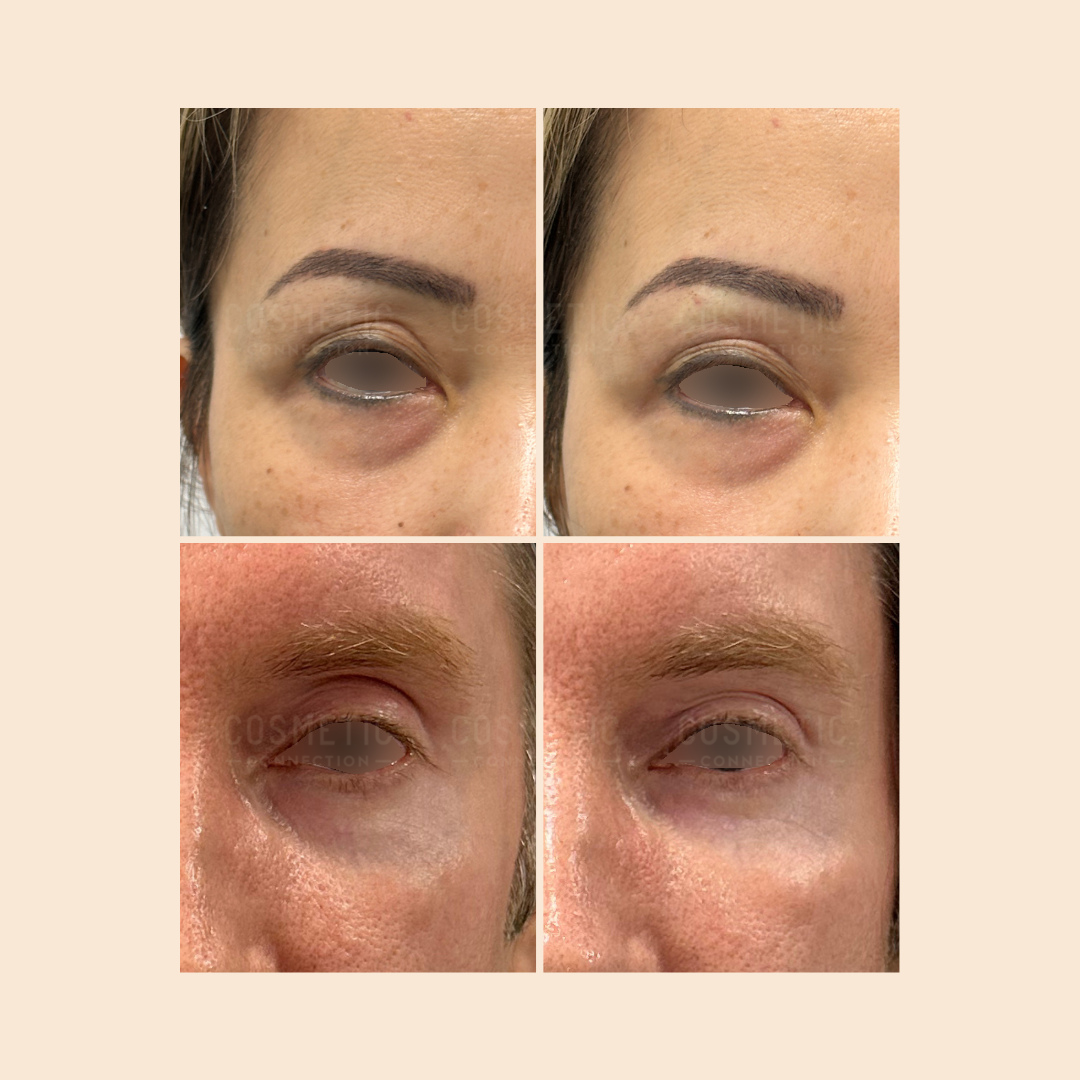
Upper eyelid exposure refers to how much of the upper eyelid is visible between the lower edge of the brow and the upper lash line. More exposure is not inherently a problem — but when volume loss beneath the brow creates a hollow, concave quality to the eyelid, that exposed area can look sunken, shadowed, or skeletal rather than defined and full. This article explains what upper eyelid exposure actually means, what determines how much you have, and when non-surgical volume restoration is the appropriate response.
Quick answer: Upper eyelid exposure is the visible portion of the upper eyelid between the brow and the lashes. High exposure with good underlying volume reads as defined and youthful. High exposure with volume loss reads as hollow, aged, or fatigued — a condition known as the A-frame deformity or upper eyelid hollowing. Non-surgical volume restoration addresses the hollowing without altering the amount of exposure itself.
What does upper eyelid exposure actually mean?
Upper eyelid exposure is simply a measurement — the vertical distance of visible upper eyelid between the brow and the upper lash line. Aesthetically, it matters because it influences how the eye reads: how large, how open, how youthful, how defined.
There is no single ideal amount of upper eyelid exposure. Preferences vary significantly across cultural contexts, facial proportions, and individual aesthetics. What matters more than the measurement is what the exposed area looks like — and whether the eyelid beneath the brow has the volume and fullness to support an attractive appearance.
The concern most people are describing when they search for information about upper eyelid exposure is not actually about the amount of exposure itself. It is about what that exposed area reveals: a hollow, deflated, or sunken quality that makes the eye look tired, recessed, or older than it should. That hollow is upper eyelid volume loss — and the two concerns, while related, are different problems requiring different solutions.
What causes upper eyelid hollowing beneath visible exposure?
Upper eyelid hollowing beneath visible exposure has three primary causes.
Volume loss through ageing. A 2025 study published in the Journal of Cosmetic Medicine confirms that sunken eyelids result from the loss of orbital fat, atrophy of retro-orbicularis oculi fat (ROOF), and deficits in superficial dermal layers — with periocular support weakening and fat pad atrophy occurring progressively with age. This process typically begins in the mid-twenties and accelerates with each decade.
Genetics. A periorbital anatomy review published on PubMed Central notes that supraorbital hollowness can result from genetic factors, with this condition particularly prevalent in certain ethnic groups due to anatomical differences including weaker levator muscles and unique fat distribution patterns. For people in this group, the hollowed appearance may have been present since their teens or twenties.
Previous surgery. Over-resection of fat during blepharoplasty can produce an A-frame deformity or hollowed upper lid appearance. This is one of the clearest indications for non-surgical upper eyelid volume restoration, as it addresses directly what the surgery inadvertently created.
Is high upper eyelid exposure a problem?
Not inherently. Upper eyelid exposure exists on a spectrum, and where you sit on that spectrum is largely determined by your anatomy — brow height, orbital shape, and the position of your upper eyelid crease. None of these are problems in themselves.
The point at which upper eyelid exposure becomes a cosmetic concern is when the exposed area looks hollow rather than full — when the space beneath the brow reads as deflated or concave rather than smooth and supported. This is the A-frame deformity, and it is a volume problem, not an exposure problem. Addressing it requires restoring volume, not reducing exposure.
Conversely, some people have very low upper eyelid exposure — the brow sits close to the lash line and the eye appears heavy or hooded. This is a different concern entirely, and one that non-surgical volume restoration does not address. If low exposure or a hooded appearance is the primary concern, the appropriate assessment involves brow positioning or surgical options. You can read a detailed breakdown of the treatment options in our guide to upper eyelid volume restoration vs surgery .
How to fix upper eyelid hollowing non-surgically
When the underlying concern is volume loss — a deflated, hollow, or sunken quality to the upper eyelid — non-surgical volume restoration is a well-established and effective option.
Treatment involves placing a small amount of hyaluronic acid gel into the hollow space beneath the brow bone at the level of the bone itself. A technique paper available via ResearchGate describes placement at the preperiosteal level in small aliquot threads as restoring the smooth curve of the upper periorbital rim, giving a softer and more aesthetically pleasing appearance. The volumes used are small — a 2025 cohort study in the Journal of Cosmetic Medicine found an average of 0.8 cm³ per upper eyelid across 235 treated eyelids, with excellent patient satisfaction at over one year of follow-up.
Treatment takes 15–30 minutes. A topical anaesthetic is applied beforehand. Most people return to their normal routine the same day, though bruising and mild swelling around the eye area is common for several days afterward. Final results settle over 2–4 weeks.
Results typically last 12–18 months before a maintenance appointment is needed. For most people, the change is subtle and natural — others notice the eyes look more rested and open, but rarely identify specifically what has changed.
You can read the full clinical picture — including risks, candidacy, and costs — in our complete guide to upper eyelid volume loss and treatment.
If you are unsure whether volume loss or another factor is driving your upper eyelid concern, a consultation is the right starting point — not a treatment plan. Book with us: our doctors will give you an honest picture of what is causing your concern before any treatment is discussed.
Get started
What upper eyelid exposure treatment cannot fix
It is worth being direct about the limits of non-surgical volume restoration, because the wrong treatment for the wrong concern produces poor results regardless of how well it is performed.
Non-surgical upper eyelid volume restoration does not:
- Remove excess or overhanging upper eyelid skin — if skin redundancy is the primary issue, surgery is the appropriate path
- Lift a drooping brow — brow descent requires either targeted treatment to the brow position or surgical correction
- Change the structural amount of upper eyelid exposure — it restores volume beneath that exposure, but does not alter how much of the lid is visible
- Address functional eyelid problems — impaired vision from heavy upper lids requires a surgical assessment
In our experience, one of the most common presentations is someone who has identified upper eyelid exposure as their concern but whose actual issue is a combination of factors — brow position, volume, skin quality, and midface descent all contributing to a tired or aged appearance around the eye. Treating one in isolation without assessing the others rarely produces the result the person was hoping for.
Frequently asked questions
What is the ideal amount of upper eyelid exposure?
There is no universal ideal. Upper eyelid exposure varies significantly across individuals, ethnicities, and aesthetic preferences. What matters more than the measurement is whether the exposed eyelid area has the volume and fullness to support an attractive appearance. A hollow, deflated lid with high exposure reads very differently to a full, supported lid with the same amount of exposure.
Can you reduce upper eyelid exposure without surgery?
Reducing the structural amount of upper eyelid exposure — changing how much lid is visible — is not what non-surgical volume restoration addresses. What it can do is change how that exposed area looks by restoring the fullness and curve beneath the brow. For those seeking hunter eyes — a specific aesthetic characterised by defined, almond-shaped eyes with a particular upper eyelid structure — you can read our dedicated guide to hunter eyes .
What is the A-frame deformity?
The A-frame deformity is a clinical term for upper eyelid hollowing where the brow bone and lid create a concave, triangular shadow between them when viewed from the front. It can develop through ageing, genetics, or over-aggressive fat removal during blepharoplasty.
Is upper eyelid hollowing treatment safe?
It carries a higher risk profile than most non-surgical facial treatments due to the complex anatomy around the eye. According to data cited in Ophthalmology Times, the incidence of vascular complications with hyaluronic acid treatments is approximately 0.01%–0.05% per treatment. Choosing a doctor with specific periorbital training who carries emergency reversal agents in clinic is essential.
How long does upper eyelid hollowing treatment last?
Most people see results lasting 12–18 months. The periorbital area has less muscular activity than most other treatment sites, which tends to mean slower breakdown of hyaluronic acid. Individual variation in metabolism, the volume placed, and the product used all influence duration.
What does upper eyelid hollowing treatment cost in Australia?
Uupper eyelid volume restoration is priced between $1,500 and $3,000. With us pricing is flat-fee — no add-ons once treatment is planned. Read more about how our pricing works.