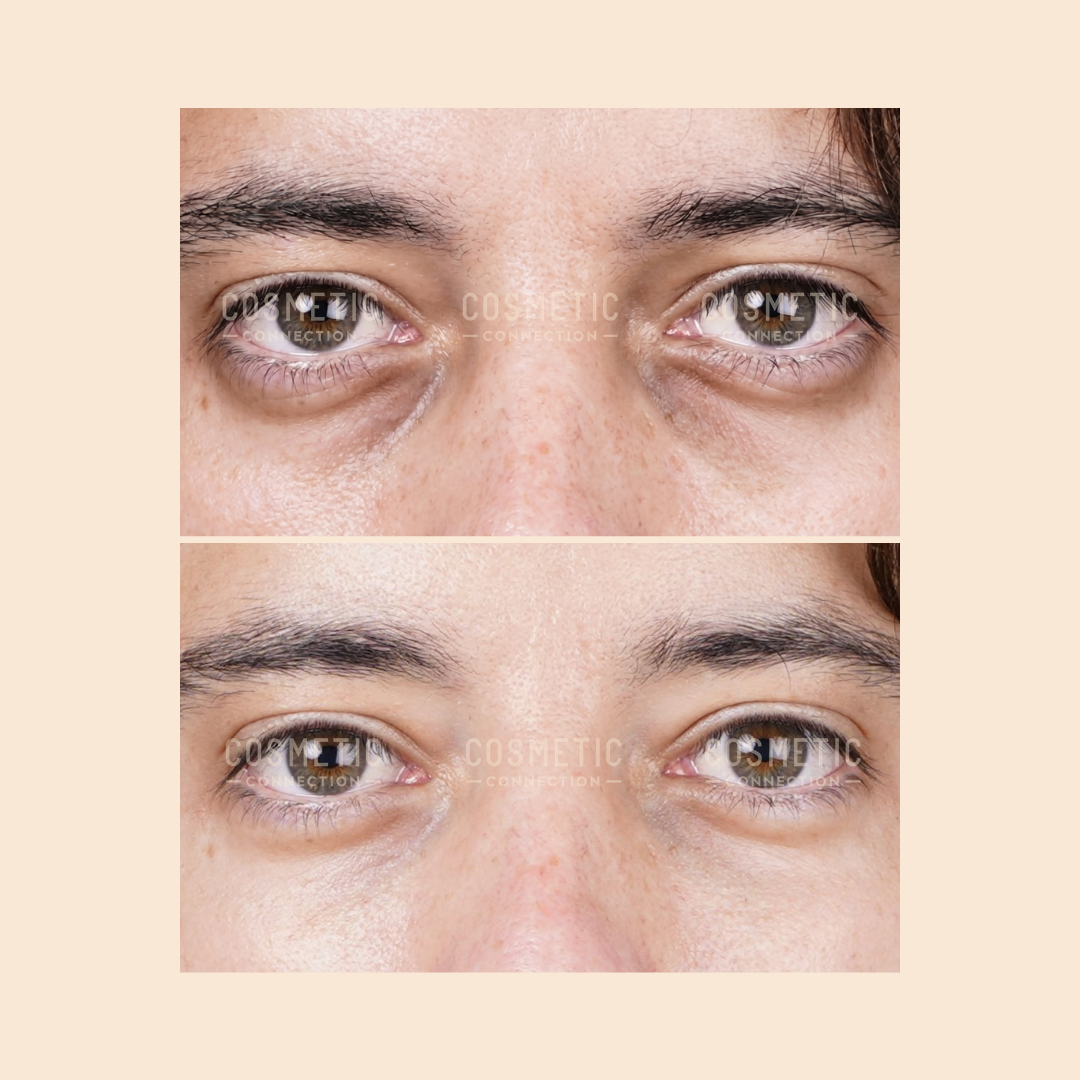
Under eye hollowing and tear trough shadows are among the most common concerns we see at our under eye treatment clinic — and one of the most frequently misunderstood. The hollow groove that forms beneath the eye, known as the tear trough, deepens as the face loses volume with age. The result is a shadowed, sunken appearance that makes people look tired regardless of how much sleep they have had. Non-surgical treatment can restore the lost volume in this area, softening the shadow and refreshing the overall appearance of the face.
This guide covers everything you need to make an informed decision: what causes under eye hollowing, how treatment works, who is a good candidate, what it costs in Australia, and what to realistically expect from results.
Quick answer: Under eye and tear trough treatment uses volume-restoring non-surgical techniques to address the hollow groove beneath the eye. It works by replacing lost volume in the periorbital area, softening the shadow that makes the face look tired or older. Treatment takes around 30 minutes, results typically last 12 to 18 months depending on the individual, and the procedure is reversible. It is not suited to everyone — a proper suitability assessment is essential before treatment.
What is the tear trough, and why does it hollow with age?
The tear trough is the groove that runs from the inner corner of the eye diagonally downward across the lower eyelid. In youth, this area sits smoothly, supported by fat, bone, and soft tissue beneath the skin. As the face ages, that support diminishes — and the groove becomes more pronounced.
The changes responsible for tear trough hollowing are structural. The bones of the mid-face gradually lose density, which causes the orbital rim (the bony ridge surrounding the eye socket) to widen. This widening reduces the support beneath the lower eyelid. Simultaneously, the fat pads that cushion the under-eye area atrophy and shift. The combined effect is a sinking of the tissue beneath the eye, creating the characteristic hollow and shadow.
As noted in the Journal of Aesthetic Nursing (2021), these changes occur through bone reabsorption, causing orbital rim widening with age that makes the eyes appear deeper and hollower over time. The skin in this region is also among the thinnest on the face, which means even subtle volume changes are immediately visible.
Under eye hollowing is not only an age-related concern. Some people have a naturally pronounced tear trough from a younger age due to facial anatomy. In our clinical experience, we see patients in their mid-20s seeking treatment for structural hollowing that has been present most of their adult life.
How does under eye treatment work?
Non-surgical under eye treatment restores volume to the periorbital area using a carefully placed product beneath the skin. The goal is to support the tissue above and reduce the shadow cast by the hollow groove.
The treatment is precise and anatomically demanding. The under-eye area contains a complex network of blood vessels and nerves, and the skin is exceptionally thin. For this reason, technique matters more here than in almost any other area of the face. At Cosmetic Connection, this treatment is performed by our clinical team using a suitability-first approach — meaning treatment only proceeds when it is appropriate for the individual.
A cannula (a blunt-tipped instrument) is commonly used in this region because it allows the treating clinician to move through the tissue with greater precision and a reduced risk of bruising compared to a standard needle. That said, the optimal approach is determined by the individual’s anatomy at the time of assessment, not by a fixed protocol.
According to a 2022 systematic review published in Plastic and Reconstructive Surgery, no statistically significant differences in aesthetic results or adverse events were found between needle-based and cannula-based approaches — underscoring that technique, product selection, and placement accuracy are the critical variables, not the instrument alone.
Who is a good candidate for under eye treatment?
Not everyone is suitable for under eye treatment, and a responsible clinic will assess suitability carefully before proceeding. The tear trough area is one of the highest-risk zones on the face for non-surgical treatment, and the result is highly anatomy-dependent.
People who tend to respond well to under eye treatment share several characteristics:
- A clearly defined hollow or groove beneath the eye (rather than generalised puffiness)
- Good skin quality in the periorbital area — thin or crepey skin can make results less predictable
- Sufficient bone and soft tissue support in the mid-face
- Realistic expectations about what non-surgical treatment can achieve
People for whom under eye treatment may not be the right first step include those with significant lower eyelid laxity, prominent orbital fat herniation (where fat pushes forward beneath the skin to create puffiness), or very thin, translucent lower eyelid skin. In these cases, treatment can sometimes worsen the appearance rather than improve it.
For a detailed look at suitability considerations, see our guide on who is a suitable candidate for under eye treatment.
It is also worth understanding that under eye hollowing does not exist in isolation. In many cases, loss of cheek volume and midface support contributes significantly to the under-eye appearance — and addressing only the tear trough without considering the mid-face can produce an incomplete result. This is why we assess the full face, not just the area of concern.
What results can you realistically expect?
When treatment is well-matched to the individual, the improvement in under eye hollowing can be significant. The shadowed groove softens, the face looks more rested, and the transition between the lower eyelid and the cheek becomes smoother.
Results are not instantaneous. Swelling is common in the first 48 to 72 hours following treatment, and the final result typically becomes visible after one to two weeks once any swelling or minor bruising has resolved. Some people experience no visible downtime; others have bruising that takes up to two weeks to settle. This is not a function of how well the treatment went — it reflects individual variation in how the tissue responds.
A 2024 systematic review and meta-analysis published in Aesthetic Plastic Surgery, covering 2,556 participants across 31 studies, reported an overall patient satisfaction rate of 91% following under eye volume treatment. The same review found that swelling occurred in around 19% of cases and bruising in approximately 18% — both temporary and typically resolving without intervention.
In terms of longevity, most people find results last between 12 and 18 months. Some patients maintain improvement for longer, depending on their metabolism, the product used, and how much volume was placed. For a detailed breakdown of what to expect at each stage, see our post on under eye treatment results, timeline, and longevity.
What are the risks?
Under eye treatment carries a more complex risk profile than most other areas of the face. This is not a reason to avoid it — but it is a reason to choose a provider carefully and to understand what you are agreeing to before treatment begins.
Common, temporary side effects include swelling, bruising, and minor unevenness that resolves as the product settles. These are expected in many cases and are not complications.
Less common but more significant risks include the Tyndall effect — a blue-grey discolouration that can occur when product is placed too superficially beneath very thin skin. This is one of the most frequently cited complications in the literature and is largely technique-dependent. A 2024 meta-analysis in Aesthetic Plastic Surgery found the rate of blue discolouration across published studies was 0.9%, and contour irregularities occurred in approximately 5.3% of cases.
The most serious risks — vascular occlusion and visual complications — are rare but require immediate clinical management. These risks are significantly reduced when treatment is performed by an experienced, medically qualified clinician who carries appropriate reversal agents and knows how to use them.
Our full discussion of risks, what to watch for, and how we manage complications is covered in the under eye treatment risks and side effects guide.
Get started
How much does under eye treatment cost in Australia?
Under eye treatment in Australia typically ranges from $1,800 to $4,000 per appointment. The variation reflects several genuine factors: the extent of the hollowing being addressed, the number of treatment areas involved, the product or combination of products selected, and the experience level of the treating clinician.
Price should not be the primary selection criterion for this treatment. The under-eye area is among the highest-risk zones on the face, and the cost of correcting a poorly performed result — including the potential need for reversal — can far exceed the cost of treatment done well the first time.
At Cosmetic Connection, we operate on a flat-fee pricing model, which means the price quoted at your consultation is the price you pay — no add-ons, no per-mL charges applied unexpectedly after the fact. For a full breakdown of what drives cost variation and how to evaluate quotes, see our post on under eye treatment costs in Australia.
How do you choose the right provider for under eye treatment?
Provider selection matters more for under eye treatment than for almost any other non-surgical cosmetic procedure. The anatomy is complex, the margin for error is narrow, and the consequences of treatment placed incorrectly are visible and sometimes difficult to correct.
When assessing a provider, the questions worth asking are:
- What is their medical qualification and how much experience do they have specifically in periorbital treatment?
- Do they perform a suitability assessment before proceeding, or do they treat everyone who presents?
- Do they carry reversal agents on-site and know how to use them?
- Do they offer a flat-fee or itemised quote, and is the pricing transparent before you commit?
- What is their approach when a result is not what was expected?
The under-eye region is not the place to prioritise cost or convenience over clinical credentials. For a detailed guide on how to evaluate providers and what separates a cautious clinical approach from a commoditised one, see our post on how to choose the right under eye treatment provider.
You can also learn more about what sets a doctor-led approach apart and how we approach treatment planning at our clinics.
Under eye treatment and the broader face
One of the most common errors in under eye treatment is treating the tear trough in isolation. In many cases, the under-eye hollowing is partly a downstream effect of volume changes elsewhere in the face — particularly in the cheeks and mid-face, and sometimes the upper face too.
When the mid-face loses volume, the cheek descends and the tissue beneath the eye loses its support. Treating only the tear trough without addressing the underlying structural changes can produce a result that looks slightly off — or one that requires more frequent retreatment than if the mid-face had been considered as part of the plan.
Similarly, changes to the upper eyelid and brow area affect how the under-eye region reads visually. The periorbital area functions as a whole, and the most natural outcomes come from assessing it that way. This is the basis of the holistic total eye rejuvenation approach we take at Cosmetic Connection — treating the eye region as a connected structure rather than a series of isolated concerns.
Treatment is reversible
One of the most important things to understand about non-surgical under eye treatment is that the most commonly used products are reversible. If a result is not what was hoped for, or if a complication arises, the product can be dissolved. This is not a guarantee against all complications — but it does mean that the vast majority of unsatisfactory outcomes can be corrected.
At Cosmetic Connection, reversal agents are held on-site at all times. We are clear about this in our consultations because it matters for your safety — and because it reflects the standard of care we hold ourselves to.
Get started
Frequently asked questions
Is under eye treatment painful?
Discomfort is generally mild and well-tolerated. Topical anaesthetic cream is applied before treatment to numb the skin. The under-eye area is sensitive, and most people report feeling mild pressure or a brief sting at most. The treatment itself takes around 30 minutes.
How long do results from under eye treatment last?
Most people find results last between 12 and 18 months. Longevity varies depending on the individual’s metabolism, the product used, and the volume placed. Some people maintain improvement for longer; others find the area needs retreating closer to the 12-month mark.
Can under eye treatment be reversed?
Yes. The most commonly used products for under eye treatment can be dissolved. Reversal is straightforward when performed by an experienced clinician, though it requires a separate appointment.
Is there downtime after under eye treatment?
Many people have minimal visible downtime. Swelling and bruising are common in the first 48 to 72 hours and typically resolve within one to two weeks. We recommend avoiding strenuous exercise, alcohol, and blood-thinning medications in the days surrounding treatment to minimise bruising.
Does under eye treatment help with dark circles?
It depends on the cause of the darkness. When dark circles are caused by the shadow cast by a hollow tear trough, restoring volume in this area significantly reduces the shadow. When darkness is caused by pigmentation in the skin itself, volume treatment will have limited effect on the colour — though the overall appearance of the area often still improves.
What is the difference between under eye volume and tear trough volume?
The terms refer to the same treatment. “Tear trough” is the anatomical name for the groove beneath the eye; “under eye” is the commonly used layperson term. Both describe volume restoration in the periorbital area below the lower eyelid.
References
- Liu X, Gao Y, Ma J, Li J. (2024). The efficacy and safety of hyaluronic acid injection in tear trough deformity: a systematic review and meta-analysis. Aesthetic Plastic Surgery, 48(3), 478–490. https://link.springer.com/article/10.1007/s00266-023-03613-7
- Rao BK, Berger LE, Reilly C, Alamgir M, Galadari H. (2022). Tear trough filler techniques utilizing hyaluronic acid: a systematic review. Plastic and Reconstructive Surgery, 149(5), 1079–1087.
- Journal of Aesthetic Nursing. (2021). Periorbital rejuvenation and tear trough filler. Journal of Aesthetic Nursing. https://www.aestheticnursing.co.uk/content/clinical/periorbital-rejuvenation-and-tear-trough-filler/
- Kang Y et al. (2024). Static and dynamic filler-associated tear trough deformities: manifestations and treatment algorithm. Aesthetic Plastic Surgery, 48(14), 2642–2650. https://link.springer.com/article/10.1007/s00266-024-04089-9