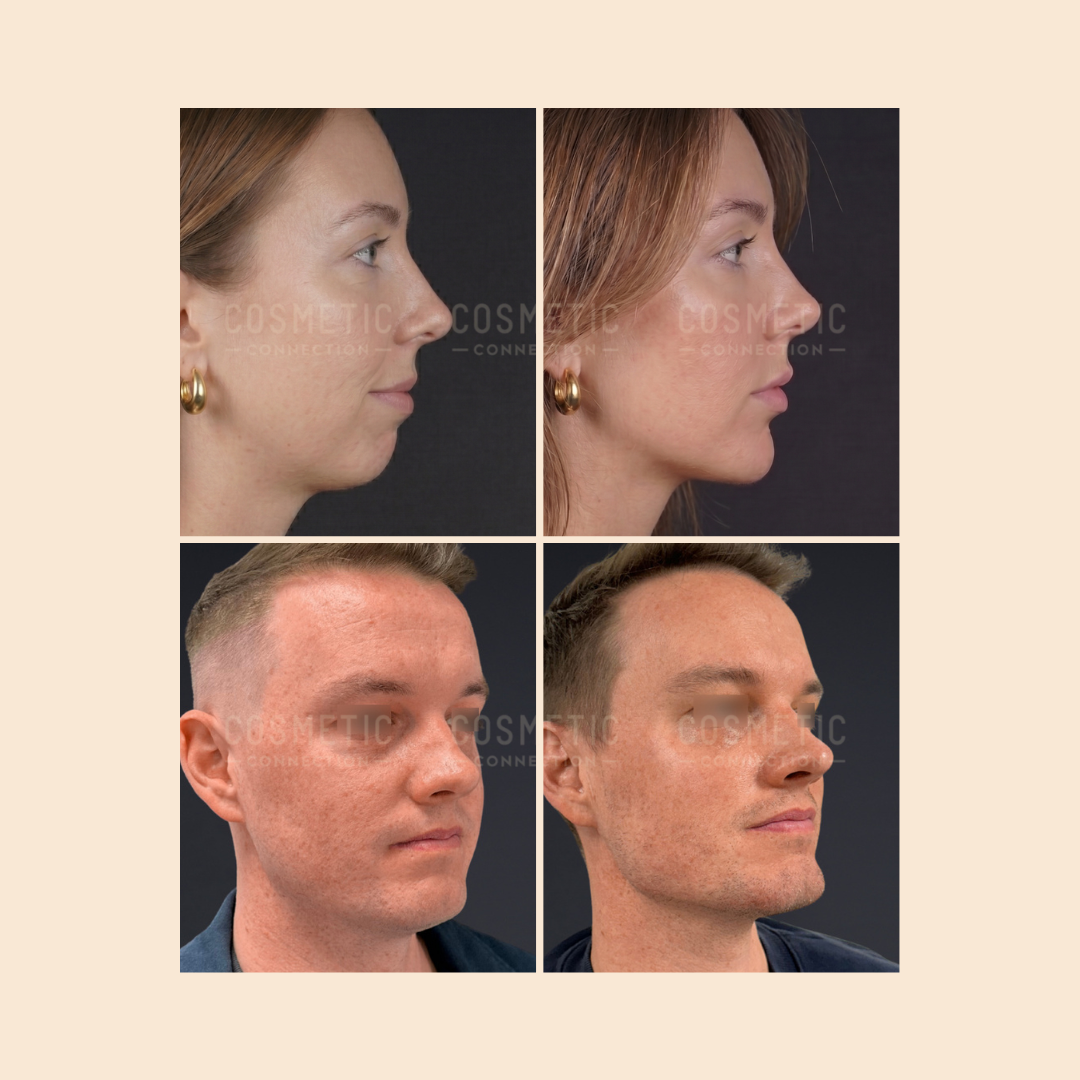
Chin contouring for men is a different exercise to chin treatment in women — not just in terms of aesthetic goals, but in anatomy, technique, and what constitutes a good result. This guide covers what makes male chin contouring distinct, the most common concerns men bring to consultation, and what realistic outcomes look like.
Quick answer: Male chin contouring aims to increase forward projection, create a broader and flatter chin base, and strengthen the profile — not taper or soften. The approach accounts for denser soft tissue and different aesthetic targets. Results in men tend to look structural rather than cosmetic, which is exactly the goal.
What men typically want from chin treatment
The concerns men bring to a chin contouring consultation tend to be specific and structural. A recessed or weak chin is the most common — the chin sits behind the vertical plane of the lips when viewed from the side, softening the profile and making the face look less defined. A short chin is another common concern, where the lower third of the face appears compressed relative to the mid and upper face.
Some men are bothered by chin asymmetry — one side sitting lower or further forward than the other. Others are seeking to improve the chin-to-neck definition, particularly where submental fat obscures the separation between the jaw and neck. And an increasing number of younger men are pursuing chin treatment as part of a broader looksmaxxing approach to facial optimisation.
What connects all of these is a desire for a result that looks like it belongs — strong, natural, and proportionate to the rest of the face.
How male chin anatomy differs
The male chin is anatomically distinct from the female in several ways that directly affect treatment planning.
Aesthetically, a masculine chin is broader and flatter at the base — it has a wider mentum (the most forward-projecting point) and sits more squarely, without the tapering or pointed quality that often characterises a feminine chin. Adding projection to a male chin while maintaining this flat, broad base is the central technical challenge of the procedure.
The soft tissue in men is also generally denser and less mobile, which affects product selection and placement depth. Treatment in men often uses firmer products placed deeper in the tissue to create lasting structural support, rather than the more superficial placement sometimes used in women for shape refinement.
Chin treatment and jawline treatment: usually planned together
In male patients especially, the chin and jawline are almost always assessed together. A strong chin projection that ends where the jawline begins does not look natural — the two need to connect in a way that creates a coherent lower face border from the chin point along the body of the jaw to the angle.
Most men who come in for a chin consultation leave with a plan that addresses both areas. This is not upselling — it is anatomy. Treating them separately in different sessions is less efficient and often produces a less satisfying result than planning the lower face as a whole from the start.
At Cosmetic Connection, combined chin and jawline treatment is common and is handled in a single appointment. Our guide to jawline contouring for men covers the jawline component in detail.
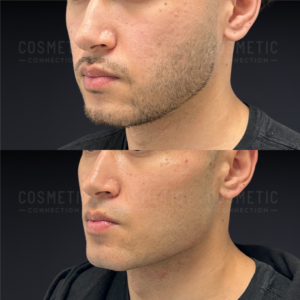
Before and after combined male non-surgical lower face contouring, targeting the chin and jawline.

Before and after combined male non-surgical lower face contouring, targeting the chin and jawline.
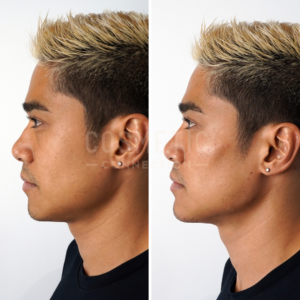
Before and after combined male non-surgical lower face contouring, targeting the chin and jawline.
Get started
Non-surgical chin contouring vs chin implant: the male comparison
Men researching chin options often encounter chin implants — a surgical silicone prosthesis placed directly against the bone. For men with significant structural underdevelopment, an implant can produce a degree of change that non-surgical treatment cannot match.
For most men, however, non-surgical contouring achieves the result they are looking for without surgery, general anaesthetic, or recovery time. It is also reversible and can be adjusted over time — which matters when you are making a decision about your face. Our full chin implant vs non-surgical guide covers this comparison in detail.
| Factor | Chin implant | Non-surgical chin contouring |
|---|---|---|
| Permanence | Permanent | 12–18 months typical |
| Degree of change | Significant | Moderate — strong structural refinement |
| Recovery | 1–3 weeks | 1–3 days mild swelling |
| Reversibility | No | Yes |
| Cost (Australia) | $8,000–$20,000+ | From $1,000 |
| Looks natural in men | Yes, when well planned | Yes, when well planned |
The looksmaxxing context
A meaningful proportion of the men we see for chin treatment have arrived via a looksmaxxing research pathway — they have already explored mewing, jaw exercises, and bone structure, and they want to understand where non-surgical treatment fits.
The answer is straightforward: mewing and facial exercises have very limited structural effect in adults, as covered in our jawline definition guide. Non-surgical chin contouring, by contrast, produces immediate and documentable structural changes. For men who want to improve their facial aesthetics with something that actually works, it is a much more effective tool.
The important caveat is proportion. The goal is a chin that enhances your face, not one that dominates it. In our experience, the men who are happiest with their results are those who started conservatively, saw how their face responded, and built from there rather than trying to maximise change in a single session.
What the treatment involves and what to expect
A chin contouring appointment at our clinics begins with an assessment that looks at the chin in the context of the full face — profile, frontal view, and the relationship between the chin, jawline, and nose. For men, we also assess whether the masseter muscles are contributing to the lower face appearance and whether addressing jaw width alongside chin projection would improve the overall result.
Treatment takes 20–30 minutes. Topical numbing is applied beforehand. Most men experience mild swelling and some tenderness for one to three days, after which the result is visible. The full result settles at two weeks.
Chin contouring at Cosmetic Connection is priced from $1,000, with combined chin and jawline treatment in the $1,500–$4,500 range under our flat-fee model. Full detail is in our chin contouring cost guide.
Get started
Frequently asked questions
Is chin contouring popular with men?
Yes and growing. Male chin and jaw treatments have increased significantly in Australia over the past several years, driven by both younger men in the looksmaxxing space and men in their 30s to 50s addressing age-related softening of the lower face.
Will chin contouring make me look like I have had work done?
Not when planned well. The goal is a result that looks like a naturally strong chin. In our experience, well-executed male chin contouring is not identifiable as a cosmetic procedure — it reads as a better version of the person’s existing features.
Do I need to treat the jawline at the same time?
Not necessarily, but often yes. The chin and jawline work together, and treating one without considering the other frequently produces a result that looks incomplete. Your consultation will clarify whether both areas are contributing to your concern.
How much projection can non-surgical chin contouring add?
This varies between individuals and depends on the starting anatomy. Clinically, meaningful projection improvements are achievable non-surgically for most men with a moderately recessed chin. For more significant structural deficits, surgery may be required for a dramatic result.
Can I get chin contouring and masseter treatment in the same session?
Yes. Many men have both in a single appointment. Adding chin projection while reducing jaw width can create a very different lower face silhouette — stronger and more defined without being wider. Your consultation will determine whether both are appropriate for your anatomy and goals.