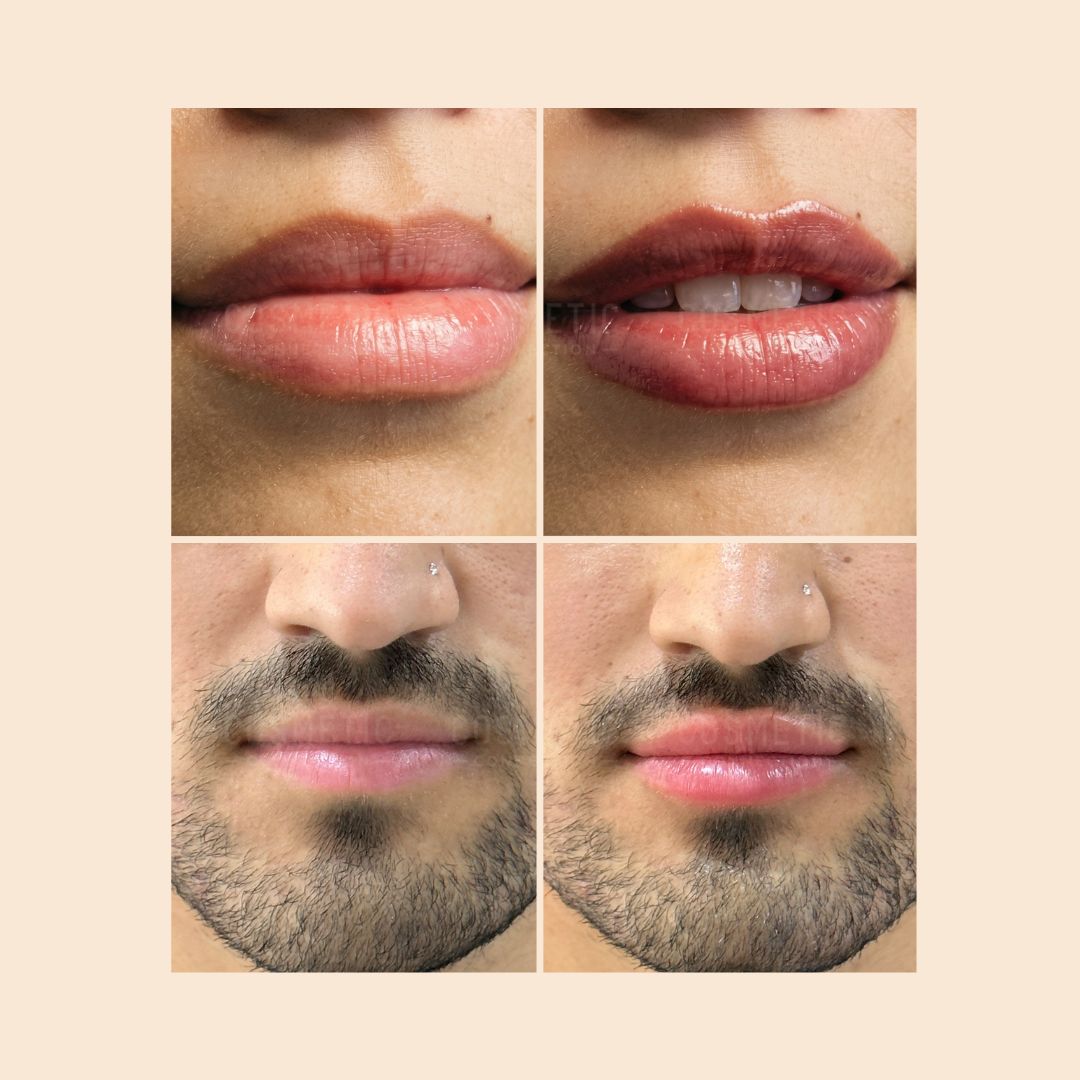
One of the most common questions before a first lip enhancement appointment is how much volume to use. This guide explains lip enhancement treatment volume, including what the volume numbers mean, what different volumes realistically achieve, and why volume is less relevant than many believe.
Quick answer: The specific volume of treatment is less relevant than the type of volume and the technique. Specific volume requirements vary depending on starting size, lip tissue type, product, technique, and goals. The right approach is to start conservative for your specific needs and add more once healed if needed. Post-treatment swelling let’s you experience a bigger change, so you will know if more volume at a subsequent session is needed.
What does the volume number actually mean?
Volume in lip enhancement refers to the amount of treatment administered in a single session, measured in millilitres. A standard syringe used for lip volume treatment contains 1ml of product. Half a syringe is 0.5ml. Many clinics offer the option between the two.
The volume number is a measure of quantity, not outcome. The same 1ml administered by two different clinicians using two different techniques can produce dramatically different results. Volume is one input into the outcome; technique, product selection, treatment depth, and anatomical starting point all contribute equally or more.
What different volumes realistically achieve
Associating a result with just volume is impossible without understanding your starting point, product type, lip tissue type, and treatment technique. However, as a rule of thumb, most people need more volume than they initially believe.
Despite this, a conservative approach (in both type and quantity) is always preferable, because once healed, more can always be added.
| Volume | Best suited to | Typical visible outcome | Who it suits |
|---|---|---|---|
| 0.25ml | Very small lips | Hydration change only | Patients wanting the smallest possible change; those with existing volume wanting minor correction |
| 0.5ml | Very small lips, routine maintenance | Noticeable but natural improvement; visible change in most anatomies | First-time patients; patients with moderate baseline volume; patients who want to test their response before committing to more |
| 1ml | Average lips, routing maintenance | Meaningful result in most anatomies; significant in lower-volume lips | Patients with naturally thin lips; patients building on prior 0.5ml treatment; patients with clear shape or asymmetry goals |
| 1.5ml | Fuller lips, building size | Substantial change; requires experienced clinician to maintain natural appearance | Patients with very low baseline volume; patients with significant asymmetry; those with restoration goals after volume loss |
| 2ml+ | More pronounced changes | Dramatic change; almost always staged across two sessions | Rarely appropriate in a single session; discuss with practitioner |
Interestingly, it is almost never the case that someone needs exactly 0.5 or 1mL exactly. It has historically been advertised this way to productise a service, so people undergo more treatments.
How to choose the right lip treatment size
To choose the right lip filler size, have a consultation with an experienced aesthetician. Trying to choose the right size without the knowledge and experience of an expert is difficult, and inaccurate. Rather than trying to choose the right size, think about the goals you have for your lips. During a consultation, clearly communicate these goals. It is the job of the clinician to design the best treatment plan to achieve the lip size you want.
Why the volume decision belongs at consultation, not booking
Any clinic that asks patients to select their volume at the time of online booking before they have been assessed by a practitioner is working backwards. Volume selection before assessment prioritises sales over outcome.
The appropriate volume for a given patient depends on:
- The natural volume and shape of both the upper and lower lip
- The ratio of upper to lower lip (the aesthetic ideal is approximately 1:1.6, with the lower lip fuller)
- The lip-to-face proportion: lips that look natural on one face may look excessive on another
- The patient’s specific goals: border definition and hydration requires less volume than overall fullness
- Prior treatment history: residual product from prior sessions changes the anatomical starting point
- The technique being used: some techniques achieve more result per ml than others
A conservative first treatment with a follow-up refinement session is preferable to a maximal first approach. Post-treatment swelling allows you to experience a bigger change, without the risk of over-treating.
It is straightforward to add volume at review once the initial swelling has resolved and the result is clear. Reversing an overfilled result often requires dissolving the entire treatment and starting again.
As it is impossible to predict volume requirements with certainty, it is not possible to know exactly how much volume you need.
The upper lip vs lower lip — does volume split matter?
Most lip enhancement treatments address both the upper and lower lip in the same session. The split of volume between upper and lower is a technique decision, not a patient preference. A common error is placing excessive volume in the upper lip relative to the lower as this creates an unnatural proportion and is a frequent contributor to overdone-looking results.
The lower lip is naturally fuller than the upper lip in most aesthetically balanced faces. Treatment planning that respects this ratio rather than maximising upper lip volume because it is the most visible produces consistently more natural outcomes.
Of course, treatments should also consider your personal aesthetic preferences. Part of treatment planning is not just about ideal ratios, but also understanding your lip goals, and tailoring the volume distribution to achieve the look you want.
What 0.5ml looks like vs 1ml — realistic expectations
The most common source of disappointment after first-time lip treatment is expecting a certain result and getting something different, usually more subtle than expected.
| Starting anatomy | 0.5ml result | 1ml result |
|---|---|---|
| Naturally thin lips with low baseline volume | Very subtle volume improvement; natural-looking; likely less than many patients expect | Noticeable change; still natural with correct technique |
| Moderate baseline volume | Subtle definition improvement only | Modest volume and definition increase; ideal result in most cases |
| Good baseline volume already present | Minimal visible change, if any | Minimal enhancement; subtle definition improvement |
| Post-prior treatment (some residual product) | Top-up and refinement | Potentially more than needed, assess with practitioner first |
The concept here is that larger baseline lips need more volume to see a change, compared to smaller natural lips that need less.
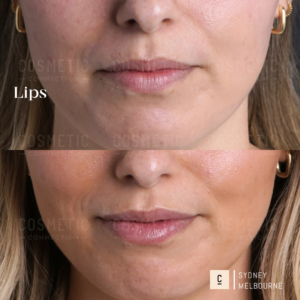
Before and after 1mL (healed)
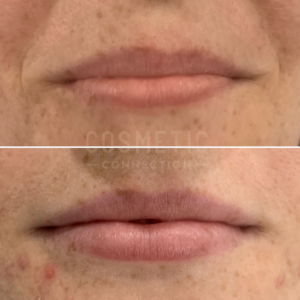
Before and after 0.5mL (healed)
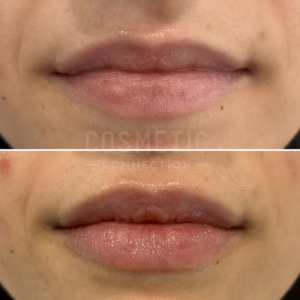
Before and after 1mL (healed)
For more visual references of realistic results across different starting points, see our guide to what natural-looking lip enhancement actually looks like.
If you want to explore your options and suitability for lip enhancement, request a consultation with our clinical team. We’ll assess your lips using our 3 pillar framework, and provide fair, honest guidance.
Get started
Does 1mL make a difference?
Yes, in most cases 1mL is sufficient to achieve a visible difference. The exception is in cases where there is a larger starting size, in which case 1mL is often insufficient.
Frequently asked questions
Is 0.5ml enough to make a visible difference?
For most patients with naturally thin or low-volume lips, yes, 0.5ml produces a visible (yet subtle) improvement. For patients with moderate existing volume who want a subtle refinement, 0.5ml is often insufficient. The result depends more on the product, technique used, and the starting anatomy than on the volume alone.
Will 1ml look unnatural?
Not necessarily. The result primarily depends on product type and technique rather than volume. Unnatural results are caused by a treatment that does not respect what the anatomy supports, and by incorrect placement, not just the volume. Inexperienced clinicians compensate for poor technique and product selection by using more volume than necessary.
Can I get more volume added at my review?
Yes. A follow-up appointment is standard practice at reputable clinics and allows both the practitioner and the patient to assess the final result once all swelling has resolved. If additional volume would improve the outcome, it can be discussed and administered at that point. This is far preferable to over-treating at the first session.
What happens if I get too much volume?
If the result is overfilled or unnatural, the cosmetic substance can be reversed. Reversal returns the lips toward their natural baseline within 24 to 48 hours, after which new treatment can be planned with a corrected approach. See our guide to reversing lip enhancement treatments for a full explanation.