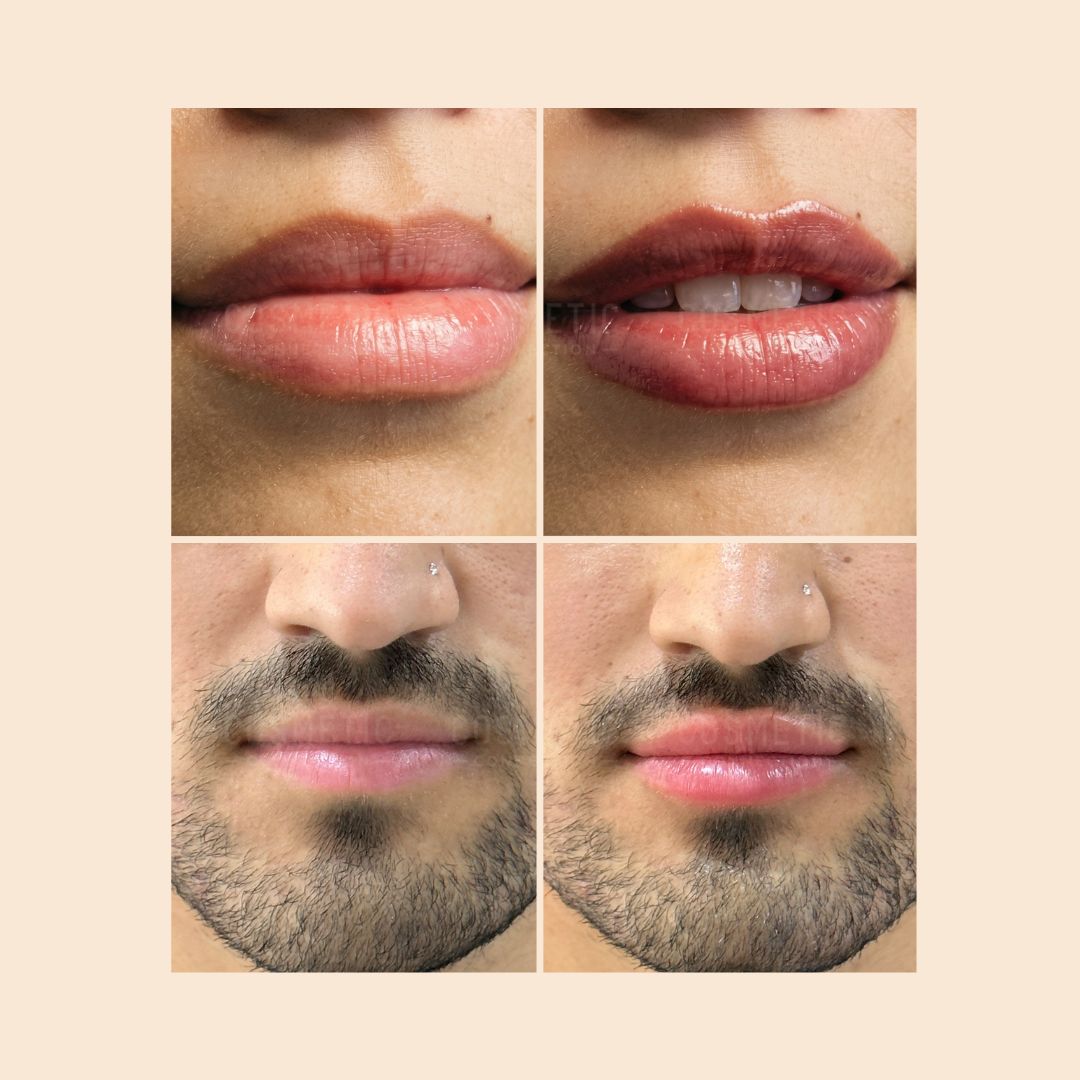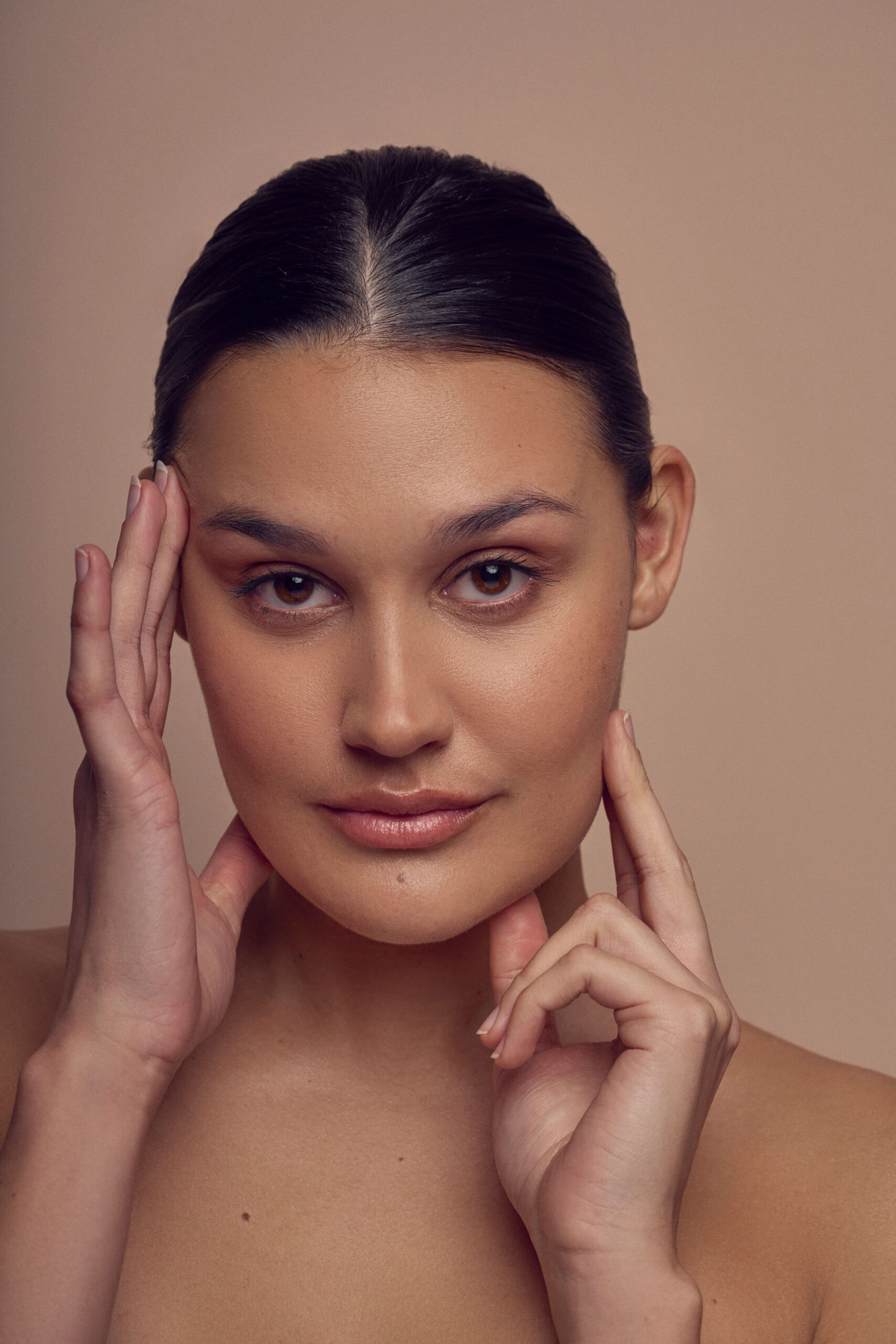
The most common thing people say before their first lip enhancement appointment is some version of: “I don’t want it to look obvious.” This guide explains what a natural result actually means clinically, what determines whether a result looks natural or overdone, and how to maximise the probability of achieving the outcome you are looking for.
Quick answer: A natural-looking lip enhancement result is one where the lips appear better than before — more defined, proportionate, or fuller — without appearing visibly treated. It is determined primarily by technique and volume appropriateness, not by the treatment category itself. Unnatural results are the product of excess volume relative to the anatomy, incorrect placement, or poor clinical judgment — not an inherent property of lip enhancement treatments.
What makes a lip enhancement result look natural?
Natural-looking results share a set of consistent clinical characteristics. Understanding these helps patients evaluate before-and-after images and communicate goals clearly at consultation.
| Characteristic | What it looks like in practice |
|---|---|
| Proportionate volume | The lips are appropriately full relative to the rest of the face — they do not dominate or draw attention away from other features |
| Preserved natural shape | The existing lip architecture — the cupid’s bow, the natural philtral columns, the natural fullness distribution — is enhanced, not replaced |
| Defined but not rigid border | The vermillion border is sharper and more defined, but transitions naturally to the surrounding skin — not a sharp, demarcated line |
| Natural movement | The lips move naturally with speech and expression — they do not appear stiff, immobile, or disproportionately large during expression |
| Consistent across angles and lighting | The result looks good from the front, in profile, and in natural light — not only in posed, filtered images |
| Appropriate upper-to-lower lip ratio | The lower lip remains naturally fuller than the upper lip — a ratio of approximately 1:1.6 is associated with aesthetic harmony, but can vary depending on culture and personal preference |
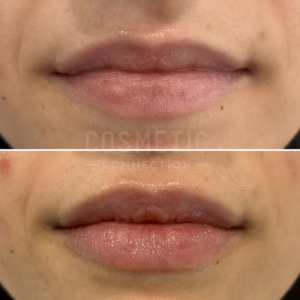
Before and after natural lip enhancement.
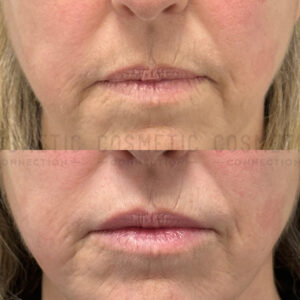
Before and after natural lip enhancement.
What makes a lip enhancement result look unnatural?
Unnatural results are almost always the product of specific clinical errors — they are not inherent risks of the treatment category. The most common causes of unnatural-looking outcomes are:
- Excessive volume: more product than the anatomy can support creates a stuffed, disproportionate appearance — the lips protrude rather than fill naturally
- Inverted upper-to-lower ratio: when the upper lip is made larger than the lower lip, the result reads as unnatural because it inverts a fundamental proportion of the face
- Product placed too superficially: product in the wrong anatomical plane creates lumps, ridging, or visible product at the surface
- Migration above the lip border: accumulated product that has moved above the vermillion border creates the “shelf” appearance that reads as obviously treated
- Lack of respect for existing lip architecture: treating the lips as a blank canvas rather than building on the individual’s natural shape produces results that look foreign to the face
The role of technique in natural results
The same volume of treatment can produce a natural result or an unnatural result depending entirely on how and where it is placed. The technique determines the distribution, depth, and shape of the product within the tissue.
Different techniques suit different goals and anatomies. A classic volumising approach distributes product through the body of the lip for overall fullness. A border definition approach places product precisely at the vermillion border for definition without significant volume addition. The Russian technique creates vertical projection centrally with less lateral spread, suited to patients wanting height and definition rather than overall fullness. A combined anatomical approach tailors the technique specifically to the individual anatomy and goals.
For more detail on how different techniques produce different results, see our guide to lip enhancement techniques.
The role of volume in natural results
Every anatomy has a proportionate volume limit; the maximum amount of added volume that the lip can hold while still looking natural relative to the rest of the face. Beyond this limit, additional volume looks worse rather than better.
This limit is different for every patient. Some anatomies can hold 1.5ml naturally; others look proportionate with 0.5ml. The limit cannot be predicted by looking at the lips alone, it must be assessed in the context of the full face, including the nose, chin, facial width, and overall proportions.
A practitioner who recommends maximum volume without individual assessment is not using a natural-result approach. A practitioner who recommends the minimum effective volume for the stated goal, and checks in at a follow-up appointment before adding more — is.
For guidance on volumes, see our full breakdown of lip enhancement treatment volumes.
How to communicate “natural” at your consultation
The word “natural” means different things to different patients. To communicate effectively at consultation:
- Bring reference images of results you like — and results you want to avoid
- Be specific about which aspect of your lips you want to change — volume, definition, symmetry, or something else
- State clearly if you are not comfortable with a visible change — “I want to look better, not different” is a valid and clear goal
- Ask your practitioner directly: “What volume would you start with, and why?” A practitioner who can answer this clearly and specifically is engaging in genuine anatomy-led planning
- Agree on a conservative first treatment with a 2-week review — this is the safest path to a natural result
If you want to discuss natural lip enhancement, request a consultation with our clinical team. We’ll assess your lips using our 3 pillar framework, and provide fair, honest guidance on how to avoid migration, or manage it if it has occurred.
Get started
Frequently asked questions
Can lip enhancement ever look completely undetectable?
Yes — in many cases. With the right volume and technique for the individual anatomy, the result is that the lips look better than before without an obvious treatment signature. Patients often receive comments that they look “refreshed” or “well” rather than any specific observation about their lips. This is the goal of a well-executed natural-result approach.
What is the most common reason lip enhancement looks unnatural?
Excessive volume is the most common cause. The second most common is an inverted upper-to-lower lip ratio — when the upper lip is made larger than the lower. Both are clinical judgment errors, not inherent risks of the treatment itself.
If I have had overdone lip enhancement before, can I get a natural result?
Yes. Dissolution of existing product returns the lips to their natural baseline, after which a new treatment plan using appropriate volume and correct technique can produce a natural result. Many patients who come to us after unsatisfactory prior treatment go on to achieve the natural outcome they originally wanted. See our guide to reversing lip enhancement treatments for more detail.