
Non-surgical rhinoplasty is widely considered safe when performed correctly, but the nose is one of the higher-risk areas of the face for cosmetic treatments. Therefore the risks deserve a clear, honest explanation rather than being buried in fine print. Note that because it is higher-risk does not mean that it is high risk, especially when performed by an appropriately trained and experienced doctor.
This guide covers every material risk, from common minor side effects to rare but serious complications, and explains what separates a safe provider from an unsafe one. If you are considering this procedure, this is the most important article to read before you begin choosing a cosmetic clinic.
Quick answer: The most serious risk of non-surgical rhinoplasty is vascular occlusion, where the substance compresses or enters a blood vessel, potentially causing skin damage or, in very rare cases, vision changes. This risk is manageable with correct technique and a qualified practitioner who has appropriate reversal agents on-site. Minor side effects like bruising and swelling are common and temporary.
Why the nose is a higher-risk area for treatments
The nose has a dense network of blood vessels that supply blood to both the nose itself and, critically, to structures around the eye. The angular artery and dorsal nasal artery are branches of larger vessels with connections that, in rare cases, can allow the substance to travel toward the eye.
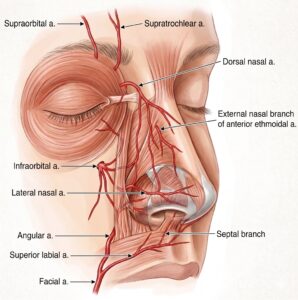
This anatomy does not make the procedure dangerous in the hands of a trained, experienced practitioner, but it does mean that practitioner selection matters more for non-surgical rhinoplasty than for other treatments. It is not a procedure where general experience is sufficient. Specific nasal anatomy training and complication management capability are essential to reduce the chance of the treatment going wrong.
The most serious risk: vascular occlusion
Vascular occlusion occurs when the treatment inadvertently enters or compresses a blood vessel, interrupting blood supply to the surrounding tissue. According to the TGA, this is the most serious complication associated with facial treatments.
In the nose, vascular occlusion can cause:
- Blanching (white discolouration) of the skin immediately after treatment, the first warning sign
- Skin damage if blood supply is not restored quickly
- In extremely rare cases: vision changes if the substance reaches the ophthalmic artery
Vascular occlusion is a medical emergency that requires immediate treatment with an appropriate reversal agent. A practitioner trained in complication management will recognise blanching immediately, stop the procedure, and administer the reversal agent without delay. This is why a doctor-led clinic with highly experienced clinicians and emergency protocols is a meaningful safety advantage, not just a marketing claim.
Common, lower-severity risks
| Side effect | How common | Duration |
|---|---|---|
| Bruising | 5% of patients | 3–7 days |
| Swelling | Very common | 24–72 hours |
| Redness at treatment site | Very common | A few hours |
| Tenderness | Common | 1–3 days |
| Mild asymmetry immediately post-treatment | Common (temporary) | Resolves as swelling settles |
These effects are expected and temporary. They do not indicate a complication and resolve without intervention in the vast majority of cases.
Less common but clinically significant risks
Lumps and irregularities: If the treatment is placed too close to the skin or in excess, visible lumps can form. The nasal skin, particularly over the bridge, can be thin, making surface irregularities more visible here than in other areas.
Persistent asymmetry: Minor post-treatment asymmetry is common and usually resolves as swelling settles. Persistent asymmetry that does not resolve within 4 weeks should be reviewed.
Treatment migration: Rarely, the substance can shift from the original location over time. Migration is rare, easy to treat, and resolves on its own as the visible effect from the treatment wears off.
Infection: Rare, but any procedure carries a small infection risk. Signs of infection — increasing redness, warmth, pain, or discharge — should prompt immediate medical review.
What separates a safe provider from an unsafe one?
In Australia, the Medical Board of Australia’s guidelines for cosmetic medical procedures require that practitioners are trained and experienced in the treatments they perform. They must also conduct a thorough consultation, an assessment to ensure you’re a good candidate, document informed consent, and ensure patients understand all material risks before proceeding.
Beyond the regulatory minimum, here is what to look for:
| Safety indicator | What to look for |
|---|---|
| Reversal agent availability | Confirmed on-site, not just “available” — ask directly |
| Practitioner qualifications | Medical degree and specific training |
| Complication management training | Ask directly — “What would you do if I had a vascular event?” |
| Consultation quality | A real assessment of your anatomy, not a brief look |
| Consent process | Written, specific, not just a generic form |
| Doctor performed treatment | Doctor treats, not just oversees |
At Cosmetic Connection, appropriate reversal agents are always available at every appointment. Our practitioners are trained in vascular complication recognition and management, and our suitability-first approach means we will decline to treat patients whose anatomy or history increases risk beyond an acceptable threshold.
Get the decide guide
Can complications be reversed?
In most cases, yes. The treatment used for non-surgical rhinoplasty in Australia can be reversed using an appropriate medical agent. In a vascular occlusion scenario, immediate reversal treatment is the primary intervention. For aesthetic complications like lumps or asymmetry, the treatment can be reversed and the area re-treated once it has settled.
This reversibility is one of the most significant safety advantages of non-surgical rhinoplasty. It is also why permanent products should never be used in the nose. If something goes wrong, there is no reversal option.
Frequently asked questions
Is non-surgical rhinoplasty riskier than other treatments?
Yes, generally. The nasal vascular anatomy is more complex and has connections to critical structures. This does not mean it is unsafe or high risk. It means the skill and safety preparation of the practitioner matter more than for lower-risk areas to ensure a safe procedure.
How do I know if I’m having a vascular occlusion?
The earliest sign is blanching, a sudden white or pale discolouration of the skin immediately after or during treatment. You may also notice unusual pain. If you experience either of these during a procedure, tell your practitioner immediately. Such changes get progressively worse, eventually causing small clusters of pustules or blisters.
Are there people who should not have non-surgical rhinoplasty?
Yes. People with active skin infections near the nose should not undergo the treatment until healed. People with a history of nose job surgery or trauma to the nose are higher-risk candidates, but can still undergo treatment in most cases. These factors should be disclosed at consultation.
What should I do if I think I’m having a complication after leaving the clinic?
Contact your treating clinic immediately. If you have signs of vascular occlusion like progressive skin discolouration, unusual pain, or blanching, this is a medical emergency. If you cannot reach the clinic, visit your nearest emergency department.
Want to know more about non surgical rhinoplasty?
Read our complete guide to non surgical rhinoplasty in Australia.