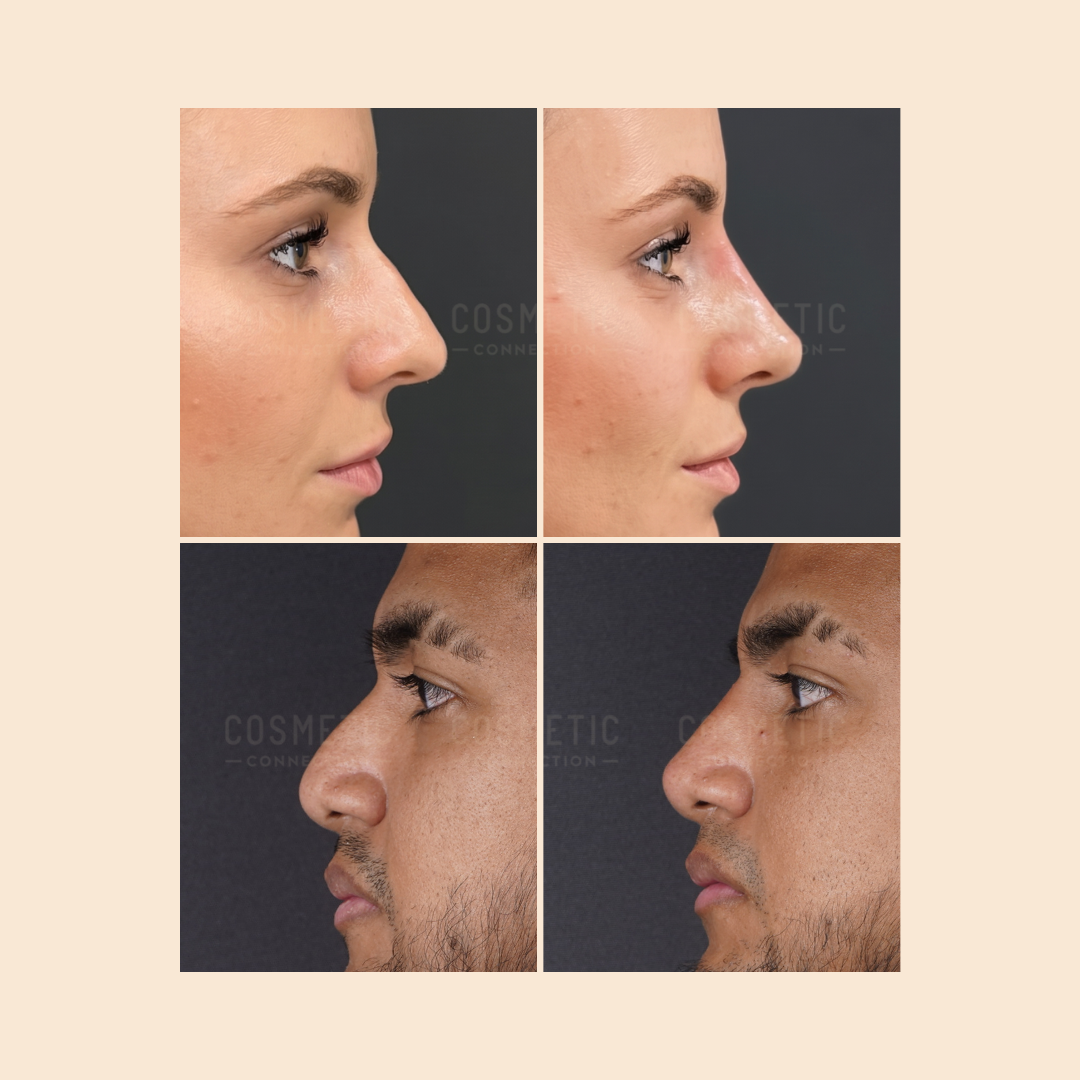
Choosing the right provider for non-surgical rhinoplasty is one of the most important decisions you will make about this procedure, more important than the product and equipment used, the clinic’s aesthetic, or the price. The nose is one of the higher-risk areas for cosmetic treatments, and the difference between an excellent outcome and a serious complication often comes down to who is holding the needle. This guide gives you a practical, criterion-based framework for evaluating any provider you are considering in Australia.
Quick answer: The most important criteria when choosing a non-surgical rhinoplasty provider in Australia are: doctor-led or doctor-supervised care, confirmed reversal agent availability on-site, specific nasal treatment experience, transparent upfront pricing, and a genuine suitability assessment before any treatment is offered. In Australia, many cosmetic treatments are Schedule 4 prescription medicines regulated by the TGA. Providers operating without appropriate medical oversight are not compliant with Australian law.
Why provider selection matters more for this procedure
Not all cosmetic treatments carry the same risk profile. The nose is different from lower-risk areas. The nasal vascular anatomy is complex, with arterial connections that in rare cases can allow the substance to reach vessels supplying the eye. Vascular occlusion, one of the most serious complication of facial aesthetic treatments, is more consequential in the nose than almost any other facial area.
A practitioner who performs high volumes of other cosmetic treatments is not automatically qualified to perform non-surgical rhinoplasty safely. Specific anatomical training, complication management capability, and on-site emergency equipment are non-negotiable for this procedure.
Does it matter whether a doctor or nurse performs the treatment?
This is one of the most searched and most misunderstood questions in the cosmetic treatment space. The honest answer is nuanced.
In a well-run, doctor-supervised model, a highly experienced nurse can perform non-surgical rhinoplasty, provided a doctor is genuinely involved in the in-person assessment, prescribing, and oversight. The key word is genuinely. In practice, many clinics describe themselves as “doctor-supervised” when the doctor’s involvement is limited to signing a prescription remotely, with no real in-person clinical oversight.
For non-surgical rhinoplasty specifically, doctor-performed care where the doctor assesses your anatomy and performs the treatment themselves, carries the lowest risk for three reasons: doctors are trained in medicine, have more extensive training in anatomy and emergency management; a doctor performing the procedure can make real-time clinical decisions without needing to escalate to a supervisor; and doctor-led clinics are more likely to have robust complication management protocols as a matter of institutional culture.
In cases where a non-surgical rhinoplasty is being used to improve a surgical result, a doctor must perform the treatment.
Criterion 1: Medical oversight and qualifications
In Australia, most cosmetic treatments are Schedule 4 prescription medicines. They must be prescribed by an authorised prescriber, a registered medical practitioner, and administered under appropriate clinical supervision. This is a legal requirement under TGA regulations, not a recommendation.
| Provider model | TGA compliant | Recommended for nose treatment |
|---|---|---|
| Doctor performs the procedure | ✅ Yes | ✅ Yes |
| Doctor supervises, nurse performs | ✅ Yes if supervision is genuine | ✅ No |
| Registered Nurse operates independently | ❌ No | ❌ No |
| Beauty therapist or unlicensed provider | ❌ No | ❌ No |
Cosmetic Connection operates on a doctor-performed model for nose treatments across all our clinics.
What qualifications should a non-surgical rhinoplasty doctor have?
| Qualification or training | What it indicates |
|---|---|
| MBBS or equivalent medical degree | Base medical qualification — minimum requirement |
| Fellowship or specialist training (ACCSM, ACAM) | Advanced cosmetic medical training |
| Specific nasal anatomy and technique training | Most directly relevant qualification for this procedure |
| Membership of professional bodies | Signals engagement with professional standards |
Criterion 2: Reversal agent availability
An appropriate reversal agent must be physically present in the clinic at the time of your appointment, not available to order, not at a nearby pharmacy. On-site. This is the single most important safety equipment question for this procedure.
Ask directly: “Do you have the reversal agent on-site at my appointment?” Any hesitation or answer that is not a clear yes should disqualify the provider. You can also ask to see it.
Criterion 3: Specific nasal experience
General experience does not transfer automatically to non-surgical rhinoplasty. Ask:
- “How many non-surgical rhinoplasty procedures do you perform per month?”
- “What specific training have you done in nasal anatomy and technique?”
- “Can you show me before-and-after photos from your own patients for this procedure?”
Choosing the right doctor for your non-surgical rhinoplasty is vital.
What to look for beyond qualifications
Volume and specificity of experience A practitioner who performs non-surgical rhinoplasty regularly will have a more refined technique than one who offers it occasionally. Ask how many procedures they perform per month, and how many years they’ve been doing it.
Media presence and peer recognition Practitioners sought out by media for expert commentary have typically earned peer recognition. This is not a guarantee of skill, but it is a meaningful corroborating signal.
Patient reviews with procedure-specific language Look for reviews that specifically mention non-surgical rhinoplasty outcomes, consultation experience, and the practitioner’s approach to suitability and honesty about limitations.
Transparency about limitations A practitioner who occasionally declines to treat, or who redirects clients toward surgery when that is more appropriate, is demonstrating clinical integrity.
Clinic reputation and standards Clinicians typically work at clinics that align with their standards, experience and ethics. Not only should you research the clinician, but also look into the clinic where the clinician works.
Criterion 4: A genuine suitability assessment
A provider who agrees to treat you without a thorough assessment of your anatomy, goals, and health history is not providing safe care. A genuine suitability assessment should include review of your specific nasal anatomy, an honest discussion of what is achievable and what is not, review of your health history including previous surgery and prior treatments, written informed consent specific to your situation, and a clear explanation of what happens if you are not a suitable candidate.
Criterion 5: Transparent, upfront pricing
| Pricing model | How it works | Potential issue |
|---|---|---|
| Per unit | Charged for each unit of product used | Creates incentive to use more product |
| Flat-fee | One price covers the full procedure | Aligns provider incentive with using the right amount |
| Voucher/discount | Discounted treatment through third-party | Often indicates compromised safety protocols |
Non-surgical rhinoplasty costs can vary significantly in Australia.
Flat-fee pricing, as used here at Cosmetic Connection, means the cost confirmed at consultation is the cost you pay.
Criterion 6: Before-and-after photos are real, consistent, and diverse
Reliable before-and-after non-surgical rhinoplasty photos use the same lighting, the same camera angle, and the same facial expression in both images. If the lighting changes, the angle shifts, or the patient is smiling in one photo and neutral in the other, the comparison is not reliable. Small changes in any of these factors can make a result look more dramatic than it actually is, in either direction.
A genuine portfolio also shows a range of starting points. If every photo shows a similar nose shape and a similar outcome, you are not seeing how the practitioner handles your specific concern. Ask to see results on noses similar to yours, whether that is a dorsal hump, a wide tip, or asymmetry.
We’ve seen patients arrive at consultation with screenshots from social media that turned out to be filtered, differently lit, or simply not the clinic’s own work. Ask directly: “Are these your own patients, and were the photos taken in the same lighting and angle?” A confident provider will answer this without hesitation.
- Same lighting in both photos
- Same camera angle and distance
- Same facial expression, ideally neutral
- A range of starting nose shapes and concerns, not just one type of result
- Confirmed as the clinic’s own patients, not sourced from elsewhere
Criterion 7: Clear aftercare and complication management process
Clinics should provide detailed aftercare information and follow-up support.
Ask: “What is your process if I experience a complication or am unhappy with my result after treatment?” The answer should be specific and confident.
A responsible clinic offers a follow-up at approximately 4-8 weeks post-treatment. Watch for clinics that charge separately for follow-up or do not include one at all.
Get started
How clinics stack up against this checklist
| Criteria | Budget/volume clinic | Mid-range clinic | Doctor-led specialist clinic |
|---|---|---|---|
| Doctor involvement | Often absent | Variable | ✅ Standard |
| Reversal agent on-site | Not always confirmed | Usually | ✅ Always |
| Nasal-specific experience | Variable | Variable | ✅ Confirmed |
| Proper consultation | Often brief | Sometimes | ✅ Standard |
| Upfront flat-fee pricing | No | No | ✅ Standard |
| Follow-up included | Rarely | Sometimes | ✅ Standard |
| Complication process | Often unclear | Sometimes | ✅ Documented |
Doctor vs nurse: a direct comparison for non-surgical rhinoplasty
| Factor | Doctor-led | Nurse-led (supervised) | Nurse-led (independent) |
|---|---|---|---|
| TGA compliance | ✅ | ✅ if genuine supervision | ❌ |
| Anatomy training depth | Extensive | Variable | Variable |
| Emergency management capability | High | Moderate | Variable |
| Real-time clinical decision making | ✅ | Requires escalation | Requires escalation |
| Recommended for this procedure | ✅ First choice | ✅ With significant. caveats | ❌ |
Questions to ask when you call a clinic
- “Is a doctor involved in my non-surgical rhinoplasty consultation and treatment?”
- “Do you have the reversal agent on-site at every appointment?”
- “How many non-surgical rhinoplasty procedures does your team perform per month?”
- “What is the total cost?“
- “Is a follow-up review included?”
Red flags that should make you walk away
- No doctor involvement in consultation or treatment
- Reversal agent not confirmed on-site
- Treatment offered without a proper consultation
- Pricing that changes on the day
- Discount vouchers for non-surgical rhinoplasty specifically
- Practitioner cannot answer questions about complication management
- High-pressure sales tactics or limited-time offers
Frequently asked questions
Is it safe to have non-surgical rhinoplasty performed by a nurse in Australia?
It depends on the oversight model. A nurse operating under genuine doctor supervision, where a doctor is involved in the prescription, the in-person assessment, and has oversight of the procedure, can legally perform the treatment within a compliant framework. A nurse operating independently without doctor oversight is not operating within TGA requirements.
How do I verify a practitioner’s qualifications?
Medical practitioners and nurses in Australia are listed on the AHPRA public register at ahpra.gov.au. Search the practitioner’s name to confirm their registration status and whether any conditions apply.
Should I choose the cheapest provider?
No. Price is the least reliable indicator of quality or safety for this procedure. The indicators that matter are qualifications, oversight model, reversal agent availability, and consultation quality. Also look at the clinic itself, which often reflects the level of practitioner working their.
What if I’ve already had treatment and am unhappy with the result?
Consult a qualified, doctor-led clinic for an assessment. In most cases, existing treatment can be reversed and the area re-treated.
Can I trust clinic reviews when evaluating quality and safety?
Partially. Reviews are useful for assessing patient experience and communication quality. They are less reliable for assessing safety. Use reviews as one input alongside this checklist, not as your primary evaluation tool.
What if a clinic ticks most boxes but not all?
For non-surgical rhinoplasty specifically, reversal agent availability and doctor performed on on-site supervision are non-negotiable. If a clinic fails either of these two criteria, it is not appropriate for this procedure regardless of how well it scores on others.
How do I find a doctor who specialises in non-surgical rhinoplasty in Australia?
Search for doctor-led cosmetic medicine clinics in your city. Look for practitioners who specifically mention non-surgical rhinoplasty in their content rather than just treatment generally. Verify experience through ACCSM, ACAM, and CPCA, and assess their specific experience through published case work and reviews.
Is a plastic surgeon better than a cosmetic doctor for non-surgical rhinoplasty?
No. Plastic surgeons are the appropriate choice for surgical rhinoplasty. For non-surgical rhinoplasty, a cosmetic doctor with specific nasal training and high case volume is often the more experienced choice, because this procedure is a core part of their daily practice, not a peripheral offering.
What should I expect at a good initial consultation?
A thorough consultation determines suitability. It should involve a physical assessment of your nose, a discussion of your specific concern and goals, an honest conversation about what is achievable, the pros and cons, a review of your health history, and time for your questions.
Want to know more about non surgical rhinoplasty?
Read our complete guide to non surgical rhinoplasty in Australia.