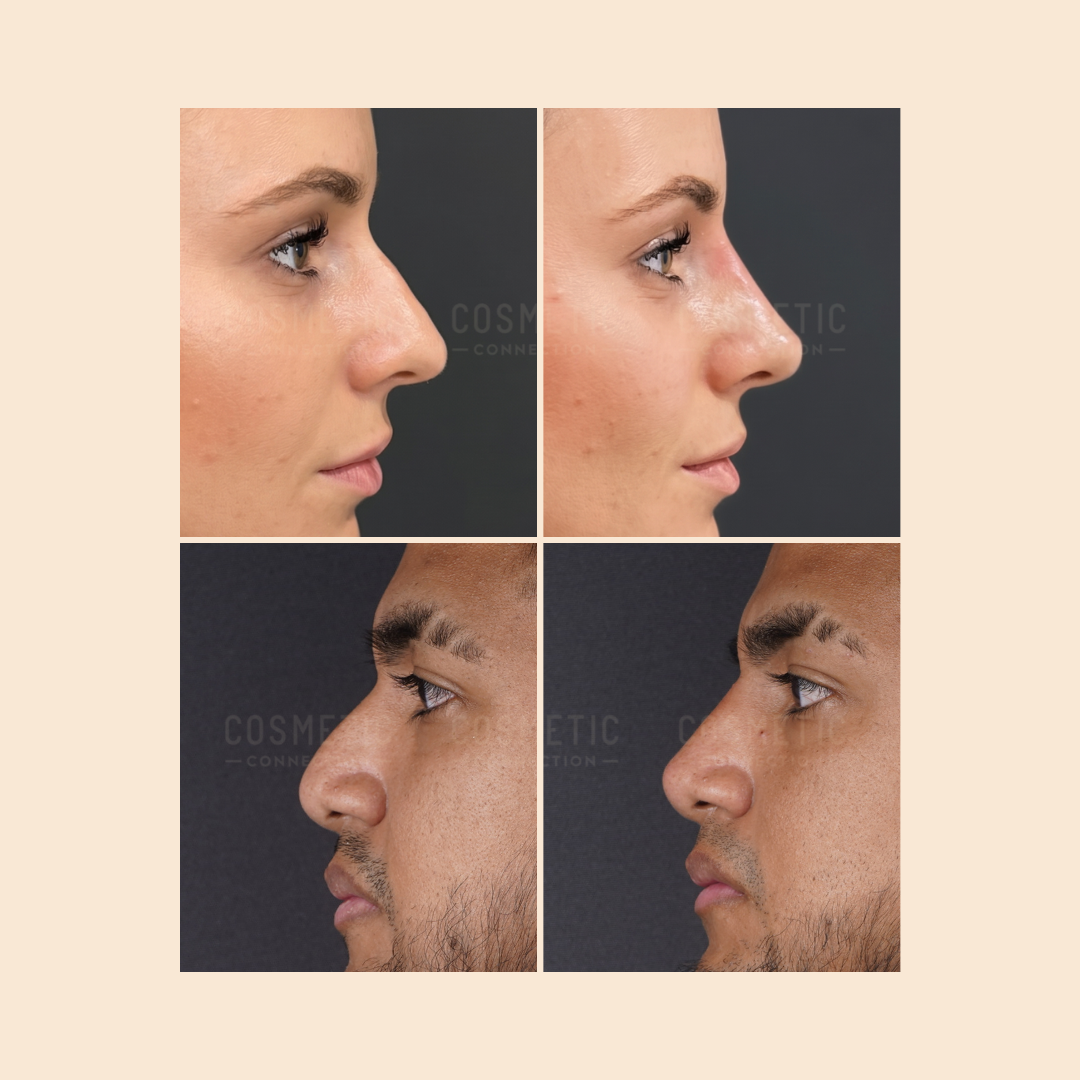
Non-surgical rhinoplasty has genuine advantages: no surgery, no downtime, immediate results, and reversibility. It also has limitations that are often glossed over in clinic marketing. This guide gives you an honest, balanced breakdown of the pros and cons, so you can make a properly informed decision.
Quick answer: The main advantages of non-surgical rhinoplasty are no downtime, immediate results, reversibility, and significantly lower cost than surgery. The main disadvantages are that it cannot reduce nose size. Whether the pros outweigh the cons depends entirely on your specific concern and goals.
The case for non-surgical rhinoplasty
No surgery, no general anaesthesia The procedure uses non surgical methods, not incisions. There is no surgical risk, no general anaesthesia, and no recovery ward. For people who want a meaningful improvement without the commitment of an operation, this is a significant advantage.
No downtime Most clients return to normal activities the same day. There is mild redness and possible bruising, but no swelling that prevents daily function. Aftercare is simple and easy to follow. Compare this to surgical rhinoplasty, which involves 2–4 weeks of visible swelling and bruising, time off work, and significant activity restrictions.
Results are immediate You see a result on the day of treatment, not weeks later. Minor swelling in the first 48–72 hours can slightly affect the final appearance, but by day 3–5 the result is largely stable and visible.
It is reversible The treatment can be reversed using an appropriate medical agent if you are unhappy with the result. This is a meaningful safety net that surgery cannot offer.
Lower cost than surgery Surgical rhinoplasty in Australia typically costs $15,000–$25,000 or more. Non-surgical rhinoplasty costs $700–$1,800 on average. For people exploring a change before committing to surgery, or for whom surgery is not financially accessible, this is a practical advantage.
Can be used to preview a surgical result Many people use non-surgical rhinoplasty to test what a straighter profile or improved bridge might look and feel like before deciding whether to pursue surgery.
Can be used to improve a surgical result Regret after rhinoplasty is far more common than many believe. In cases where surgical results do not meet expectations, we can use non-surgical methods to refine the results of a rhinoplasty.

Left image: after rhinoplasty surgery. Middle image: immediately after non-surgical rhinoplasty to improve surgical result. Right image: years after non-surgical rhinoplasty without additional treatment.
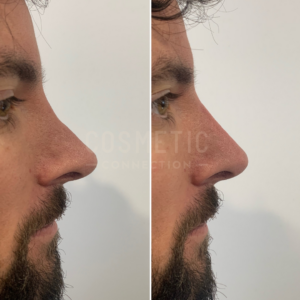
Left image: after rhinoplasty surgery. Right image: immediately after non-surgical rhinoplasty to improve surgical result.
The case against — limitations to understand clearly
It cannot reduce nose size Treatment adds volume, it cannot physically reduce the size of the nose, narrow the nostrils, or restructure the underlying bone and cartilage. For people whose primary concern is a nose that is too large, non-surgical rhinoplasty is the wrong tool.
Results are temporary Unlike surgery, non-surgical rhinoplasty requires ongoing maintenance every 12–18 months.
The nose carries higher vascular risk The nasal vascular anatomy creates a specific risk of vascular occlusion that is higher than for areas like the cheeks or lips. According to the TGA, this is the most serious complication associated with facial cosmetic treatments.
Results depend heavily on practitioner skill The procedure is not forgiving of error, lumps, asymmetry, and overfilling are visible and can be difficult to correct quickly. This makes the choice of provider more consequential here than other treatments.
Not suitable for everyone Significant concerns such as wide nasal bones, large nostrils, breathing issues, may be outside the scope of what treatment can address.
Pros and cons at a glance
| Factor | Non-surgical rhinoplasty | Surgical rhinoplasty |
|---|---|---|
| Downtime | None to minimal | 2–4 weeks |
| Results visible | Immediately | After swelling resolves (weeks to months) |
| Reversible | Yes | No |
| Can reduce nose size | No | Yes |
| Cost | $600–$1,500 | $8,000–$20,000+ |
| Vascular risk | Present (manageable) | Surgical and anaesthetic risks |
| Requires repeat treatments | Yes | No |
| Suitable for structural change | No | Yes |
How to decide which is right for you
1. What do you actually want to change? If the answer involves adding definition, improving proportion, projecting a flat nose, camouflaging a bump, or lifting a tip, non-surgical rhinoplasty may be appropriate. If the answer involves making the significantly nose smaller, narrowing wide nostrils, or correcting a breathing problem, nose job surgery is likely the right path.
2. What can you tolerate? To help you decide beyond purely the results, consider the differences in risk, cost, and downtime.
For a more detailed comparison, see our full guide: Non-surgical rhinoplasty vs surgical rhinoplasty — how to choose.
A note on permanence & longevity
One of the fundamental reasons people prefer surgery over non-surgical rhinoplasty is the misconception that the result is permanent.
This is a critical oversight, and one that can end up costing you tens of thousands in unexpected costs.
Non-surgical methods are temporary, wearing down slowly over 18 months. While repeat treatments are needed, they can be redesigned based on changing preferences, and how you nose changes as you age.
Surgery gives a permanent change, but the nose you get after the procedure is not the nose you will have forever. The nose, like all areas of the face, changes with age. This means that while you think surgery is a permanent solution, it is actually a non-reversible one. The permanence relates to the ability to go back to your natural appearance, rather than describing what the outcome actually is.
It is common for people to undergo multiple rhinoplasty surgeries across their lifetime, not because the first one did not go well, but because the initial result that they were happy with has been lost with the ageing process.
Get started
Frequently asked questions
Is non-surgical rhinoplasty worth it?
For the right candidate — someone with a specific, achievable concern and realistic expectations — most people find it worth it. Dissatisfaction is most common when the procedure was performed on an unsuitable candidate or when expectations exceeded what was achievable.
Can I switch to surgery later if I start with non-surgical rhinoplasty?
Yes. Having treatment does not prevent you from pursuing surgery later. However, if you are planning surgery in the near term, your surgeon may prefer you to have the existing product reversed first to allow accurate assessment of your natural anatomy.
What if I only want a very subtle change?
Non-surgical rhinoplasty is well-suited to subtle improvements. Conservative volume and precise technique produce understated results that look entirely natural.
Are there people who regret non-surgical rhinoplasty?
Yes, primarily people who had unrealistic expectations, were not suitable candidates, or chose a provider without appropriate qualifications and safety protocols.
Want to know more about non surgical rhinoplasty?
Read our complete guide to non surgical rhinoplasty in Australia.