Yes, jowl treatment works — but only when it matches what is actually causing your jowls. Most people have a combination of volume loss in the lower face and changes in skin structure, and the best outcomes come from addressing both. This guide explains what jowls are, why they form, which treatments have the strongest track record, and how to work out what is right for your situation.
If you have noticed your jawline softening, a heaviness appearing below your cheeks, or skin beginning to gather along your lower face — you are not imagining it. Jowling is one of the most common concerns we see across our patient base, and it tends to arrive earlier than most people expect.
Quick answer: Jowl treatment is effective when it targets the right cause. For most people with early to moderate jowling, non-surgical volume treatment can restore definition to the lower face and jawline. For more significant structural descent, surgical options offer more lasting correction. The right approach depends on your anatomy, degree of change, and goals — and should always be assessed in person.
What are jowls and why do they form?
Jowls are the soft tissue changes that occur along the lower face — below the corners of your mouth, extending toward your jaw angle. The skin and tissue soften, the jawline loses its definition, and a fold or heaviness appears that was not there before.
This happens because of changes across multiple layers of the face at once. Bone density in the jaw and chin reduces with age, removing the structural foundation the overlying tissue sits on. Fat compartments in the lower face shift and descend. The ligaments that anchor skin to the underlying structures weaken. Skin itself loses elasticity. The result is that tissue which once sat cleanly along the jawline migrates downward and forward — creating what we recognise as jowling.
It is not simply loose skin. It is a structural change that involves bone, fat, muscle, and ligament together. This is why topical products, facial exercises, and devices that only work on the skin surface tend to produce minimal results — they are addressing the wrong layer.
Several factors accelerate the process: cumulative sun exposure, smoking, significant weight fluctuations, genetics, and — in some cases — certain cosmetic treatments that reduce lower face muscle bulk without prior assessment of the surrounding anatomy.
Does masseter treatment cause jowling?
This is one of the most common questions we hear, and it deserves a direct answer. No, masseter treatment does not cause jowling. However, it can make pre-existing jowls more visible by reducing support.
The masseter muscle sits at the angle of the jaw and provides structural support to the overlying tissue. When this muscle is treated to reduce jaw width or address grinding, it reduces in bulk over several months. In patients who already have lower face volume loss or early laxity, this reduction can remove a layer of support that was helping hold overlying skin in position — making existing jowling more visible.
This does not mean masseter treatment causes jowls or accelerates them. They key is to anticipate who is likely to notice their jowls more after masseter treatment, and discuss this possibility before proceeding.
Should jowls be more visible after masseter treatment, there are two options:
- Let the treatment wear off – the jowls will revert to their pre-treatment appearance
- Perform treatments that support the lower face to reduce jowls. This is more appropriate when one wishes to sustain the masseter results.
What non-surgical treatments are used for jowls?
Non-surgical jowl treatment focuses on restoring the volume and structural support the lower face has lost — rather than attempting to tighten or lift tissue from the outside. This is why volume-based approaches tend to produce more natural and lasting results than energy devices alone in most cases.
The primary approach used in our clinics involves placing treatment product strategically in the areas around and behind the jowl — not directly into the jowl itself. The key areas are the pre-jowl sulcus (the hollow that forms between the chin and the jowl), the mandibular line running toward the jaw angle, and sometimes the chin. By restoring volume to these zones, the jawline regains its continuity and the jowl appears significantly less prominent.
Collagen stimulating treatments are also used in this area, particularly where there is notable reduction in skin quality alongside volume loss. These work differently from standard volume replacement — they stimulate the body’s own collagen production over time, improving skin firmness and reducing laxity from within.
For patients with broader lower face changes — including descending cheeks contributing to jowl formation — cheek contouring may be part of the treatment plan. The midface and lower face work together, and addressing only the jowl area while ignoring midface descent often produces incomplete results.
The table below outlines the main non-surgical approaches and where each sits in the treatment landscape:
| Treatment type | Primary mechanism | Best suited to | Approximate durability |
|---|---|---|---|
| Volume treatment — pre-jowl sulcus and jawline | Restores structural support around the jowl | Early to moderate jowling with adequate tissue quality | 12–24 months |
| Collagen stimulating treatment | Stimulates own collagen production, reduces laxity | Skin quality loss alongside volume change | 18–36 months, builds progressively |
| Combined lower face programme | Volume and collagen stimulation, with cheek support where needed | Moderate jowling, post-weight-loss changes, post-masseter treatment | 18–30 months with maintenance |
You can explore the full range of jowl contouring treatments on our treatment page.
Who is a good candidate for non-surgical jowl treatment?
Non-surgical treatment tends to work best for people in the early to moderate stages of jowling — where there is visible softening of the jawline and some hollowing around the pre-jowl area, but the tissue has not significantly descended beyond the jaw border.
The ideal candidate typically has reasonable skin quality, some remaining structural integrity in the lower face, and realistic expectations about the degree of change achievable without surgery. Age is less relevant than anatomy — we see suitable candidates in their 30s and unsuitable candidates in their 50s, and vice versa.
Candidates who are less likely to achieve satisfying outcomes from non-surgical treatment alone include those with significant skin laxity below the jaw, very heavy jowling where tissue has dropped substantially, or those who have already tried non-surgical approaches and reached the limits of what they can achieve.
Suitability is always assessed in person. A photograph or a description is not enough to make an accurate recommendation in this area of the face.
Get started
How is jowl treatment different from a facelift?
A surgical facelift addresses jowling by physically repositioning the descended tissue back to where it originated and removing any excess skin. For patients with established, significant jowling — particularly where tissue has dropped well below the jawline — surgery offers a degree of correction that non-surgical treatment cannot match.
Non-surgical volume treatment works differently. Rather than lifting tissue, it restores structural support around the jowl — filling the hollow that makes the jowl appear more prominent and re-establishing the jawline contour. It does not physically reposition descended tissue, but it changes the visual relationship between the jowl and the surrounding anatomy in a way that reads as significant improvement to most observers.
The two approaches are not in competition. Many patients begin with non-surgical treatment and later consider surgery as changes progress. Others find that well-planned non-surgical treatment meets their goals for many years. Our detailed comparison of non-surgical jowl treatment and surgical facelift covers this decision in full.
What results can you expect from jowl treatment?
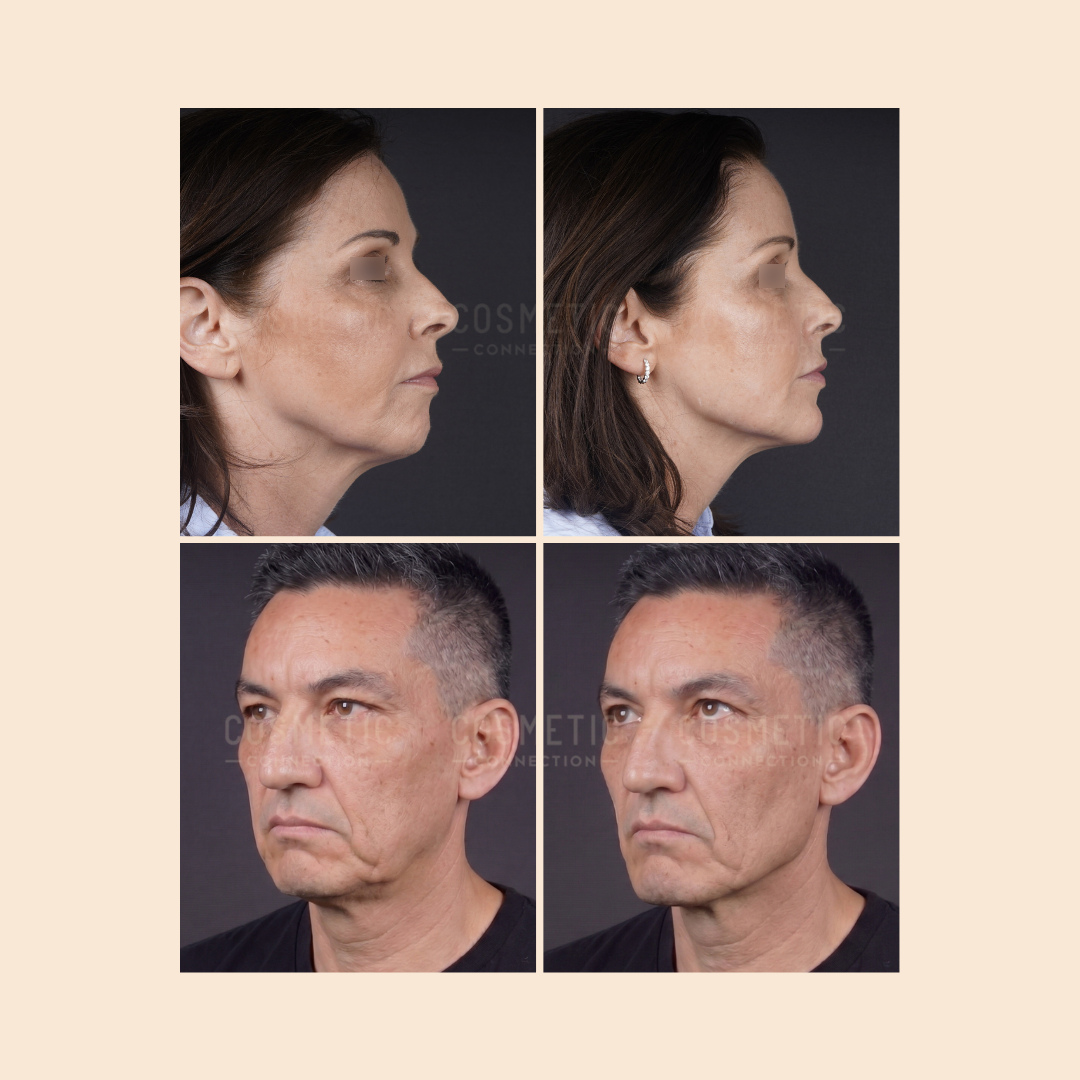
The most consistent result from well-planned non-surgical jowl treatment is a cleaner, more defined jawline — with the heaviness or softness along the lower face visibly reduced. Most patients also notice an improvement in the overall balance of the lower face, as the area between the chin and jaw angle regains its continuity.
Results from volume treatment are typically visible within one to two weeks of the procedure, once any initial swelling has resolved. Collagen stimulating treatments build more gradually over three to six months as the body’s own tissue response develops — meaning results continue to improve after the treatment itself is complete.
Longevity depends on the treatment approach used, the degree of change at the outset, and individual factors including how quickly someone continues to age after treatment. Most patients return for maintenance treatment at 12 to 24 months.
For a closer look at what outcomes look like in practice, see our post on jowl treatment before and after results.
The broader context of facial balancing is also worth understanding — because jowling rarely exists in isolation. Changes in the cheeks, marionette area, and chin all contribute to how jowling reads on the face, and treating only one element often produces results that feel incomplete.
How much does jowl treatment cost in Australia?
The cost of jowl treatment varies considerably depending on the approach used, the complexity of the lower face anatomy, and the number of areas being addressed. A single-area approach to a mild pre-jowl sulcus will sit at a different price point from a comprehensive lower face programme addressing the jawline, chin, and cheeks together.
At our clinics, we use flat-fee pricing — meaning the cost is agreed before treatment, with no variable charges based on product volume. This makes it straightforward to plan your treatment without unexpected costs.
For a full breakdown of jowl treatment costs and what is included, see our dedicated jowl treatment cost guide. You can also view our full flat-fee services list for an overview of how our pricing works.
Get started
Frequently asked questions
At what age do jowls typically start to appear?
Jowling can begin showing in the mid-30s, and in some people as early as their late 20s — particularly those with genetics that predispose them to lower face volume loss, or with significant sun exposure history. Australia’s UV environment accelerates structural facial changes compared to many other countries, meaning earlier onset is more common here than in the UK or USA.
Can you fix jowls without surgery?
For early to moderate jowling, yes. Non-surgical volume treatment and collagen stimulating approaches can significantly reduce the appearance of jowls by restoring structural support around the pre-jowl area and jawline. Surgery offers a greater degree of correction for established or significant jowling, but is not the only effective option.
Does masseter treatment always cause jowls?
No. Masseter treatment is associated with jowling in a subset of patients — specifically those who already have jowls. In patients without jowls, masseter treatment will not cause them. In those with jowling and skin laxity, it may make them more obvious, but will not accelerate their development. Should jowls be more noticeable after masseter treatment, you can either treat the jowling, or let the masseter treatment wear off. Proper suitability assessment beforehand is the key factor.
How long does jowl treatment last?
Volume-based treatment typically lasts 12 to 24 months before maintenance is needed. Collagen stimulating treatment tends to last longer — 18 to 36 months — and may improve further over the first six months after treatment as the collagen response matures. Individual factors including ongoing ageing, lifestyle, and treatment approach all affect longevity.
Is jowl treatment painful?
Discomfort is generally minimal. Treatment in this area of the face is well tolerated by most patients. Numbing cream is applied beforehand and the procedure itself typically takes 20 to 40 minutes depending on the areas treated. Some mild swelling or tenderness afterward is normal and resolves within a few days.
What is the difference between jowls and a double chin?
Jowls refer to the soft tissue changes along the lower face and jawline — the heaviness or descent that appears below the corners of your mouth and along the jaw. A double chin refers to fullness beneath the chin itself, typically caused by submental fat. The two concerns can co-exist but involve different anatomy and are addressed by different treatments.