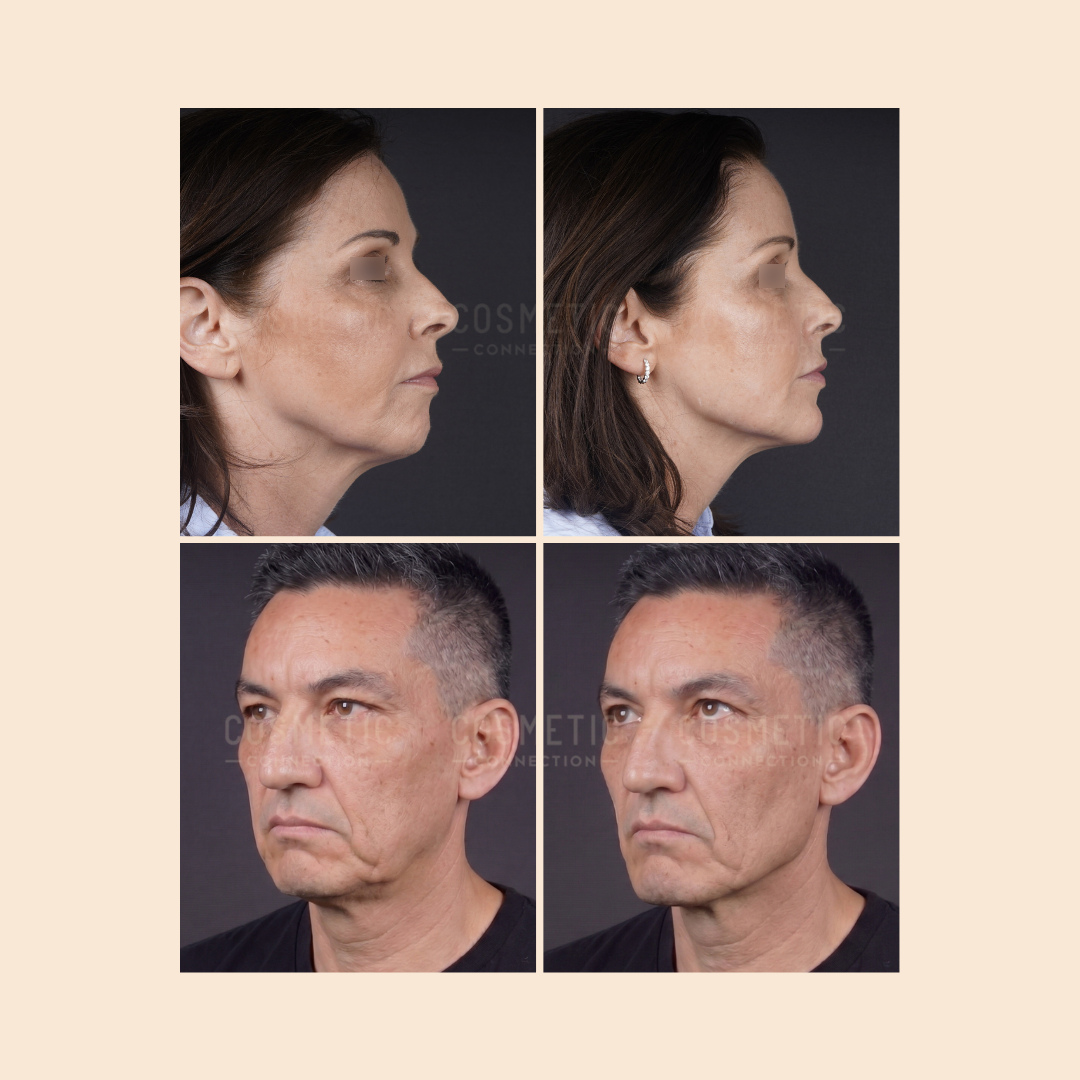
The most important question when considering jowl treatment is not “which option is better” — it is “which option is better for your specific anatomy and degree of change.” Non-surgical volume treatment and surgical facelift are both genuinely effective for jowling, but they work differently, suit different people, and produce different types and degrees of result. This guide gives you an honest, detailed comparison so you can make an informed decision — or have a more productive conversation at your consultation.
Quick answer: Non-surgical jowl treatment suits people with early to moderate jowling who want significant improvement without surgery, downtime, or general anaesthesia. A facelift suits people with established or significant jowling where tissue has descended substantially and non-surgical treatment cannot produce the degree of correction they want. Many people do both over time — non-surgical first, surgery later if needed.
How each approach actually works
Understanding the mechanism behind each approach makes the comparison much clearer.
Non-surgical jowl treatment works by restoring the structural support around the jowl — not by lifting or removing the jowl itself. As the face ages, the hollow that forms beside the chin (the pre-jowl sulcus) and the loss of definition along the mandibular line are what make jowling look prominent. Volume treatment restores these areas, re-establishing jawline continuity so the jowl sits in better proportion with the surrounding anatomy. Collagen stimulating treatments additionally improve the skin’s structural quality over time, reducing laxity from within.
A facelift works differently. It physically repositions the soft tissue and skin of the lower face back toward where it originated — lifting and resecuring the descended tissue to restore the jawline definition that has been lost. Excess skin is removed. The underlying structures are repositioned. The result is a direct correction of the structural descent that caused the jowling.
This distinction matters: non-surgical treatment changes how the jowl appears by restoring what is around it. Surgery changes where the jowl actually sits.
Side-by-side comparison
| Factor | Non-surgical jowl treatment | Surgical facelift |
|---|---|---|
| How it works | Restores volume and structural support around the jowl | Repositions and resecures descended tissue, removes excess skin |
| Best suited to | Early to moderate jowling, good skin quality, realistic expectations | Moderate to significant jowling, established tissue descent, those wanting permanent correction |
| Downtime | Minimal — swelling and tenderness for a few days | 2–4 weeks, with significant initial bruising and swelling |
| Anaesthesia | Topical numbing cream only | General anaesthesia or sedation |
| Results visible | 1–2 weeks | 6–12 weeks as swelling resolves; final result at 6 months |
| Longevity | 12–24 months (volume); 18–36 months (collagen stimulation) | 7–10 years typically |
| Reversibility | Certain products reversible; collagen stimulation is not | Not reversible |
| Risk profile | Low — bruising, swelling, rare vascular events | Higher — scarring, infection, nerve effects, anaesthesia risks |
| Cost (approximate) | Varies significantly by approach and clinician | Significantly higher; single procedure |
| Maintenance required | Yes — 12–24 monthly maintenance appointments | No, though natural ageing continues |
| Degree of correction | Significant in suitable candidates; has a ceiling | Greatest degree of correction available for established jowling |
Who gets the best results from non-surgical treatment?
Non-surgical jowl treatment consistently produces its best results in patients who share a specific combination of characteristics:
- Early to moderate jowling — visible softening of the jawline, some pre-jowl hollowing, but tissue has not descended significantly below the jaw border
- Reasonable skin quality — adequate elasticity means the skin responds well to the underlying volume restoration
- Realistic expectations — understanding that the approach addresses the visual impact of jowling rather than physically repositioning tissue
- A preference to avoid surgery, anaesthesia, or extended downtime
- Willingness to maintain results with ongoing treatment at appropriate intervals
Age is less relevant than anatomy. We see excellent non-surgical candidates in their 50s and poor candidates in their 30s. What matters is the degree of structural change, not the number of years.
Who gets the best results from a facelift?
A facelift produces its best outcomes in patients who have progressed beyond what non-surgical treatment can meaningfully address:
- Established jowling where tissue has descended clearly below the jaw border
- Significant skin laxity in the lower face and neck
- Those who have previously had non-surgical treatment and feel they have reached the limits of what it can achieve
- Those who want a single, long-lasting procedure rather than ongoing maintenance
- Those who are medically suitable for general anaesthesia and prepared for surgical recovery
A facelift is not a first resort or a last resort — it is the right option when the underlying anatomical problem has progressed to a level where surgery is the most appropriate tool.
Get started
The sequence question: should you try non-surgical first?
This is one of the most common questions in consultations about jowling, and the honest answer is: it depends on where you currently are.
If you have early to moderate jowling, non-surgical treatment is a logical first step. It produces meaningful results in suitable candidates, carries low risk, requires no downtime, and does not prevent surgery later if you eventually want it. Many patients find that well-planned non-surgical treatment meets their goals for five to ten years before surgery ever becomes relevant.
If you have established, significant jowling and your primary goal is the greatest degree of improvement — or if you have already tried non-surgical treatment and found it insufficient — going directly to surgery may be the more efficient path. Non-surgical treatment as a precursor to surgery in this situation risks spending money on results that fall short of what you actually want.
The sequence should be determined by a thorough assessment of your current anatomy and a clear conversation about your goals — not by a general principle that one approach comes before the other. Our patient journey page explains how we approach this assessment.
Can non-surgical and surgical treatment be combined?
Yes, and this is increasingly common. Some patients have surgical treatment for the primary structural descent and then use non-surgical volume treatment in the years following to maintain the result and address the gradual ageing that continues after surgery.
Others find that non-surgical treatment of the cheeks, chin, and jawline — through approaches like facial balancing — complements surgical outcomes by addressing volume changes that surgery alone does not correct. A facelift repositions tissue but does not restore volume. If the midface has also lost volume, addressing that non-surgically alongside or after surgery produces better overall facial harmony.
The two approaches are not mutually exclusive — they address different aspects of facial ageing and can work well together when sequenced correctly.
What about other non-surgical options — energy devices, thread lifts, skin tightening?
It is worth addressing these directly, because they come up frequently in research and are often positioned alongside or instead of volume treatment for jowling.
Energy devices — including radiofrequency, HIFU, and ultrasound-based skin tightening — can produce modest improvement in mild skin laxity. In the right patient with very early changes and good skin quality, they can be a useful adjunct to volume treatment. As a standalone approach for established jowling, the evidence for meaningful, lasting results is limited.
Thread lifts provide a mechanical lift using biodegradable sutures and can produce visible improvement, particularly in the mid-face and lower face. Results typically last 12 to 18 months. They are most effective in patients with mild laxity and adequate tissue. For significant jowling, threads alone are unlikely to achieve the degree of correction most patients are looking for.
At our clinics, we focus on volume-based and collagen stimulating approaches for jowling because these address the underlying anatomical cause — volume and structural loss — more directly than surface-acting devices. We discuss all options honestly at consultation and will tell you clearly if we believe a different approach or referral for surgery is better suited to your situation. That is part of what our suitability-first approach means in practice.
The role of cheek descent in jowling
One factor that is often overlooked in jowl treatment decisions is the contribution of cheek descent. The midface and lower face are anatomically connected — the fat compartments that give the cheeks their fullness sit above and adjacent to the area where jowling occurs.
As cheek volume descends with age, it loads the lower face and contributes directly to jowl formation. Treating only the jowl without addressing the fallen midface that is partly driving it often produces results that feel incomplete — or that require more extensive treatment in the jowl area than would otherwise be needed.
Understanding cheek volume loss and how it relates to lower face changes is an important part of understanding your jowling — and whether addressing the midface should be part of your treatment plan. Marionette lines are another adjacent concern that often co-presents with jowling and responds well to treatment as part of a lower face programme.
Get started
Frequently asked questions
Is non-surgical jowl treatment worth it compared to a facelift?
For the right candidate, yes — and significantly so. Non-surgical treatment in someone with early to moderate jowling produces results that are meaningful and natural-looking, with no surgery, no anaesthesia, and minimal downtime. Whether it is “worth it” relative to a facelift depends entirely on your degree of jowling and your goals. They are not the same intervention and should not be evaluated against the same benchmark.
Will non-surgical jowl treatment stop me from having a facelift later?
No. Non-surgical volume treatment does not prevent surgery later and does not make surgery more complicated in the hands of an experienced surgeon. The two approaches can be sequenced over time as your needs change.
How do I know if my jowling is too significant for non-surgical treatment?
The clearest signs that non-surgical treatment may not be sufficient are: tissue that has descended clearly below the jaw border, significant skin laxity in the neck as well as the lower face, and a degree of structural descent that a mirror and consistent angles make clearly apparent. An in-person assessment is the only reliable way to determine this — photographs are not sufficient for accurate evaluation.
What is the biggest risk with non-surgical jowl treatment?
The most common risk is an unsatisfactory aesthetic result — either from incorrect placement of product or from treatment that does not adequately address the degree of change present. Serious risks such as vascular events are rare but not impossible and are managed through careful technique and practitioner training. Product reversibility (where applicable) provides a safety net for aesthetic outcomes.
Is a facelift safer than non-surgical treatment?
Surgical facelift carries higher inherent risk than non-surgical volume treatment — including risks associated with general anaesthesia, infection, nerve effects, and scarring. Non-surgical treatment carries lower overall risk, though serious complications, while rare, can occur. Neither is entirely without risk. The decision should weigh degree of expected improvement against risk profile in the context of your specific situation and health history.
What questions should I ask at a jowl treatment consultation?
The most useful questions are: What is actually causing my jowling — and is it volume loss, structural descent, skin laxity, or a combination? Which approach do you recommend and why? What am I unlikely to achieve with the approach you are recommending? What would the surgical option offer that non-surgical treatment cannot? These questions tend to reveal whether the clinician is genuinely assessing your situation or offering a default recommendation.