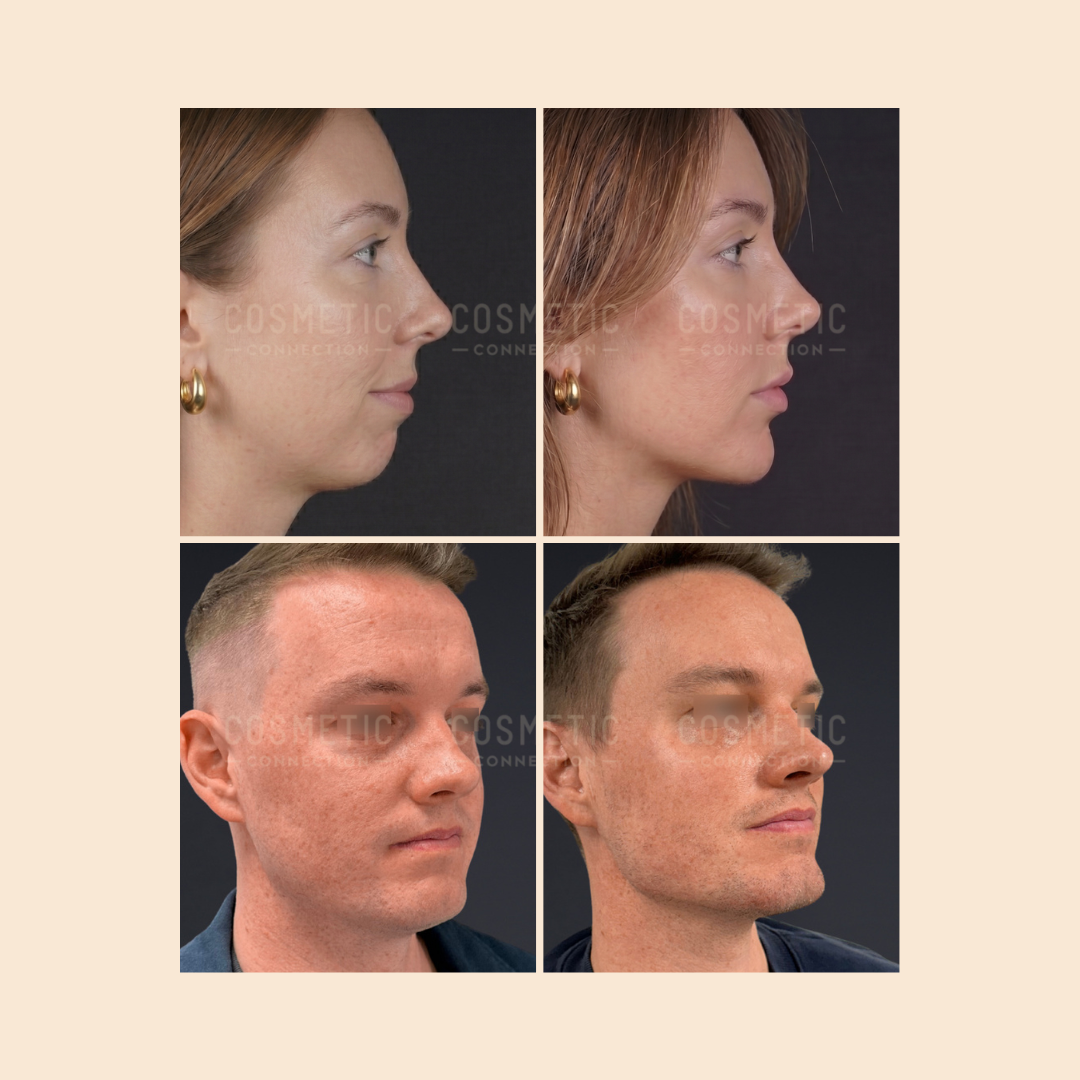
Non-surgical chin contouring is one of the most impactful lower face treatments available — capable of changing the profile, improving facial balance, and altering how the whole lower face reads, often in a single appointment. This guide covers everything: what the treatment involves, who it suits, what results are realistic, how it compares to surgery, and what it costs.
Quick answer: Non-surgical chin contouring uses precisely placed cosmetic treatments to alter chin projection, shape, and symmetry without surgery. It suits most adults with a recessed, asymmetric, or disproportionate chin. Results are visible immediately, last 12–18 months typically, and are fully reversible.
Why the chin matters more than most people realise
The chin is the anchor point of the lower face. It determines how the profile reads, how balanced the face appears from the front, and how the jawline transitions into the neck. A chin that projects appropriately makes the nose look smaller, the jaw look stronger, and the neck look longer — not because those features have changed, but because the proportions that frame them have.
In our experience, the chin is one of the most underaddressed areas in cosmetic treatment planning. Many people come in focused on the nose, the jawline, or the jowls, and the chin is contributing significantly to the concern without them having identified it. A proper consultation — one that looks at the face as a whole rather than treating a single feature in isolation — will almost always pick this up.
The chin also interacts directly with the jawline. For most people seeking lower face definition, the chin and jawline are best planned together. Our complete guide to jawline definition covers this relationship in detail.
What non-surgical chin contouring can address
The concerns that bring people to a chin contouring consultation tend to fall into a few clear categories.
Recessed or weak chin projection. This is the most common concern. A chin that sits behind the vertical plane of the lips and forehead creates a profile that reads as soft or undefined. Improving projection — even modestly — can dramatically change how the face reads from the side.
Short chin. A chin that is proportionally short relative to the mid and upper face can make the lower third of the face appear compressed. Adding vertical length can improve facial thirds balance and give the face a more harmonious overall proportion.
Chin asymmetry. Very few people have a perfectly symmetrical chin. When asymmetry is noticeable — either in shape or position — targeted treatment can create a more balanced appearance.
Chin shape refinement. Some people want a more pointed, V-shaped chin; others want a broader, flatter base. The approach differs depending on the goal, and what suits each person depends heavily on the rest of their facial structure.
Bum chin or chin cleft. A prominent cleft or dimpling in the chin can be softened with precise placement. This is a more technically nuanced application but one we address regularly.
Chin changes with age. Like all facial structures, the chin loses volume and support over time. Bone resorption, soft tissue descent, and skin laxity all contribute. Restoring structure in this area is a meaningful part of lower face rejuvenation for many patients.
How the treatment is planned
No two chins are the same, and the treatment plan needs to reflect that. At Cosmetic Connection, planning begins with a clinical assessment that looks at the chin in the context of the whole face — the nose, the jawline, the lips, and the profile.
The key measurements we consider include the Ricketts E-plane (a reference line from the tip of the nose to the chin used to assess lip and chin projection), the facial thirds (the ratio of upper, mid, and lower face height), and the cervicomental angle (the angle between the chin and the neck). These are not aesthetic opinions — they are anatomical reference points that guide where treatment will make the most meaningful difference.
The treatment itself takes 20–40 minutes. Topical numbing is applied beforehand. Results are visible immediately and evolve over the following two weeks as any mild swelling settles.
Male vs female chin contouring: what changes
The aesthetics of the chin differ significantly between male and female faces, and the treatment approach needs to account for this.
A conventionally masculine chin is broader, flatter, and squarer at the base. It tends to have more forward projection. Adding to a male chin typically means extending the projection while maintaining or enhancing the width — creating a strong, flat base rather than a pointed or tapered result.
A conventionally feminine chin is narrower, more tapered, and often slightly pointed. For women, the goal is usually to add projection without width, creating a refined V-shape that complements rather than dominates the lower face.
These are generalisations, and every individual’s goals are different. The clinical approach is always led by the person in front of us, not a textbook aesthetic. Our dedicated guide to chin contouring for men covers the male approach in detail, including how the chin relates to jawline masculinisation.
Get started
Chin contouring and the jawline: why they are usually planned together
The chin and jawline are a single functional unit in lower face aesthetics. A strong jawline with a weak chin looks mismatched. A well-projected chin attached to a poorly defined jawline looks isolated. In most lower face contouring consultations, we assess both and recommend treatment that addresses the relationship between the two — not just one in isolation.
Treating both in a single session is common and efficient. Under Cosmetic Connection’s flat-fee model, the cost reflects the treatment required rather than the number of areas. Combined chin and jawline contouring typically falls in the $1,500–$4,500 range depending on the volume and complexity involved, with chin-only treatment typically starting from $1,000. Full detail is in our chin contouring cost guide.
The jowls also interact with this picture. For older patients especially, jowl descent can be partially addressed through chin and jawline treatment by restoring the structural support the lower face has lost. Our guide to jowl treatment covers this relationship.
How non-surgical chin contouring compares to a chin implant
The most common alternative to non-surgical chin contouring is a surgical chin implant. The differences are significant: surgery is permanent, requires general or local anaesthetic, involves a one to three week recovery, and carries risks including infection, nerve damage, and implant-related complications. The degree of change achievable is greater, which matters for people with severe structural concerns.
For most people, however, non-surgical treatment achieves what they are looking for at a fraction of the cost, with no recovery, full reversibility, and the ability to adjust over time. A full side-by-side comparison is in our chin implant vs non-surgical guide.
What results look like
Results from non-surgical chin contouring are visible immediately and typically look best at two weeks once any initial swelling has settled. The change is structural — the profile improves, the chin reads as more present, and the lower face looks more balanced.
The most meaningful results we see are in people with a recessed chin and a straight or slightly retrognathic profile. A modest increase in projection in this group can produce a result that looks like it always belonged there — natural, proportionate, and unhurried. Our before and after guide to chin contouring results shows what realistic outcomes look like across different face types.
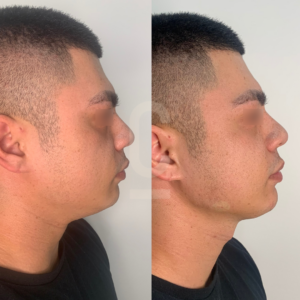
Before and after non-surgical chin and jaw enhancement.
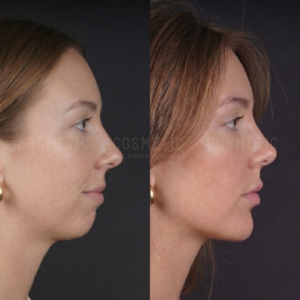
Before and after non-surgical chin and jaw enhancement.
Get started
Frequently asked questions
Who is a good candidate for non-surgical chin contouring?
Most adults with a recessed, short, asymmetric, or disproportionate chin are suitable candidates. Suitability is confirmed at consultation, where we assess the chin in the context of the whole face and confirm whether the concern can be meaningfully addressed non-surgically.
Is chin contouring painful?
Most people find it well-tolerated. Topical numbing is applied 15–20 minutes before treatment. The procedure itself typically takes 20–40 minutes and involves minimal discomfort. Some mild tenderness and swelling for one to three days afterward is normal.
How long do chin contouring results last?
Most people find results are maintained for 12–18 months before a review or top-up is needed. Longevity varies between individuals based on metabolism, lifestyle, and the amount of treatment placed. Over time, many people extend the interval between treatments.
Can chin contouring make my nose look smaller?
Improving chin projection does not change the nose, but it changes how the nose reads relative to the rest of the face. A more balanced lower face proportion can make a prominent nose appear less dominant — this is one of the reasons chin treatment is often recommended before considering anything nose-related.
Is non-surgical chin contouring safe?
In the hands of an experienced, doctor-led clinical team, the safety profile of non-surgical chin contouring is well established. As with all cosmetic treatments, there are risks — including bruising, swelling, asymmetry, and rare but serious vascular events. Choosing a qualified, experienced provider significantly reduces these risks. Our guide to chin contouring risks covers what to know and what to look for in a provider.