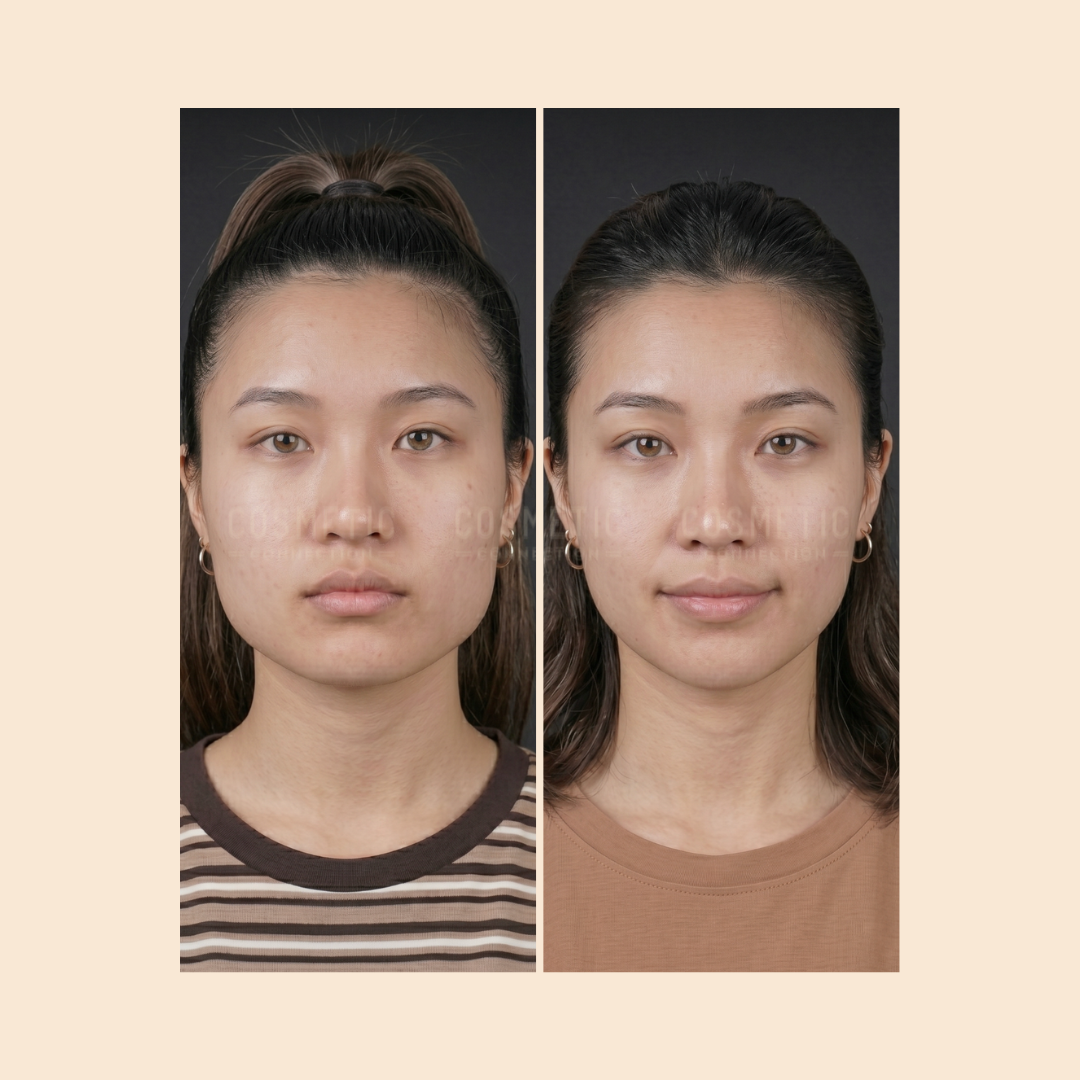
Masseter treatment is a non-surgical procedure that reduces the size of the masseter muscles — the chewing muscles on either side of the jaw — to slim the lower face and soften a square or wide jawline. It is one of the most requested facial contouring procedures in Australia, used for both cosmetic and functional purposes. This page explains what the treatment involves, how it works, who it suits, and what to expect.
Quick answer: Masseter treatment involves placing a muscle-relaxing treatment into the masseter muscles on both sides of the jaw. This reduces the muscle’s activity and, over several weeks, causes it to gradually reduce in size. The result is a slimmer, more tapered jawline. Sessions take around 15 minutes and require no downtime.
What is the masseter muscle?
The masseter is a powerful jaw muscle on either side of the face, running from the cheekbone down to the lower jaw. Its primary function is chewing — it generates the biting force needed to break down food. It is one of the strongest muscles in the body relative to its cross-sectional area.
In some people, the masseter is naturally large. In others, it grows larger over time as a result of teeth grinding, jaw clenching, habitual gum chewing, or a diet high in hard foods. When the masseter is enlarged, it widens the lower face and can create the appearance of a square or heavy jaw.
Understanding how the masseter muscle works and why it enlarges is useful context before considering treatment — it explains why non-surgical treatment can be effective for some people and less so for others.
How does masseter treatment work?
Masseter treatment uses a prescription muscle-relaxing treatment placed directly into the masseter muscle on both sides of the face. The active agent is a muscle-relaxing substance that temporarily reduces the muscle’s ability to contract with full force.
With reduced activity, the masseter undergoes disuse atrophy — it gradually reduces in bulk over the weeks following treatment. This is the same biological process by which any muscle reduces in size when it is used less. The treatment does not cause sudden or dramatic change. The muscle reduces slowly, which is part of why results look natural.
The effect is temporary. The muscle’s nerve supply regenerates over time, and without further treatment, the muscle will return to its original size. Most people begin maintenance treatment before this happens. For a more detailed explanation of the mechanism, our guide on how masseter treatment works at a cellular level goes deeper on the biology.
What is masseter treatment used for?
The procedure has two main applications that often overlap in the same patient.
Cosmetic jawline slimming — reducing the visual width of the lower face to create a slimmer, more tapered profile. This is the most common reason people seek treatment. It is particularly well suited to people with a square face shape where the width comes primarily from muscle bulk rather than bone structure.
Jaw clenching and bruxism management — reducing the force generated by the masseter to decrease the effects of teeth grinding and jaw clenching. This can alleviate associated symptoms including jaw tension, headaches, and tooth wear. Our guide to bruxism and jaw clenching treatment covers this in detail.
Both applications use the same treatment. The indication — cosmetic, functional, or both — shapes the consultation and the treatment plan, but the procedure itself is the same.
What happens at a masseter treatment session?
A session at Cosmetic Connection begins with a suitability assessment. We assess the size and activity of your masseter muscles, confirm that non-surgical treatment is appropriate for your goals, and explain what to expect in realistic terms — including the timeline for results and how many sessions you are likely to need.
The treatment itself takes ten to fifteen minutes. A fine needle is used to place the muscle-relaxing treatment into the masseter on both sides. Most people describe the discomfort as minimal. There is no anaesthesia required and no downtime — you can return to normal activities immediately.
For a full account of what the session involves, our step-by-step masseter treatment guide covers the process from consultation through to the full results timeline.
Get started
What results can you expect and how long do they last?
Results develop gradually and are not visible immediately after the session. Most people notice early softening at four to six weeks, with more visible slimming continuing over the following two to three months as the muscle reduces in bulk.
Initial results typically last four to six months before the muscle begins to return to its original size. With consistent treatment over multiple sessions, many people find that the degree of slimming improves and the interval between treatments can extend. Some reach a point where one or two sessions per year maintains their result.
| Timeframe after treatment | What to expect |
|---|---|
| 0–2 weeks | No visible change; reduced muscle contractile activity begins |
| 4–6 weeks | Early softening becomes noticeable at the jaw angle |
| 2–4 months | Progressive slimming; full result developing |
| 4–6 months | Peak result; early signs of muscle recovery begin |
| 6–9 months without re-treatment | Muscle returns toward original size |
Our masseter treatment results guide shows what realistic outcomes look like across different starting points and across multiple sessions.
Who is masseter treatment suited to?
Masseter treatment is suited to people whose jaw width or squareness is driven primarily by masseter muscle bulk — either naturally large muscles, or muscles that have enlarged over time due to clenching, grinding, or other parafunctional habits.
It is less effective where jaw width comes primarily from bone structure. A clinical assessment establishes which factor is dominant in your case.
Treatment is available to adults in good health. It is not appropriate during pregnancy or breastfeeding, and certain neuromuscular conditions affect suitability. These are discussed at consultation.
For a detailed breakdown of suitability criteria — including how to tell whether your jaw width is muscle or bone driven — our suitability guide for masseter treatment covers the assessment criteria in full.
How does masseter treatment compare to surgical jaw reduction?
Surgical jaw reduction physically reshapes the jaw bone and is permanent. Non-surgical masseter treatment reduces muscle bulk and is temporary but reversible. For most people, the cause of jaw width is muscle — not bone — which makes non-surgical treatment the appropriate first step.
Surgery is generally considered only when bone structure is the dominant driver of jaw width and when the risks of surgery are clearly outweighed by the anticipated outcome. The risk profile of surgical jaw reduction — including nerve damage, general anaesthesia, and a recovery measured in months — is significantly higher than non-surgical treatment.
Our detailed comparison of masseter treatment and jaw reduction surgery covers how to make this decision, including a side-by-side breakdown of cost, recovery, risk, and who each option suits.
How much does masseter treatment cost in Australia?
Non-surgical masseter treatment in Australia ranges from $600 to $1,500 per session, depending on the extent of treatment required and the clinic’s pricing model.
The most important pricing distinction to understand is flat-fee versus per-unit pricing. Per-unit pricing means the final cost depends on how many units are used — which can vary between patients and may result in a higher bill than initially quoted. At Cosmetic Connection, we use a flat-fee model — one cost, confirmed before your appointment, with no add-ons.
Our facial slimming treatment cost guide covers the full pricing landscape in Australia, including what drives cost variation and how to compare clinics on more than just price.
Get started
Masseter treatment in Sydney and Melbourne
Cosmetic Connection offers masseter treatment at our Sydney clinic in St Leonards and our Melbourne clinic in Toorak. Both operate under the same doctor-led model and flat-fee pricing structure.
Visit our locations page for address details, or read the city-specific guides above for information about what to expect at each location.
Frequently asked questions
Is masseter treatment the same as jaw botox?
Yes — “jaw botox”, “masseter botox”, “jaw slimming treatment”, and “masseter treatment” all refer to the same procedure: a muscle-relaxing treatment placed into the masseter muscles to reduce their size and slim the lower face. The terminology differs but the treatment is the same.
How is masseter treatment different from facial slimming?
Masseter treatment is the primary tool in non-surgical facial slimming. “Facial slimming” refers to the broader goal — a slimmer, more defined lower face — while “masseter treatment” refers to the specific procedure used to achieve it. Our complete facial slimming guide explains how masseter treatment fits into a broader facial contouring plan.
How long before I see results?
Early softening is typically noticeable at four to six weeks. The full slimming effect may need multiple sessions, and can develop over 3-6 months as the muscle gradually reduces in bulk with prolonged relaxation. Results begin to fade after five to six months without re-treatment.
Is masseter treatment painful?
Most people describe it as mildly uncomfortable rather than painful. The needle is fine and the treatment is brief. Some people choose topical numbing cream beforehand, though most find it unnecessary. Our guide on treatment discomfort covers this in detail.
What are the side effects?
Common side effects are mild and temporary — bruising, tenderness, and minor swelling at the treatment sites, typically resolving within a few days. Less common effects include temporary asymmetry or reduced chewing strength. Serious adverse events are rare when treatment is administered by an experienced medical practitioner. Our masseter side effects guide covers the full risk profile.