
Nose filler is the colloquial term for one type of non-surgical rhinoplasty, a cosmetic procedure that reshapes the nose without surgery. It is one of the most searched cosmetic treatments in Australia, and one of the most misunderstood. This reference guide covers the complete picture: what nose filler is, how it works, what it can and cannot achieve, how long results last, what the risks are, what the procedure costs in Australia, how to find a qualified provider, and how the treatment compares to surgical rhinoplasty. It is written as a comprehensive resource for anyone researching this topic in depth.
Quick answer: Nose filler, also called liquid rhinoplasty or non-surgical rhinoplasty, is a procedure that uses a substance to reshape the nose without surgery. Results are immediate, last 12–18 months, and are reversible. In Australia, the substances used must be administered under appropriate medical supervision.
What is nose filler and what substance is used?
Nose filler refers to the use of a cosmetic treatment, most commonly a hyaluronic acid-based substance, to add volume and alter the shape of the nose. Hyaluronic acid is a naturally occurring substance found in the body’s connective tissue. When used as a treatment, it is formulated into a gel of varying densities to suit different anatomical applications.
For the nose specifically, a firmer, higher-density formulation is used to provide structural support, the same gel used for lips would not provide sufficient lift or definition in the nasal region. The choice of product, its rheology (how it behaves under pressure and movement), and the injection technique all influence the quality and safety of the outcome.
The procedure is also sometimes called a liquid rhinoplasty, non-surgical nose job, or injectable rhinoplasty, all referring to the same treatment.
What can nose filler achieve?
Nose filler works through the strategic addition of volume, it does not remove tissue or physically restructure bone or cartilage. This is the most important distinction between nose filler and surgical rhinoplasty.
What nose filler can achieve:
| Concern | Mechanism | Realistic outcome |
|---|---|---|
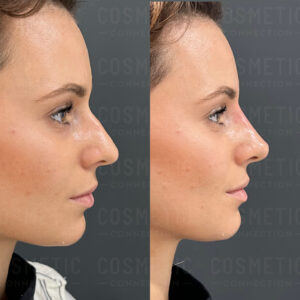
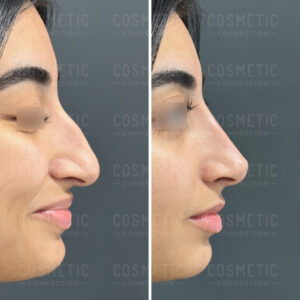
| Dorsal hump (bump on the bridge) | Filler above and below the hump creates a straighter profile line | Significant visual correction of profile; hump is camouflaged, not removed |
| Flat or low nasal bridge | Volume added along the dorsum increases height and projection | Improved proportion; nose appears slimmer and more defined |
| Drooping nasal tip | Volume projects the tip upward | Visible lift and improved rotation |
| Nasal asymmetry | Volume added to the smaller or lower side | Meaningful correction of minor asymmetry |
| Wide nose (flat bridge type) | Bridge height addition creates vertical definition | Nose appears slimmer through proportional change |
| Nose-to-face proportion | Strategic volume placement improves overall facial balance | Improved harmony between nose and other features |
What nose filler cannot achieve:
- Physical reduction of nose size
- Narrowing of the nasal bones or nostrils
- Correction of a deviated septum
- Improvement of breathing function
- Permanent structural change
How does the procedure work?
A non-surgical rhinoplasty session involves the following steps:
- Consultation and assessment — the treating practitioner reviews the patient’s goals, examines the nasal anatomy including skin thickness, vascular landmarks, and existing tissue, and discusses realistic outcomes and risks, to determine suitability
- Treatment planning — injection points, product selection, and volume are mapped based on the individual anatomy
- Injection — the procedure takes 10–20 minutes; a fine needle or cannula is used depending on the zone and technique
- Real-time assessment — results are assessed from multiple angles during the procedure and adjustments made
- Aftercare and follow-up — aftercare instructions are provided and a follow up may be scheduled
How long does nose filler last?
The longevity of nose filler depends on several interacting factors:
| Factor | Direction of effect |
|---|---|
| Product density (cross-link level) | Higher density = longer duration |
| Volume injected | Higher volume = generally longer duration |
| Nasal zone (bridge vs tip) | Bridge lasts longer; tip sees slightly faster reduction |
| Individual metabolism | Higher metabolism = faster breakdown |
| Treatment history | Residual from prior sessions can extend longevity |
In clinical practice, nose filler results typically persist for 12–18 months. The nasal region is a relatively low-movement area compared to lips or forehead, which contributes to longevity at the longer end of this range for many patients.
After 2–3 consistent treatment cycles, some patients find that residual product from previous sessions means each subsequent treatment requires less volume to achieve the same result.
What are the risks of nose filler?
The nose is considered one of the higher-risk areas of the face for injectable treatments, although it is still classified as a low-risk treatment when performed correctly. Understanding the risk profile is essential for both patients and practitioners.
Vascular occlusion — the most serious risk
Vascular occlusion occurs when the injectable substance enters or compresses a blood vessel, interrupting blood supply to the surrounding tissue. Vascular occlusion is one of the most serious complication associated with facial injectable treatments.
The nasal anatomy includes the angular artery, dorsal nasal artery, and lateral nasal artery — branches of larger vessels with anastomotic connections that can, in rare cases, allow the injectable substance to reach the ophthalmic artery and vessels supplying the eye.
Signs of vascular occlusion:
- Blanching (immediate white discolouration) of the skin during or after injection
- Unusual or disproportionate pain during injection
- Progressive skin discolouration post-procedure
- Vision changes (rare — indicates severe complication)
Management: immediate administration of an appropriate reversal agent is the primary intervention. This must occur within minutes to avoid permanent tissue damage. This is why the reversal agent must be physically present in the clinic at every appointment — not available to order or accessible nearby.
Other risks:
| Risk | Incidence | Management |
|---|---|---|
| Bruising | 5–10% of patients | Resolves 3–7 days; hirudoid may help |
| Swelling | Very common | Resolves 24–72 hours |
| Surface irregularities or lumps | Uncommon with correct technique | Review after healed; reversal if persistent |
| Asymmetry | Common temporarily; persistent uncommon | Review after healed; additional treatment or reversal |
| Infection | Rare | Antibiotic treatment; medical review |
| Treatment migration | Rare with correct technique | Assessment and reversal if necessary |
| Skin necrosis | Remote; associated with vascular occlusion | Emergency reversal; wound management |
Is nose filler reversible?
Yes. The treatments used for non-surgical rhinoplasty in Australia can be reversed using an enzyme that catalyses the breakdown of hyaluronic acid. When administered into the treated area, hyaluronidase produces significant reversal within 24–48 hours in most cases.
Reversal is used in three contexts:
- Emergency reversal — in the event of vascular occlusion, immediate hyaluronidase administration is the primary treatment
- Aesthetic reversal — if a patient is unhappy with the result, elective reversal returns the nose to baseline before re-treatment
- Pre-treatment clearance — if a patient presents with existing filler from a prior provider, reversal is sometimes indicated before adding new product
This reversibility distinguishes hyaluronic acid filler from permanent injectable substances (PMMA, silicone, calcium hydroxylapatite used non-standard) — none of which should be used in the nose because complications from these products cannot be reversed.
How much does nose filler cost in Australia?
Non-surgical rhinoplasty in Australia is priced across a wide range depending on the provider model, the practitioner’s qualifications, the location, and the volume and product used.
| Pricing tier | Typical Australian range | What it typically reflects |
|---|---|---|
| Budget | $600–$900 | Nurse-led, high volume, variable safety protocols |
| Mid-range | $90–$1,100 | Mixed models |
| Doctor-led premium | $1,100–$1,800 | Medical assessment, full complication preparedness |
By city:
- Sydney: $900–$1,800
- Melbourne: $850–$1,600
- Brisbane: $800–$1,200
- Gold Coast: $750–$1,500
Non-surgical rhinoplasty is not covered by Medicare or private health insurance in Australia. It is a cosmetic procedure with no applicable item numbers.
Nose filler vs surgical rhinoplasty: a complete comparison
| Factor | Nose filler (non-surgical) | Surgical rhinoplasty |
|---|---|---|
| Anaesthesia | Topical numbing only | General anaesthesia |
| Procedure time | 10–30 minutes | 2–4 hours |
| Downtime | None to minimal | 2–4 weeks |
| Results visible | Immediately | After 6–12 months (swelling resolves gradually) |
| Duration of results | 12–18 months | 10+ years – nose changes with age |
| Reversible | Yes | No |
| Can reduce nose size | No | Yes |
| Can narrow nostrils | No | Yes |
| Can correct breathing | No | Yes (septoplasty component) |
| Can remove dorsal hump | Camouflages | Physical removal |
| Risk | Low | High |
| Cost in Australia | $900–$1,800 | $15,000–$25,000+ |
| Repeat treatments required | Yes — every 12–18 months | Potentially – every 10-15 years |
| Suitable for structural change | No | Yes |
| Suitable for subtle proportion improvement | Yes | Yes |
Read more about surgical vs non-surgical nose reshaping.
Who performs nose filler in Australia?
In Australia, cosmetic injectable treatments, including the substances used for nose filler must be prescribed by an authorised prescriber (a registered medical doctor) and administered under appropriate clinical supervision.
In practice, non-surgical rhinoplasty is performed by:
- Cosmetic doctors: registered medical practitioners with specific training in cosmetic injectable medicine. This is generally the recommended model for nasal injectable treatment given the complexity and risk profile
- Plastic surgeons: primarily surgical specialists; may offer non-surgical rhinoplasty as a complementary service, with less experience in injections
- Nurses: registered nurses or nurse practitioners who, in a properly supervised model, may administer injectable treatments under doctor oversight. The degree of oversight varies significantly in practice
- Dermatologists: skin specialists who may offer cosmetic injectables as a complementary service
Nose filler in Sydney and Melbourne
Non-surgical rhinoplasty is among the most commonly performed cosmetic injectable procedures in both Sydney and Melbourne. Both cities have a high concentration of providers across a wide quality spectrum.
In Sydney, nose filler providers are concentrated in the CBD, North Shore, Eastern Suburbs, and Inner West. Pricing reflects Sydney’s higher operating costs and averages $1,100–$1,800 for doctor-led treatment.
In Melbourne, nose filler providers are concentrated in the inner south-east, including Toorak, South Yarra, Hawthorn, and Prahran, as well as the CBD. Pricing averages $850–$1,600 for doctor-led treatment.
Cosmetic Connection offers doctor-led non-surgical rhinoplasty at its St Leonards (Sydney) and Toorak (Melbourne) clinics, using a suitability-first assessment model and flat-fee pricing.
Get started
Specific nose types and treatment considerations
Flat bridge (common in East Asian, Southeast Asian, South Asian, and African anatomies) Bridge height treatment is one of the most consistently satisfying applications of non-surgical rhinoplasty. Adding volume along the dorsum increases vertical projection, which reads as a slimmer, more defined nose from the front. Results are predictable and longevity is typically at the longer end of the range due to the low-movement nature of the bridge.
Dorsal hump (bump on the bridge) The camouflage technique, adding volume above and below the hump to create a straight profile line — is effective for small to moderate humps. Large humps exceed the practical limit of the non-surgical approach; the volume required to create a straight profile makes the overall nose appear larger and wider. For large humps, surgical rhinoplasty is the appropriate intervention.
Drooping tip Tip placement rotates it upward, shortening the apparent length of the nose and improving the profile. This is a technically demanding zone as the skin over the tip is thinner and more transparent than over the bridge, making surface irregularities more visible. Conservative, precise volume is essential.
Bulbous tip Filler adds volume, and when used strategically can refine a bulbous tip. However, over-treatment worsens the concern. Therefore, for pronounced changes, surgery is more appropriate.
Wide nose Width caused by a flat bridge responds well to bridge height treatment. Width caused by wide nasal bones or a large nostrils cannot be improved non-surgically. An honest suitability assessment must distinguish between these two presentations before treatment is offered.
What do nose filler results look like?
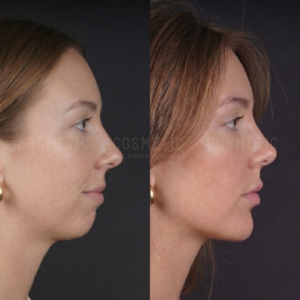
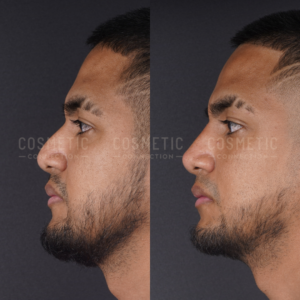
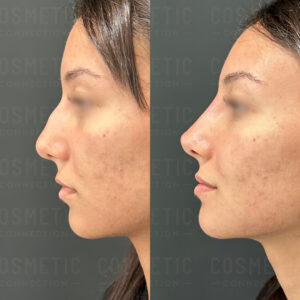
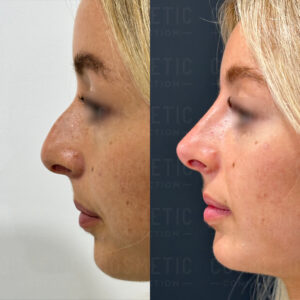
Aftercare for nose filler
Post-treatment care affects both the safety and longevity of the result.
Immediate (0–48 hours):
- Avoid strenuous exercise, alcohol, and direct heat exposure
- Do not apply pressure to the nose: no glasses resting on the bridge, no face-down massage
- Apply a wrapped ice pack briefly if swelling is uncomfortable
- Avoid makeup directly over injection sites for 24 hours
First 2 weeks:
- Avoid high-impact exercise for the first 48–72 hours; resume gradually
- No facials or treatments applying pressure to the nose
- Avoid prolonged sun exposure without SPF
- Glasses that rest on the bridge should be avoided for at least 1 week; ideally 2 weeks
Assessment: The final result is visible at 2 weeks once all swelling has resolved. A follow-up review appointment at this stage is standard practice at reputable clinics and allows for assessment and minor adjustments if needed.
Nose filler swelling stages – what to expect
Following non-surgical rhinoplasty (nose filler), it’s normal to experience swelling. Here’s a breakdown of the stages of nose filler swelling you can expect:
Immediately after treatment
- Slight redness and tenderness around the injection sites.
- Minimal swelling, localised to the treated areas. This is usually barely noticeable, but may appear slightly uneven.
Day 1:
- Swelling reaches its peak within 24 hours. Your nose may look fuller and puffy.
- This is temporary and doesn’t reflect the final result.
- You may notice mild discomfort in your nose.
Days 2-3:
- Swelling subsides, becoming less noticeable each day.
- Your nose will still look somewhat puffy, but the shape will become more defined.
Days 4-5:
- Swelling should be mostly resolved.
- Any slight persistent swelling will reduce over the next week, revealing your final result.
Tips to reduce swelling after non-surgical rhinoplasty
- Everyone heals differently, so your own experience may vary.
- If you experience significant swelling, pain, redness, or bruising, immediately contact your clinic.
- Avoid activities that worsen swelling for 24 hours. This includes alcohol, strenuous activities, excessive heat, and sun exposure.
- Minimise swelling by gently applying wrapped cold pack to your nose. Use it intermittently for a few hours after your treatment.
How to choose a nose filler provider in Australia
The most important criteria when evaluating a nose filler provider:
- Doctor-led or genuinely doctor-supervised — choosing a clinic that has doctors on site, not just “medically affiliated”
- Doctors with proper training — General injectable training is not enough. Nose-specific training is required
- Reversal agent on-site at every appointment — confirmed, not just “available”
- Specific nasal injectable experience — ask directly about volume and training
- Genuine suitability assessment — not a booking form
- Transparent, upfront pricing — flat-fee preferred; per-unit pricing creates incentives for over-treatment
- Follow-up review included — standard at responsible clinics
- Clear complication management process — ask specifically what happens if there is a vascular event
Red flags: no doctor involvement, reversal agent not confirmed, treatment booked without proper consultation, pricing that changes on the day, discount vouchers for nose treatment specifically.
Practitioner verification: AHPRA registration can be confirmed at ahpra.gov.au for all registered medical practitioners and nurses.
Common myths about nose fillers
Myth: Nose fillers are painful.
Fact: Nose fillers can cause some discomfort, but the procedure is generally very well-tolerated.
Myth: Nose fillers are permanent.
Fact: Nose fillers are not permanent. The effects of nose fillers typically require maintenance every 12-18 months.
Myth: Nose fillers cannot drastically change the shape of your nose.
Fact: While nose fillers are powerful ways to optimise fine details of your nose, when used correctly that they can also dramatically alter the shape of your nose for the better.
Myth: Anyone with basic training can perform a nose filler treatment.
Fact: It is important to have nose fillers administered by a qualified medical professional with extensive experience in treating noses.
Myth: Nose fillers can cause serious side effects.
Fact: Like any medical procedure, there are potential risks and side effects associated with nose fillers include serious ones. This is why its vital to choose the right clinician, to keep the risks low.
Myth: You can’t wear glasses after getting nose fillers.
Fact: While you may experience some swelling or tenderness after getting nose fillers, you should be able to wear glasses a few days after the procedure.
Myth: Nose fillers are only for women.
Fact: Both men and women can benefit from nose fillers. In fact, the demand for non-surgical nose enhancement among men has been significantly increasing in recent years.
Myth: Nose fillers can make you look fake or artificial.
Fact: When performed by a qualified medical professional, nose fillers refine your nose and give you a more balanced, proportionate look.
Myth: Nose fillers are only for people with small noses.
Fact: Nose fillers can be used to enhance the appearance of any size nose.
Myth: Nose fillers will widen the nose from the front.
Fact: Experienced clinicians are able to make your nose look slimmer from the front.
Myth: Nose fillers have a high risk of making you go blind.
Fact: Vision loss is a risk of all fillers, but it is a very remote risk when adequate precautions are taken, and the treatment is performed by a fully trained doctor.
Frequently asked questions
What is the difference between nose filler and non-surgical rhinoplasty?
They are the same procedure described with different terminology. Nose filler refers to the injectable treatment used; non-surgical rhinoplasty refers to the procedural outcome — nose reshaping without surgery. Liquid rhinoplasty is another term for the same thing.
Can nose filler fix a broken nose?
No. A broken nose involves structural damage to the nasal bones. Injectable treatment adds volume — it cannot repair or realign bone. Some post-injury cosmetic asymmetries can be partially improved non-surgically, but this requires careful assessment and is not appropriate in all cases.
Can dermal filler lift the nose tip?
Yes, the nose tip can be lifted by adding projection and support.
Is nose filler safe during pregnancy or breastfeeding?
No. There is no safety data for cosmetic injectable treatments during pregnancy or breastfeeding. They are contraindicated in both situations.
How do I know if my previous nose filler has fully gone?
The most reliable way is assessment by a qualified practitioner. Ultrasound imaging can identify residual product in some cases. Clinically, a practitioner can assess tissue consistency and behaviour at the injection sites to estimate how much residual product remains.
What is the tinkerbell nose tip with dermal filler?
The tinkerbell nose tip describes an approach that aims to maximise tip projection. This is achieved by projecting the nose tip, and leaving a cap in the supratip area, creating a deep inflection point between the dorsum and tip.
Can nose filler migrate to other parts of the face?
With correct technique, migration is uncommon. However, inappropriate injection depth, excess volume, or product with poor structural properties can lead to the substance shifting from the intended location over time. This is one reason product selection and technique matter significantly for this procedure.
What is the difference between a cannula and a needle for nose filler?
Both are used for non-surgical rhinoplasty. A needle is sharp and allows more precise point placement. A cannula is blunt and flexible, which reduces the risk of penetrating a blood vessel directly. Many practitioners use a combination of both techniques depending on the zone. Neither approach entirely eliminates vascular risk — knowledge of anatomy and aspiration technique are more important than the instrument used.
How many sessions of nose filler does it take to achieve the result I want?
In most cases, one session achieves the primary result. A second session may refine the outcome once swelling has fully resolved at 2 weeks and the practitioner has a clear view of the baseline result. Ongoing maintenance sessions every 12–18 months maintain the achieved result over time.
How do you sleep with nose fillers?
Avoid sleeping on your stomach or with your face pressed against your hands, wrists and arms for 5 days. Sleeping with one pillow on your back or side is ideal.
Are nose fillers worth it?
Nose filler has a very high satisfaction rate, but whether or not it is worth it is a very personal decision that depends on how dissatisfied you are with your current nose, and how you perceive the cost and risk involved in treatment. A consultation is the best way to find out whether nose fillers are worth it for you.
Does nose filler work for asian noses?
Yes, nose filler is one of the most commonly performed cosmetic treatments in Asia. Typically, treatments aim to project and define the nasal bridge.
What happens to my nose if I stop having nose filler after many years of treatment?
The injectable treatment gradually reduces after cessation of maintenance sessions, and the nose returns toward its natural baseline. There is no evidence that long-term nose filler use permanently alters the nasal anatomy in ways that would make the natural nose look worse — though this is a common concern. Some patients find their nose looks very similar to their pre-treatment baseline after full reduction of accumulated product.
Want to know more about non surgical rhinoplasty?
Read our complete guide to non surgical rhinoplasty in Australia.